Thursday, October 31, 2024

How to Report Election Fraud

If we work together, we can make this election too big to rig!
Virtually all of us have the tools to report election interference, voter intimidation, and illegal voting in near real-time: smartphones with Internet access and the X (Twitter) service. If we use them, it will be much more difficult for the Democrats to steal this election.
Unlike 2020, we have a major platform on which to report election shenanigans, thanks to . We saw the effectiveness of this earlier this week when polls in Bucks County, PA were shut down early during early voting. Because it got reported on X, a lawsuit was filed and the court issued an order to extend early voting through Friday, November 1st. That got us a couple more days of early voting!
We also have a better ground game due to people like in Pennsylvania. Scott worked his ass off getting voters registered and mainly due to him, Bucks and Luzerne Counties flipped from blue to red. He's also taken to task misbehaving county boards of electors.
Additionally, the RNC is now chaired by , not Rona (Romney) McDaniel.
First, join the X Election Integrity Community:
If you see any irregularities at your polling place do your best to gather evidence:

Please repost this for a wider audience.
Let's go!

Tuesday, October 08, 2024

50% off Anker SOLIX C1000 Portable Power Station

  If you are in need of a portable power station with a built-in inverter, this Anker unit is 50% off today at Amazon.


https://amzn.to/4eRh0Co

Friday, October 04, 2024

New Sheath for the Cattaraugus 225Q Quartermaster Knife

The replica sheath that I ordered from eBay seller "banddinsidethegoldmine" arrived today. It's a pretty close replica of the original sheaths. Here's a pic with the knife in the replica sheath next to the original that it came with. After I took the pic I applied some neatsfoot oil, which darkened it a bit, as expected.


The seller also has right handed sheaths, but since I'm left handed I stuck with the historically correct lefty sheath.


Monday, September 30, 2024

Cattaraugus 225Q "Quartermaster" Knife

Last week I started reading up on the Cattaruagus 225Q "Quartermaster" knives that were produced for the US military during World War 2. My interest was piqued so I went online looking for one as a user.

Up until fairly recently they were available for $50 or less but as with everything else, prices have gone up. I found this one on eBay and was able to get it for $90 + tax and shipping. It arrived today.


For a knife made about 80 years ago it's in extremely nice shape. The carbon blade is free from serious corrosion or pitting and shows signs of only light use. It came with a nice, sharp edge, too.

The stacked leather washer handle is also in very nice condition. It bears the typical random grooves found on my 225Qs, intended to enhance one's grip. The pommel is tight and doesn't show any signs of being used as a hammer. Overall the hilt is tight. I've applied a few light coats of Fiebing's 100% neatsfoot oil and the washers have soaked it up. I'll add some more and then give it a coat of Sno-Seal, which is mostly beeswax.

On the other hand, the sheath is showing its age and for that reason I have a replica on the way for actual use. I've given it a couple light coats of neatsfoot oil and like the knife's handle, it's drinking up the oil.

The 225Q has a 6" blade with a swedge on the back of the tip, but it's not sharpened. The blade is 3/16" thick at the spine and a hair under 1.3" wide. The small guard shouldn't get in the way of use in woodcraft or dressing game.

The blade shape is very similar to my Varusteleka Terävä Jääkäripuukko 140, which I've used to process a few deer. I'd expect the Cattaruagus to perform similarly to the Finnish knife.

For size references, here's the Cattaraugus flanked by a Mora Kansbol and a Case Stockman.


As a contemporary of the USN Mk.2 fighting knife, AKA the "Kabar," it invites a comparison. The 225Q's blade is an inch shorter but a little thicker. I like the feel much better than the more famous Kabar. Likewise, the blade geometry on the 225Q makes it a better field knife than the later USAF Aircrew Survival Knife, AKA the "bolt knife". (Having used a USAF knife in the field, I am not a fan of it.)

I'm looking forward to taking this knife into the woods and using as it was intended to be.


Saturday, September 21, 2024

First Range Trip with the Rector Rifle

I took the Rector rifle to the range today.

My load was a .389 ball in a 0.018" pillow ticking patch lubed with Hoppe's No.9 BP Lube and Bore Cleaner, on top of 50 grains of Goex 3Fg. This seated easily with only thumb pressure in the muzzle. It shot several inches high at 50 yards from the bench but unfortunately did not group well. I think it's too loose a patch/ball combination.

So I decided to try a thicker patch on my 12th shot. I had some 0.020" patch material with me. I loaded it up and it was noticeably more snug. However, on this shot, the cleanout screw blew out.


The screw didn't go far, landing on the shooting bench. This obviously put an end to shooting the rifle for the day so I cleaned it up and put it away.

After getting home and inspecting the screw closely it looks like the threads stripped out. I think what happened is that was undersized and let go with the higher pressure with the tighter patch.

It looks like I can retap the hole for the cleanout screw hole to accept a 10-32 screw to get the gun back into shooting condition.

Aside from being a bit undersized, the .389 balls didn't look so great. I've had excellent results from Rush Creek balls previously but these didn't look good. I got a Lee .390 mold in and will cast up a bunch to try.

If I can't get the rifle grouping well I'll probably send the barrel to Bobby Hoyt and have it rebored to .45.

Anyway, aside from the Rector rifle I also brought my Numrich Arms H&A Heritage Model underhammer .45. I've always shot .440 balls from it since that what my dad used when he taught me to shoot with it. I decided to try .433 balls for easier loading because I want to shoot it from woods walks without using a mallet to start the balls. With the .433 balls in ticking over 50 grains of Goex 3Fg, all the holes were touching from the 50 yard bench. After I got home I ordered a Lee .433 mold.


After shooting that group I adjusted the sights so POA = POI at 50 yards.


Sunday, September 15, 2024

A Percussion Target Rifle by J.H. Rector

I picked up this original 19th Century target rifle via trade yesterday at Dixon's. The asking price was $850.


From what I've been able to determine, J.H. Rector was active in Syracuse 1845 - 1855, and later moved to Buffalo, NY with a partner. My SWAG is that it was built sometime around 1850.

The .40 caliber barrel is 29.5" long and 1" across the flats. It's held to the stock with a single key. It's rifled with 6 grooves although I haven't checked the twist rate yet. The best thing, is that it's in excellent condition. It had some surface rust in the bore which cleaned up nicely with Hoppe's No.9 and elbow grease. There's no significant pitting.It has a hooked breech, but it's not a patent breech. This is an ideal setup IMO. I borescoped it today and this is the breech face. You can see where the flash channel enters the barrel:


The barrel is marked "J.H. Rector Syracuse" with the serial number. It's also marked "Cut by E.G. Davies".

The nipple is .265" x 28 and in good shape but has a larger hole than I'd like. As it turns out Track carries this size as "oversize" nipples, so I ordered a couple.

A closeup of the lock, which is marked "A.T Russel" (only one L):


A sharp eye will see that the hammer nose is damaged, likely from corrosion. I measured its diameter and I may be able to use the neck of a .44-40 case soldered on as repair.

Very clean inside. It's fitted with a fly, although that's not strictly necessary since it doesn't have set triggers.


It holds solid at full and half cock.

The tang is drilled and tapped for a lollipop-style peep sight, which is missing. Once I figure out the thread size I'll look into making a replacement.


All the furniture is iron (tested with a magnet) except for the brass inlays on both sides of the butt.


That small crack at the heel, along with a small chip behind the tang, along with a few dents are the only stock damage.

The business end:


The ramrod appears to be original or a period replacement. The muzzle end is plain but the bottom is fitted with a reversible tow worm.


The gun weighs 9.1 lbs. on my bathroom scale and 46.5" long overall.

For the past few months I've been casually looking for a shootable 19th Century percussion rifle on Gunbroker and Guns International. So, when I saw this on the rack at Dixon's I found it hard to resist.

It's in fantastic shape for a gun that's potentially 175 - 180 years old. I plan to shoot it. Along with the gun I got a bag of .389" balls and have a Lee .390 mold on the way from Track of the Wolf.

Incidentally, if you search for 19th Century percussion rifles you'll find a lot of them that resemble this one. By the last few decades of the century much of the country was settled so this style was developed for target shooting, not taking large game or fighting. Many gunsmiths along the Eastern seaboard were turning out very high quality guns of this type. You can see some of them in Ned Roberts' The Muzzleloading Caplock Rifle, which is pretty much the Bible for percussion rifles.

Friday, September 13, 2024

Replica Hawksley Flask from Veteran Arms

I just received this copper Hawksley flask replica today from Veteran Arms. Shown with my Zouave or Peace flask for scale on the left. The originals were made in England in the 19th Century.


Closeup of the adjustable valve. It's marked in drams. One dram = 27.348 grains. I will leave it at the smallest setting of 2-1/2 drams and dispense into a separate powder measure, for safety's sake. If you pour the powder into the gun directly from the flask, you risk of having it go off like a bomb in front of your face if there is a spark down the bore.


A nice feature of the Hawksley-style flasks is that the entire valve assembly unscrews for filling, which is nicer than the American-style flasks that fill through the pour opening, requiring you to use a funnel and hold open the valve. I filled the new flask with some Scheutzen 2Fg. I'm not sure of the capacity, probably about a half pound, but it should hold enough for a woods walk or day of shooting at the range.

Wednesday, September 04, 2024

New .54 Caliber Barrel for my Cabela's Hawken Rifle

Two years ago I took a very large doe in Tioga County, PA with my left handed .50 Cabela's (Investarm) Hawken. The ball was loaded over 70g grains of 3Fg black powder and impacted at about 55 yards. It was a high chest cavity broadside shot with the ball impacting a few inches behind the right shoulder. It made a mess of the chest cavity but the deer ran, which is normal. What I wasn't happy with was the minimal blood trail, which was difficult to follow with the forest floor covered in leaves. A complete pass-through would've have let more blood out faster and made the blood trail easier to follow.

I thought about experimenting with conicals like a Hornady Great Plains or Lee REAL bullet, but then I saw that muzzle-loaders.com carries replacement barrels for this rifle in .54 caliber. They sell it as the Bridger Hawken. Since I like shooting patched round balls I decided to get the larger caliber barrel.

It came well packed and included a replacement tang, which I didn't use. The barrel came with sights and a nipple. The gun as it now looks:


Monday I took it to my club and zeroed the sights for 50 yards. Like my Investarm Gemmer Hawken, it likes a .530 patched ball on top of 80 grains of 2Fg Scheutzen black powder. I used CCI No.11 caps for ignition.

The first two shots were in one hole at the bottom right. After some sight adjustments I put 6 rounds into the group in the center. POA was 6:00 on the bullseye. This is an SR-1 target. The black is 8" in diameter. Of note is that the barrel doesn't seem sensitive to lube. Most of my shots were lubed with Mr. Flintlock, since that allows me to shoot many rounds without swabbing. However, I also shot some rounds lubed with Track of the Wolf's Mink Oil Tallow, which I'll use when hunting. The 6 shot group I circled was 3 shots with Mr. Flintlock and 3 with Mink Oil Tallow.


I recovered about half the patches I used. None showed signs of burnout or cuts. The edge fraying is normal for fired patches, IME.


I lost count of how many rounds I shot but it was around 25 - 30. I shot my last 5 offhand at 50 yards. By this time I was tired and the recoil was getting to me, but this would still put a deer in the freezer.


Speaking of deer, this fawn was hanging out at the range. I took this from about 100 yards with my iPhone 12 before I started shooting. He moved to another part of the property while I was shooting but I saw him nearby on my way out.


Hopefully I'll get to connect with a deer during the October anterless-only season. While I'm not expecting any deer I shoot to drop on the spot, I'm hopeful that the larger, heavier ball will create an exit wound that causes the animal to bleed out more and sooner, for a more humane kill and less tracking.

Tuesday, September 03, 2024

Guns for Jews

On the eve of the Holocaust in 1939, the world Jewish population stood at about 16 - 17 million. By 1945, it was 10 - 11 million.

In 2024, it's at about 15.7 million. In 80 years we still haven't recovered the numbers lost due to the Nazis. 

We currently make up about 0.2% of the world's population and about 2.4% of the population in the United States.

Antisemitic trope is that the Jews control the world. Just going by the numbers this is laughable, smooth-brained thinking. Sure, we're prominent in many fields, but that's due to our culture which emphasizes learning and hard work. There are plenty of Jewish losers, too.

If the events of the past 11 months have taught us anything, we are a very small part of the world and that a vast number of people don't like us and don't want us defending ourselves. Thus, Israel must become independently able to defend itself. Likewise, Jews in the United States must embrace their Second Amendment rights so they can defend themselves against modern day Nazis, especially those being imported wholesale by the Democrats from assorted third world countries.

If you're a Jewish American looking to get equipped to defend yourself, check out my ebook "Guns For Jews" to help you get started. Get arms and training.


Saturday, August 10, 2024

Finally Shot the Gemmer Hawken

Back in January I got a .54 caliber flint Investarm Gemmer Hawken. It's the current version of the Lyman Great Plains Rifle that was sold for almost 50 years here in the US. I bought this rifle for a couple reasons. First, I wanted something a bit shorter than my longrifle for hunting. Second, I wanted the power of a .54. The deer we hunt up in Tioga get big and I would really like a complete pass-through to maximize blood trails. The huge doe I shot in 2022 stopped the .50 caliber ball I shot and the blood trail was very hard to follow. Bigger holes and two of them mean more blood out and air in, so hopefully blood trails will be a lot shorter.

Anyway, life got in the way and I didn't not shoot he rifle until today.


This is my first five shots, fired off the bench, from 50 yards. My point of aim was 6:00 on the top bullseye. As expected, it shot low because these rifles come with an extra tall front sight.


The lowest shot was the first, with the rest clustered into a couple inches. This is about as good as I can shoot from the bench with open iron sights, even with a cartridge gun, much less a flintlock. I'm quite happy with the group.

The load consisted of:

  • Hornady .530" round ball
  • 0.018" ticking patches lubed with October Country's Bumbling Bear Grease
  • 80 grains of Scheutzen 2Fg black powder
Ignition was perfect the whole day. As long as I got spark there were no flashes in the pan and ignition was quick. I had to reverse the agate flint that came with the gun after 5 shots, and it last another 5 after that. I then replaced it with a real flint.

To raise the point of impact I needed to shorten the front sight. The file I had with me was too fine to remove enough metal in a reasonable amount of time so after awhile I gave up on it. After I got home I took the barrel out to my shop where I had a coarser file and took some off the top of the front sight.

If you know the sight radius of your gun, the distance to the target, and how much you need to move the point of impact, you can use this formula to determine how much to move an adjustable sight or file a fixed sight:

(Sight radius / Distance to target) (POI change needed) = Adjustment needed

All units must be the same. E.g., my rifle has a sight radius of 21.125" and 50 yards = 1800 inches. I needed to remove a bit over a tenth of an inch from the front sight to bring up the point of impact.

Something I noticed is that with this powder charge, ball size, and patch/lube combination, I can load a second shot without wiping but it's tough. After I get it zeroed I'll try with a liquid lube to see if that makes it easier. But I may look into a thinner patch for reloads while hunting, or bring a jag and patches wet with rubbing alcohol in my shooting patch when hunting. 

Tomorrow I'm planning to get together with a friend for some shooting and I'm bringing the Gemmer Hawken. Hunting season is coming up soon so I want to verify the zero get some practice in.


Friday, July 19, 2024

Thoughts on the Crowdstrike Outage

By now you're probably aware of the massive outages caused by a bug in Crowdstrike. The bug is the result of an update pushed out overnight, which caused Windows systems to become unusable. Unfortunately, Crowdstrike is very widely used by large corporations so the impact is immediate and widespread. A Symantec Enterprise Antivirus update had a similar effect about 12 years ago, but this one is much more widespread.

We are lucky that only Windows systems were directly affected. Crowdstrike also makes endpoint protection software for Mac and Linux. We use it on everything. Several of my coworkers who use Windows were dead in the water this morning. The fix was to reboot into safe mode and delete the affected file. PCs with Bitlocker disk encryption enabled needed a recovery key from IT. I use a Mac so I wasn't directly impacted but because user authentication servers run on Windows I had trouble accessing some systems.

This could have been a lot worse. If this had affected Linux systems, it potentially could have taken out DNS and NTP servers, and the Cisco Network Registrar systems used to provision cable modems. That would have killed voice, video, and Internet service for any customer's device which rebooted. Recovery would have been greatly impeded because IT personnel wouldn't be able to communicate or get the fix easily.

AIUI, it's taken out several airlines, shipping companies, banks, and various point of sale systems.

It's a perfect example of the dangers of IT software monoculture where one bug can take out a huge swath of systems.

Consider it a sign to increase preparations for grid (power and Internet) collapse.

Tuesday, July 16, 2024

Prime Day Deal on Frankford Arsenal Hand Priming Tool

It's Prime Day at Amazon and something that's on sale is the Frankford Arsenal Hand Priming Tool. I bought one a couple months ago and have primed at least 500 cases with it. Compared with the Lee Hand Priming Tool I used for years, the FA is much better built, robust, and also allows adjusting the primer seating depth.

Using the Lee tool I'd usually lose 1 or 2 primers out of 100 due to them seating sideways. I haven't lost one primer yet with the Frankford Arsenal tool.

Normally it's priced at $79.99 but for Prime Day it's $59.99. It's worth it at the normal price. The Prime Day price is a great deal.

Friday, July 12, 2024

Guns for Jews v3.1 is now live

My ebook, Guns for Jews v3.1 is now live. Compared with the earlier versions it is greatly expanded including additional gun recommendations, discussion of ammunition, child proofing your guns and safe storage, and much more.

Get it here and please share:

https://drive.google.com/file/d/1qR9S2erlML7xpfHhcx1yjpRKWk41U7If/view?usp=sharing

Thursday, July 11, 2024

Sig Sauer P365X

The other day I traded off a few guns and came home with a Sig Sauer P365X. The gun comes with two 12 round magazines. I had enough store credit that I also got another 12 rounder and a 17 round extended magazine.

The P365X is part of Sig's family of compact and micro-sized 9mm semiauto pistols intended for conceal carry. The original P365 is exceptionally small, while the P365X is just slightly larger with a longer grip, and has a slide already milled to accept RMS-c footprint dot sights.

Overall the P365X is a tiny gun, especially when you consider its capacity. It's 6" long, 1.1" thick, and 4.8" tall. The barrel is 3.1" long. The slide is fitted with Sig's own night sights and is cut for an optic, as mentioned above.

Top-to-bottom, P365X, S&W Model 640-1 .357 Magnum, S&W M&P Shield 9:


The P365 family is very modular because the actual "gun" for legal purposes is the fire control unit (FCU), which includes the major mechanical components. You buy different grip modules and mix and match barrels and slides to create the configuration you desire.

For several years I've owned a Smith & Wesson M&P Shield 9, which is in the micro-9 class, but never really warmed up to it. (In contrast, I like the mid-size M&P 9 2.0 and full-size M&P 9 1.0 A LOT.)

Before shooting any new gun I always field strip it, remove any factory oil, and lubricate it per the owner's manual. I do this as a quality control check and to familiarize myself with the gun in case I need to resolve any issues at the range.

Field stripping is very simple and doesn't require any tools. First clear the gun to ensure it's unloaded. Then lock the slide to the rear. Next rotate the takedown lever on the left side of the frame downwards. Release the slide (which is under spring pressure) and pull it off the front of the frame.

Then pull off the recoil spring assembly and pull the barrel out of the slide.

Reassembly is in reverse order.

To remove the FCU, first clear the gun, then field strip it as normal. Then drive out the pin at the rear of the frame, from right to left. Next, tilt rear of the FCU up and pull the unit out of the grip module.


To drive out the pin you need a 3/32" punch. A Glock disassembly tool works well.

Strangely, Sig doesn't include a printed version of the owner's manual with the gun, which comes in a nice lockable plastic box with an extra mag, chamber flag, and a cable lock. There is a basic safety pamphlet included, which has a QR code on it to scan which takes you to the Sig website where you can download the manual.

In this litigious age I am amazed Sig's lawyers approved shipping a gun without a full owner's manual. You can call Sig to have them mail you a hard copy of the manual, which I intend to do so it can stay with the gun. Seriously, Sig Sauer, what are you thinking?

Yesterday I took the P365X to the range and put a mix of S&B 124 grain FMJ and Wolf Polyformance 115 grain FMJ for a total of 105 rounds through it. It had 3 or 4 failures to fully go into battery, which were resolved with a gentle tap on the back end of the slide.

Today, I did a quick field strip, clean, and relube, then took it back to the range and this time it ran flawlessly through 152 rounds of Wolf and 14 Speer Gold Dots that I had in my range bag. Today it ran flawlessly.

The P365X weighs just 17.8 oz. (500 grams) unloaded. As expected, recoil was pretty snappy. Compared with the M&P Shield, the grip is a little rounder in cross section and more comfortable for me.

The Sig's trigger reminds me of a double action revolver trigger but lighter and  with a shorter stroke. But, unlike a DA revolver trigger I can't stage it.

Shooting such a small pistol well with its short sight radius and level of recoil demands good form. If you don't have the fundamentals down pat you won't shoot well. It is not forgiving. Yesterday, I was definitely not in the zone. Today I really concentrated on my form more and shot better.

Something that will help accuracy especially under stress is a dot sight. I plan to get a Holosun green dot for it soon.

Because of the recoil I find that extended shooting sessions with this class of gun are taxing and my shooting degrades after awhile. Today I took a few breaks during the session to sweep up my spent brass and give my hand some rest.

The P365X fits a DeSantis outside the waistband holster I have for my Shield 9. It also fits a DeSantis Nemesis pocket holster but is a bit too big for my pants pockets. It would probably work OK in a large coat or vest pocket.

Overall, I am seriously impressed with the Sig P365X. It packs an amazing amount of firepower into a tiny gun that with practice is very shootable.

Sunday, July 07, 2024

More Chronograph Results

Today I got some more use out of my Garmin Xero C1 chronograph. It's so easy to use I may as well chronograph all the things.

All data is for 10 shot strings. Muzzle velocity (MV) is in feet per second, with muzzle energy (ME) is in foot-pounds. The ambient temp was about 94*F and elevation above sea level is about 160 feet.

First up was a selection of 9mm from a Glock 34 with 5.3" barrel:

Wolf Polyformance 9mm 115 grain FMJ:

  • MV: 1154.5 
  • ME: 340.3

This ran about 60 FPS faster than when I shot it in my CZ P07 with a 4.36" barrel.

Sellier & Bellot 124 grain FMJ:

  • MV: 1175.7
  • ME: 380.61

Winchester M1152 115 grain FMJ-FP:

  • MV: 1358.3
  • ME: 471.05

M1152 is the relatively new US military standard issue 9mm Ball. As expected it was a lot hotter than the Wolf and S&B range ammo. I'll have to run some of this through a carbine to see how fast it goes from a 16" barrel.

Next up was some .38 Special, with a Lee TL358-158 SWC on top of 3.8 grains of HP-38. I fired these from a S&W Model 15-3 with a 4" barrel.

  • MV: 743.1 
  • ME: 193.8

This is a nice plinking and target load that's pleasant shooting in a K-Frame with Magnas and a grip adapter.

Finally, I ran some black powder .44-40s over the Garmin. These were shot in my Cimarron Model P (Colt Frontier Six Shooter replica) which has a 5.5" barrel. Both loads used a 219 grain bullet cast in an Accurate Molds 43-215C mold.

First up was a .44 Henry-equivalent load with 1.9cc (~30 grains) of pre-factory explosion Goex 3Fg, sparked by Federal No.150 large pistol primers.

  • MV: 833
  • ME: 337.68

Not bad, and not too far behind .45 ACP Ball.

Finally were some loaded with 2.2cc (~35 grains) of Scheutzen 3Fg, sparked with CCI large pistol primers.

  • MV: 756.1
  • ME: 278.27

I am very surprised at how much slower the Scheutzen loads ran. I was under the impression that it's at least as energetic as Goex, but that didn't seem to be the case with this batch.

I plan to load up some more of each of these loads but with the same primer to remove a variable, but I doubt that the results will be much different. I also need to chronograph some loads with Swiss 3Fg, of which I have a limited supply, along with a pound of some 1990s-vintage Elephant 3Fg. I'm expecting higher velocities with the Swiss and lower velocities with Elephant. 

Tuesday, July 02, 2024

A Vest for Concealed Carry

I just got one of these vests in gray for $27 on Amazon Prime, for use as a cover garment. It looks more REI rather than tacticool. Actually, it looks more Walmart-ish than REI.


It is lightweight and uninsulated, which is what I wanted. I already have fleece insulated vests for colder weather. The shell is nylon with a polyester mesh liner for ventilation. It has four pockets: two handwarmer pockets, a chest pocket, and one inside pocket. The zippers and stitching seem pretty good. Unlike the pics on Amazon the zipper pull is American-style, i.e. with the pull on the right side. There is a hanging loop on the back.

The vest should roll up compactly so it can be stuffed in a bag when traveling. It'll be handy for when you need a few extra pockets but not something that's borderline LBE.

I tried it with a few different guns in OWB holsters. On me it’s long enough to cover a 3” S&W K-Frame if I don’t raise my arm over my head. A 2.75" Ruger Speed Six concealed a little better. A 2” barrel gives more wiggle room. A S&W M&P9 Shield concealed well. A 4" K-Frame stuck out the bottom. The guns remained covered if I bent over.

I also tried it on over one of my bulkier hoodies and it fit ok with no binding in the arm holes. So, it could work also as a windbreaker over a sweatshirt or sweater, depending on the thickness.

Sunday, June 30, 2024

Brownells Revolver Chamber Brushes

Cleaning the charge holes is an important part of maintaining a revolver. If you shoot .38 Specials in a .357 Magnum it's especially important to do so to knock back the crud ring that results. However, even using a bore brush this is a fair amount of work.

Brownells sells revolver chamber brushes for .38/.357 and .44/45. They are larger in diameter and longer than pistol bore brushes. This morning I used one when cleaning my S&W Model 64-2 snub .38.


(Yes, my workbench is cluttered.)

Note how much longer the chamber brush is than a bore brush. Also note that it's longer than the frame opening for the cylnder. Do not put the chamber brush down the bore because getting it back out is going to be extremely difficutl.

I ran the chamber brush dry through each charge hole once in each direction. It got rid of a lot of crud from the .38 Special 158 grain LSWC loads I fired yesterday.

Incidentally, after I finished cleaning the gun I replaced the wood grips and grip adapter with the set of Pachmayr Compacs it had when I got it. The Magnas with grip adapter were comfortable when dry firing but really whacked the inside of my left thumb when shooting the gun.

From last weekend:


The rubber grips are still pretty small so the piece should still conceal easily under a jacket or vest when Fall rolls around. This is a 6 shot K-Frame so it's not like I'm going to be stuffing this in my pants pocket, anyway.

Sunday, June 23, 2024

Happiness is a Smith & Wesson Combat Masterpiece

... and a box of .38 reloads.


I bought this Model 15-3 used in 1996 and have put thousands of .38 Special reloads downrange through it since then.

Today I took it to the range to test a new-to-me load: a fairly soft cast Lee TL358-158 LSWC coated with Lee Liquid Alox on top 3.5 grains of Titegroup, sparked by Servicios Aventuras primers. I load the bullets unsized and then after seating, run the cartridge through a Lee carbide factory crimp die which not only crimps the bullet in place but also resizes the round so that it's within factory spec.

I ran 10 shots over my Garmin Xero C1 Pro chronograph and it clocked an average of 779.5 FPS with an SD of 17.2.

Rather than shoot for groups, I shot at my club's 25 yard plate rack. The plates are 12" discs and I hit them a lot more than not shooting fairly rapid double action.

This is a clean burning load leaving minimal powder residue and no leading.

Saturday, June 22, 2024

Garmin Xero C1 Professional Chronograph

Many serious shooters, especially handloaders use a chronograph to measure the velocity of bullets. This allows you to get a better understanding of what the bullets you're shooting are actually doing. Ammunition manufacturers and reloading manuals provide velocity data, but the only way to see what ammunition really does in your gun is to measure it yourself.

Up until recently, most chronographs used optical sensors to calculate velocity. These devices work but have some disadvantages:

  1. They must be placed in front of the firing line. So, if you're on a range with other people you need to coordinate setup and teardown, and tweaking the position.
  2. Because they're in front of the gun, they are at risk of being hit. This is not uncommon. I know a couple people who've shot their chronographs.
  3. They can be finicky depending on the lighting. Sometimes it's too bright. Other times it's too dim. Very shiny bullets may not register well. (A potential fix for that is to color them with a black marker.)

Several years ago the Lab Radar chronograph was introduced, using Doppler RADAR to calculate velocities. From what I've read it works well. More recently, Garmin came out with the Xero C1 Pro Chronograph, which also uses Doppler RADAR. I bought one last week and tried it for the first time on Wednesday. I am completely blown away by it.

The only criticism I have so far of the Garmin is that it doesn't come with a carrying case, so I got one of these for it.

Here's a picture of the Garmin on the shooting bench at my club along with a couple of the guns I shot. That little thing on the tripod is the entire unit.


A close up:


According to the instructions that Garmin shipped, when measuring pistol bullet velocity you should have the pistol 5" - 15" over the unit. When shooting a rifle, it should be 5" - 15" to the side and behind the muzzle. Also, the bullet needs to be able to travel at least 20 yards to the target.

The bottom of the unit is threaded to accept a standard 1/4-20 camera tripod mount, so if where you shoot doesn't have a suitable bench, you have an alternative. I've also seen mounts that allow you to attach it to a rifle.

I fired a total of 70 rounds over the Garmin with no errors. Before going to the range I downloaded the Garmin ShotView app to my iPhone 12. The app and the unit sync via Bluetooth.


I measured several different handloads in a variety of revolvers.

Colt Police Positive with 4" barrel in .32 Smith & Wesson Long

  • 96 grain RNFP from Desperado Cowboy Bullets
  • 3.8 grains of Alliant Unique
  • Servicios Aventuras small pistol primer
  • PPU brass
  • Average muzzle velocity: 1058 FPS
  • Average muzzle energy: 239 ft. lbs.

I was surprised at how fast this load shot, although it's not maximum according to some data I've seen. It wasn't particularly pleasant to shoot in the little Colt.

S&W Model 1905 Military & Police, 4th Change in .32-20 (.32 WCF).

  • 96 grain RNFP from Desperado Cowboy Bullets
  • 4.7 grains of Winchester AutoComp
  • CCI small pistol primer
  • Starline brass
  • Average muzzle velocity: 746 FPS
  • Average muzzle energy:  119 ft. lbs.

The low velocity surprised me here. AutoComp is specifically designed to generate a lot of gas for pistols fitted with compensators. As such, it's rather blasty. I'll be figuring out other loads to use, probably with Bullseye and/or HP-38.

Next up were some .38 Special full charge wadcutters in two guns, a S&W Model 64-2 .38 with a 1-7/8" barrel, and a Model 66-3 .357 Magnum with a 4" barrel.

Model 64-2 in .38 Special

  • 148 grain #35891 button-nose, bevel-base wadcutter from Matt's bullets
  • 3.5 grains Alliant Bullseye
  • Winchester wadcutter brass
  • Average muzzle velocity: 757 FPS
  • Average muzzle energy: 188 ft. lbs.

I also fired the same load in the Model 66-3 in .357 Magnum.

  • Average muzzle velocity: 844 FPS
  • Average muzzle energy: 234 ft. lbs.

You can see that the longer barrel gives an extra 87 FPS and 46 ft. lbs. of energy.

Most standard pressure .38 Special 158 grain loads give around 750 FPS from a 4" barreled revolver. I had a box of .38s loaded with a Speer 158 grain LSWC on top of 3.5 grains of Bullseye. Let's see how they did in the two K-Frames:

Model 64-2 snub:

  • Average muzzle velocity: 680 FPS
  • Average muzzle energy: 163 ft. lbs.

Model 66-3:

  • Average muzzle velocity: 774 FPS
  • Average muzzle energy: 210 ft. lbs.

That's a noticeable difference. This load is quite comfortable to shoot in a K-Frame.

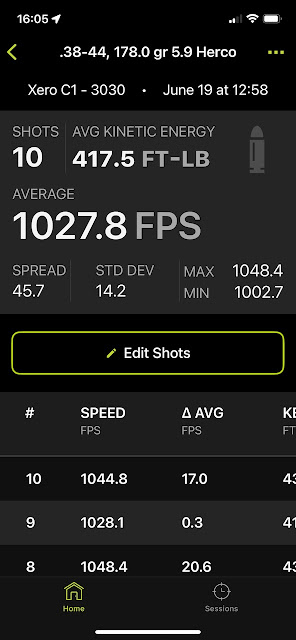
Last up were some .38 Specials loaded to duplicate the power of the .38/44, which was the predecessor of the .357 Magnum. Note that this load develops +P or +P+ level pressures and should never be fired in J-Frame or K-Frame .38 Special revolvers, or comparable guns from other makers. It should only be fired in guns chambered for .357 Magnum, or old S&W .38/44s or guns designed to handle these loads. I shot them in the Model 66-3 .357 Magnum.

Model 66-3:

  • 178 grain #358429 Keith from Matt's bullets
  • 5.9 grains of Alliant Herco
  • Winchester Small Pistol primer
  • Mixed brass
  • Average muzzle velocity: 1028 FPS
  • Average muzzle energy: 417.5 ft. lbs.

For the IPSC shooters, this load has a power factor of 183, so it easily makes major. This would make an excellent load for a woods walking gun, good for defense against most animals in the Lower 48 states.

The original .38/44 factory loads all used 158 grain bullets at 1125 FPS from a 6.5" barrel. I'm planning to load some with the same 5.9 grains of Herco under a 158 grain LSWC. I bet they'll get close to the original ballistics.