Showing posts with label Garmin Xero C1 Pro Chronograph. Show all posts

Wednesday, January 14, 2026

Wheelgun Wednesday

Today I was able to sneak out to the range for a couple hours for Wheelgun Wednesday. I brought two hoglegs with me: A Cimarron Model P in .44-40 WCF and a Cimarron Pistolero in .357 Magnum, shooting .38 Special ammunition.


First I ran two new-to-me handloads through the Model P. Both were loaded in Starline brass with a CCI No.300 primer and 7.0 grains of Winchester 244 powder. The first batch was loaded with a 200 grain lead round nose flat point (LRNFP) bullet, while the second was loaded with a 215 grain LRNFP.

The results were interesting and the opposite of what you'd expect. I.e., the lighter bullets ran slower than the heavier bullets. I attribute this to higher pressure with the higher bullet. I've seen this before with .38/44 handloads, where 5.9 grains of Herco gave ~100 FPS more muzzle velocity with a 178 grain Keith bullet than a 158 grain LSWC.

With the 200 grain bullet I got an average muzzle velocity of 827.1 FPS for 304 ft.lbs. of energy from the Model P's 5.5" barrel.


The 215 grain bullets ran at an average 903.3 FPS for 389.7 ft.lbs. of energy. About a 76 FPS difference. Both strings were 10 shots.


After running the .44s over the Garmin I changed to 10 yards and ran the Hickock-North drill with both guns, and also 6 shots one-handed on a B-8 center, followed by 10 shots fired two-handed on a B-8 center.


The ammo I used in the Pistolero were handloads with a Lee TL358-158 SWC over 4.7 grains of Unique, which ran about 842 FPS from my 4" S&W Model 15 last week. They should be going around that from the .357-chambered but 4-5/8" barreled Pistolero.


Anyway, I need to continue to work on my one-hand shooting and well as file down the front sight on the Model P, which shoots low.

Friday, January 09, 2026

Some .38 Special Chronograph Results

Today I took several .38 handloads up to the range, along with my Ruger 50th Anniversary Blackhawk chambered for .357 Magnum, and my S&W Model 15-3 Combat Masterpiece, chambered for .38 Special. Here are the results:

All strings below are 10 shots.

From a Ruger 50th Anniversary Blackhawk .357 with 4-5/8" barrel:

.38 Special
21 grains Swiss 3Fg black powder
Missouri Bullet Company 158 grain LRNFP with BP lube
Mixed brass
Servicios Aventuras primers

MV 845.5 FPS
250.9 Ft-lbs.
ES 61
Max 881 FPS
Min 820 FPS
SD 16.7

.38 Special
21 grains Schuetzen 3Fg black powder
Missouri Bullet Company 158 grain LRNFP with BP lube
Mixed brass
Servicios Aventuras primers

MV 655.9 FPS (Weak sauce)
151.2 Ft-lbs.
ES 94.7
Max 712.9 FPS
Min 618.2 FPS
SD 27.8

From a Smith & Wesson Model 15-3 Combat Masterpiece with a 4" barrel:

.38 Special
Lee TL158-SWC, 158 grains
4.7 grains of Unique
Mixed brass
Servicios Aventuras primers

MV 842.5 FPS
249.8 Ft-lbs.
ES 162
Max 906.1 FPS
Min 744.1 (WTF?)
SD 47.8

.38 Special
Lee TL158-SWC, 158 grains
4.4 grains BE-86
Mixed brass
Servicios Aventuras primers

821.1 FPS
236.6 Ft.-lbs.
ES 42.8
Max 842.8
Min 800
SD 14


The BP load with Swiss would be decent for defense. This is probably comparable to the original black powder .38 Special round in muzzle velocity, with the same weight bullte. In contrast the Schuetzen load is so slow it performs closer to the weaker .38 Smith & Wesson round.

I crunched the numbers on the Unique load after dropping the low shot. It gave an average muzzle velocity of  853.5 FPS for 256 Ft.-lbs. of energy. Bumped up to 5.0 grains it averages 925.4 FPS and 301.2 Ft.lbs. of energy. That's a very solid woods or defense load.

The load with BE-86 exceeds most standard pressure 158 grain .38 Special loads in performance. Not bad at all. With a couple extra tenths of a grain it could probably exceed 900 FPS and give .38 +P levels of performance.

Monday, November 24, 2025

More .38 Special Chronograph Results

Yesterday I loaded up 250 rounds of .38 Special. I used up the final 150 Speer 158 grain LSWCs I got when my brother and I split my dad's reloading components last year. These were loaded over 3.5 grains of Titegroup with Aguila No.1-1/2 small pistol primers. I've chronographed that load in the past and from a 4" .38 Special revolver it goes about 775 - 780 FPS, which is comparable to what factory 158 grain lead loads do.

I also had my first dud primer in quite some time today. It was one of the Aguilas. I hit it two or three times in a S&W Model 10-8 and then once more for good measure in a Pietta Pistolero (Colt SAA replica). No dice, so I'll put down that round and punch out the dud primer.

Aside from the Titegroup loads, I also put together 100 rounds with a Lee TL358-158SWC cast bullet over 4.7 grains of Unique, with Servicios Aventuras primers.

Results:


That's a large standard deviation and extreme spread, but not unusual with Unique. It's positionally dependent in the case which can lead to large spreads. That said, it shot well, albeit with a lot of smoke. The combination of the Lee Liquid Alox bullet lubricant and Unique powder makes for a very smokey smokeless load.

I don't have the ability to measure chamber pressure but the performance is definitely in the +P category. IMO, this would make a good woods load for Pennsylvania, and with proper shot placement would likely do well if defending yourself against a criminal. Even though the Lee SWC is not a hollowpoint it's got a very wide meplat and will penetrate well.

Edit: I'm a dope. This batch was loaded with 5.0 grains of Unique, not 4.7. That explains the average MV of over 900 FPS.


Friday, November 21, 2025

Chronographed the .32-20

Today I took the M-1905 Military & Police .32-20 to the range and ran a couple different loads over my Garmin Xero C1 chronograph.

First up were 10 of the rounds I loaded last week with an antique Ideal tong tool. These had a 107 grain RNFP bullet over 3.85 grains of Unique.


Next were 10 rounds from a box of HSM .32-20 cowboy action shooting ammo, which have a 115 grain RNFP bullet that's rated at 850 FPS, though HSM doesn't specify on the box or their website from what barrel length. I suspect it's from a rifle or at least a 7.5" revolver.


When I've chronographed this gun before it's been on the slow side. After I got home and cleaned it I measured the barrel/cylinder gap for each chamber using feeler gauges. They ranged from .003" to .008", so the gaps are in spec.

I need to measure the cylinder throats. I have a feeling they're a bit large and that's why the muzzle velocities I'm seeing are slower than load data suggests.


Friday, August 29, 2025

On a Percussion Revolver Kick Again

Lately I've been on a percussion revolver kick again, and chronographing several different loads. With the Garmin Xero C1 chronograph I got last year it's very easy to measure the velocity of your loads. Among other things, this tells you the relative strength of different powders. I've put my results into a spreadsheet hosted on my Google Drive here:

https://docs.google.com/spreadsheets/d/1DUpnrvYi4rrXWYR4gLM9YhW5mkkv1WjWNZwE3c2W0sM/edit?usp=drive_link

I'll update the spreadsheet as I get more data, but as you can see, from least to most energetic are Scheutzen 3Fg, Goex 3Fg, Swiss 3Fg, and Hodgdon Triple 7 3Fg.

Incidentally, I've read in several places that Triple 7 begins to lose power once you open the bottle, due to it absorbing atmospheric moisture. If that's true then it must've really been energetic because this is from a bottle I bought at least 10 years ago. Up until a couple months ago the T7 powder had remained in the bottle with the lid screwed on tightly, inside my house with central air conditioning. A few months ago I put the remaining T7 into a powder flask, which doesn't seal nearly as well as the factory bottle.

For the most part, I use loose powder and ball, but have experimented with combustible paper cartridges. The cartridges can be handy but many modern replica revolvers have loading ports which make using them difficult, unless you grind away some excess metal.

A good compromise between the convenience of cartridges and loose powder and ball are the Quick Load tubes sold by Dixie Gun Works. I've seen them in the Dixie catalog for years (really, decades) and more recently on Blackie Thomas's YouTube channel. I finally bought a couple bags, one each for .36 and .44 caliber.

Dixie tubes: https://www.dixiegunworks.com/index/page/search?FullText=dixie+tubes

I got the target tubes. In .44 caliber the maximum charge they'll hold and securely hold a roundball is 40 grains of black powder. Likewise, Dixie lists 25 grains as the maximum charge for the .36 tubes but I found 20 grains to be the most it can hold with a .380 ball. It's possible the batch I got are shorter than older batches.


(Yeah, my workbench is a mess.)

Compared with combustible cartridges in a properly setup revolver they're a bit slower to use but they are much quicker to load at home, and also more robust. That "properly setup" part is important. While the 19th Century revolvers were setup with the proper dimensions around the loading port to accept cartridges, many modern revolvers won't without some grinding. If you don't want to modify the loading port on your gun, the Dixie tubes are a nice alternative.

The Dixie tubes should also be more water resistant than combustible cartridges.

The .36 caliber tubes will fit into an MTM flip top cartridge box for .38 Special or .357 Magnum cartridges. The .44 tubes are a little too fat to fit into the MTM .44 Mag boxes but fit well in the MTM box for .500 S&W.


Another good option for field carry of pre-measured black powder charges are flip-top centrifuge tubes. I've been using them for several years to carry reloads for my rifle during the muzzleloader deer season. Patches balls are carried in a loading block.

Sunday, July 07, 2024

More Chronograph Results

Today I got some more use out of my Garmin Xero C1 chronograph. It's so easy to use I may as well chronograph all the things.

All data is for 10 shot strings. Muzzle velocity (MV) is in feet per second, with muzzle energy (ME) is in foot-pounds. The ambient temp was about 94*F and elevation above sea level is about 160 feet.

First up was a selection of 9mm from a Glock 34 with 5.3" barrel:

Wolf Polyformance 9mm 115 grain FMJ:

  • MV: 1154.5 
  • ME: 340.3

This ran about 60 FPS faster than when I shot it in my CZ P07 with a 4.36" barrel.

Sellier & Bellot 124 grain FMJ:

  • MV: 1175.7
  • ME: 380.61

Winchester M1152 115 grain FMJ-FP:

  • MV: 1358.3
  • ME: 471.05

M1152 is the relatively new US military standard issue 9mm Ball. As expected it was a lot hotter than the Wolf and S&B range ammo. I'll have to run some of this through a carbine to see how fast it goes from a 16" barrel.

Next up was some .38 Special, with a Lee TL358-158 SWC on top of 3.8 grains of HP-38. I fired these from a S&W Model 15-3 with a 4" barrel.

  • MV: 743.1 
  • ME: 193.8

This is a nice plinking and target load that's pleasant shooting in a K-Frame with Magnas and a grip adapter.

Finally, I ran some black powder .44-40s over the Garmin. These were shot in my Cimarron Model P (Colt Frontier Six Shooter replica) which has a 5.5" barrel. Both loads used a 219 grain bullet cast in an Accurate Molds 43-215C mold.

First up was a .44 Henry-equivalent load with 1.9cc (~30 grains) of pre-factory explosion Goex 3Fg, sparked by Federal No.150 large pistol primers.

  • MV: 833
  • ME: 337.68

Not bad, and not too far behind .45 ACP Ball.

Finally were some loaded with 2.2cc (~35 grains) of Scheutzen 3Fg, sparked with CCI large pistol primers.

  • MV: 756.1
  • ME: 278.27

I am very surprised at how much slower the Scheutzen loads ran. I was under the impression that it's at least as energetic as Goex, but that didn't seem to be the case with this batch.

I plan to load up some more of each of these loads but with the same primer to remove a variable, but I doubt that the results will be much different. I also need to chronograph some loads with Swiss 3Fg, of which I have a limited supply, along with a pound of some 1990s-vintage Elephant 3Fg. I'm expecting higher velocities with the Swiss and lower velocities with Elephant. 

Saturday, June 22, 2024

Garmin Xero C1 Professional Chronograph

Many serious shooters, especially handloaders use a chronograph to measure the velocity of bullets. This allows you to get a better understanding of what the bullets you're shooting are actually doing. Ammunition manufacturers and reloading manuals provide velocity data, but the only way to see what ammunition really does in your gun is to measure it yourself.

Up until recently, most chronographs used optical sensors to calculate velocity. These devices work but have some disadvantages:

  1. They must be placed in front of the firing line. So, if you're on a range with other people you need to coordinate setup and teardown, and tweaking the position.
  2. Because they're in front of the gun, they are at risk of being hit. This is not uncommon. I know a couple people who've shot their chronographs.
  3. They can be finicky depending on the lighting. Sometimes it's too bright. Other times it's too dim. Very shiny bullets may not register well. (A potential fix for that is to color them with a black marker.)

Several years ago the Lab Radar chronograph was introduced, using Doppler RADAR to calculate velocities. From what I've read it works well. More recently, Garmin came out with the Xero C1 Pro Chronograph, which also uses Doppler RADAR. I bought one last week and tried it for the first time on Wednesday. I am completely blown away by it.

The only criticism I have so far of the Garmin is that it doesn't come with a carrying case, so I got one of these for it.

Here's a picture of the Garmin on the shooting bench at my club along with a couple of the guns I shot. That little thing on the tripod is the entire unit.


A close up:


According to the instructions that Garmin shipped, when measuring pistol bullet velocity you should have the pistol 5" - 15" over the unit. When shooting a rifle, it should be 5" - 15" to the side and behind the muzzle. Also, the bullet needs to be able to travel at least 20 yards to the target.

The bottom of the unit is threaded to accept a standard 1/4-20 camera tripod mount, so if where you shoot doesn't have a suitable bench, you have an alternative. I've also seen mounts that allow you to attach it to a rifle.

I fired a total of 70 rounds over the Garmin with no errors. Before going to the range I downloaded the Garmin ShotView app to my iPhone 12. The app and the unit sync via Bluetooth.


I measured several different handloads in a variety of revolvers.

Colt Police Positive with 4" barrel in .32 Smith & Wesson Long

  • 96 grain RNFP from Desperado Cowboy Bullets
  • 3.8 grains of Alliant Unique
  • Servicios Aventuras small pistol primer
  • PPU brass
  • Average muzzle velocity: 1058 FPS
  • Average muzzle energy: 239 ft. lbs.

I was surprised at how fast this load shot, although it's not maximum according to some data I've seen. It wasn't particularly pleasant to shoot in the little Colt.

S&W Model 1905 Military & Police, 4th Change in .32-20 (.32 WCF).

  • 96 grain RNFP from Desperado Cowboy Bullets
  • 4.7 grains of Winchester AutoComp
  • CCI small pistol primer
  • Starline brass
  • Average muzzle velocity: 746 FPS
  • Average muzzle energy:  119 ft. lbs.

The low velocity surprised me here. AutoComp is specifically designed to generate a lot of gas for pistols fitted with compensators. As such, it's rather blasty. I'll be figuring out other loads to use, probably with Bullseye and/or HP-38.

Next up were some .38 Special full charge wadcutters in two guns, a S&W Model 64-2 .38 with a 1-7/8" barrel, and a Model 66-3 .357 Magnum with a 4" barrel.

Model 64-2 in .38 Special

  • 148 grain #35891 button-nose, bevel-base wadcutter from Matt's bullets
  • 3.5 grains Alliant Bullseye
  • Winchester wadcutter brass
  • Average muzzle velocity: 757 FPS
  • Average muzzle energy: 188 ft. lbs.

I also fired the same load in the Model 66-3 in .357 Magnum.

  • Average muzzle velocity: 844 FPS
  • Average muzzle energy: 234 ft. lbs.

You can see that the longer barrel gives an extra 87 FPS and 46 ft. lbs. of energy.

Most standard pressure .38 Special 158 grain loads give around 750 FPS from a 4" barreled revolver. I had a box of .38s loaded with a Speer 158 grain LSWC on top of 3.5 grains of Bullseye. Let's see how they did in the two K-Frames:

Model 64-2 snub:

  • Average muzzle velocity: 680 FPS
  • Average muzzle energy: 163 ft. lbs.

Model 66-3:

  • Average muzzle velocity: 774 FPS
  • Average muzzle energy: 210 ft. lbs.

That's a noticeable difference. This load is quite comfortable to shoot in a K-Frame.

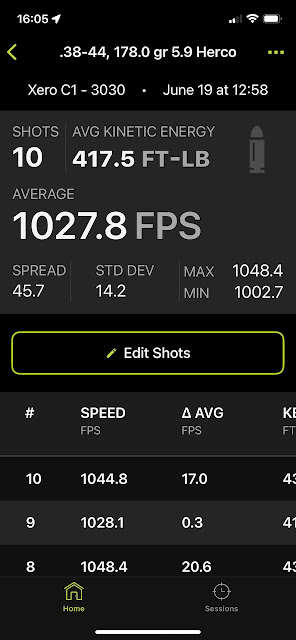
Last up were some .38 Specials loaded to duplicate the power of the .38/44, which was the predecessor of the .357 Magnum. Note that this load develops +P or +P+ level pressures and should never be fired in J-Frame or K-Frame .38 Special revolvers, or comparable guns from other makers. It should only be fired in guns chambered for .357 Magnum, or old S&W .38/44s or guns designed to handle these loads. I shot them in the Model 66-3 .357 Magnum.

Model 66-3:

  • 178 grain #358429 Keith from Matt's bullets
  • 5.9 grains of Alliant Herco
  • Winchester Small Pistol primer
  • Mixed brass
  • Average muzzle velocity: 1028 FPS
  • Average muzzle energy: 417.5 ft. lbs.

For the IPSC shooters, this load has a power factor of 183, so it easily makes major. This would make an excellent load for a woods walking gun, good for defense against most animals in the Lower 48 states.

The original .38/44 factory loads all used 158 grain bullets at 1125 FPS from a 6.5" barrel. I'm planning to load some with the same 5.9 grains of Herco under a 158 grain LSWC. I bet they'll get close to the original ballistics.