Showing posts with label Rossi 92. Show all posts

Friday, July 08, 2022

Rossi 92 Back Together

A week ago I posted about the Rossi 92 .357 carbine I bought about 10 years ago. The reduced power hammer and ejector springs and new rear sight that I ordered from Steve's Gunz arrived today.

Before reassembling the gun I deburred the parts and applied a little white lithium grease to the wear points. I'll say this one went back together a lot easier than my Interarms 65 did last year. That rifle required another set of hands to get back in one piece.

A .357 functioning dummy helped keep the ejector in place during reassembly. Highly recommended if you have an 1892-type rifle. I function checked the rifle with a few of the dummies and ejection is positive but not as violent as it was originally.

Overall, the action works much more smoothly with less effort than it did before.

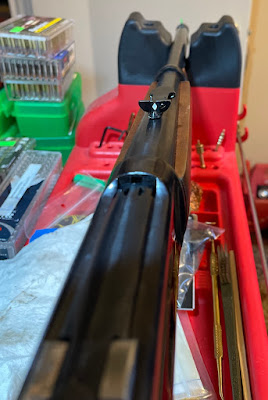
I also replaced the factory semi-buckhorn rear sight with a flat top sight made by Marble's. It has an insert that you can flip so that it has either a U- or V-shaped notch. It came with the U in place. I may take a file to it to make it a little larger, which will help in low light and make it faster to use.


Hopefully I'll get to shoot the rifle on Sunday to verify it works properly with live ammunition.

Friday, July 01, 2022

Revisiting my Rossi 92 .357 Magnum Lever Action Carbine

Back in 2012 I bought a Rossi 92 carbine with a 20" barrel chambered for .357 Magnum. A few years ago my daughter expressed an interest in deer hunting so I set it up with a Bushnell TRS-25 mounted on an NOE Bullets scout rail. Since giving hunting a couple tries my daughter lost interest, so I am revisiting the Rossi's configuration.

Although functional, the rail mounted red dot spoiled the clean lines of the rifle. Also, I wasn't satisfied with the bolt mounted peep that replaced the firing pin blocking safety. It wasn't really solid, IMO. So, I've decided to go back to open irons.

This week I finally got around to installing quick detach sling studs, made by GrovTec. I had a lace-on sling intended for muzzleloaders on the rifle but it wasn't ideal. For one thing if it got wet it was a pain to remove so the buttplate and stock could dry. For a sling I got the same Hunter Company 220-1 carrying strap. Aesthetically, it looks like a simplified USGI M1907 sling, which goes nicely with a traditional levergun. I also have one each on my Interarms 65 (Rossi 92) .44-40 and my Cabela's Hawken .50 percussion muzzleloader.

I swapped out the peep for the safety delete plug I put in the rifle shortly after I bought it. While I can see the utility of the safety when unloading the rifle it's too easy to actuate. I also put the original rear sight back on the barrel.

However, the OEM rear sight is a buckhorn that blocks a lot of the target. So, tonight I put in an order with Steve's Gunz for a flat top rear sight, along with reduced power hammer and ejector springs.

The Interarms 64 has the reduced power springs and they really help slick up the action. The lighter hammer spring still ignites even hard CCI primers, and the lighter ejector spring makes the bolt easier to close and keeps the gun from sending empties into orbit. Ejected cases land near your feet, making it a lot easier to recover the brass for reloading.

While I'm waiting for the parts I have the rifle disassembled on my bench. I'll slick up the innards but making sure there aren't any burs and polishing contact points.

Incidentally, a good friend picked up a new stainless 20" Rossi 92 in .357. This is one of the guns made in the new factory and I am extremely impressed. Right out of the box it was very smooth and the external finish was excellent, with good wood to metal fit. He's an engineer and a tinkerer, so he took it down to do an action job and replace the ejector spring. Unlike the older Rossis, he said that this resulted in minimal improvement. It appears that with their new factory, Rossi has really upped their game.

Aside from recreational shooting, my friend lives on property in one of PA's special regulations areas for hunting. This was formerly a muzzleloader, shotgun, or archery only area. However, the PA Game Commission is now allowing the use of straight walled cartridges, so he's planning to use it for deer. 35 yards would be a long shot on his land so a .357 carbine is just about perfect. If I can get out there during the appropriate season I'll probably be carrying my .357.

Tuesday, August 24, 2021

Interarms Model 65 (AKA Rossi 92) .44-40 Carbine

Back in May I picked up an Interarms Model 65 carbine in .44-40. It's simply a rebadged Rossi 92, which is a replica of the Winchester 1892.


The blueing is nicely done and a deep, blue-black. The wood has a dark stain that I like better than the light color of more recently produced Rossis. Wood-metal fit is acceptable.

The exterior condition and the bore are excellent, however the action was rough. This rifle was probably made in the early 1990s, long before Rossi bought new CNC machinery. Not much of attention was paid to the internal fit.

One nice touch is that a prior owner installed studs for quick detach sling swivels. They will come in handy. I ordered a Hunter Company #220-1 1" carrying strap for it. I have one on my Cabela's Hawken and like the simple design.

As typical of Rossi 92s it was oversprung. I installed reduced power springs for the hammer and ejector from Steve's Gunz.

Disassembly wasn't difficult with the assistance of documents found online and a couple YouTube videos. Reassembly, on the other hand, was a BITCH. This past weekend I enlisted the assistance of my friend N. who aside from being a shooter, is a mechanical engineer by training and generally the handiest guy I know.

Aside from fiddling to get it reassembled, we also had to debur the ejector and ejector collar. The action is much smoother than it was when I got it but to feed properly you need to work it like it owes you money. I think as it gets shot more it'll get even smoother. Since I work from home I've been leaving it out and cycling the action several times when I take breaks during the day. I've already noticed that the carrier is working better. (The action is well lubricated with oil and white lithium grease in spots.)

After we got it back together we ran 31 rounds of my black powder, .44 Henry-equivalent handloads through it shooting at a gong. That load is 1.9cc or ~28 grains of 3Fg BP, a 1/8" thick nitro card to take up air space, and a 219 grain bullet cast in an Accurate Molds 43-215C, all in a Starline case. Primers were CCI.

With the reduced power ejector spring the cases cleared the rifle easily but landed near my feet, instead of being launched several yards. The reduced power spring also make fully closing the action easier.

I'd forgotten to bring a bottle of moose milk with me so I just ran a patch with some Ballistol on it through the bore while still at N.'s, then finished cleaning it at home. I first wet brushed the bore and then after about 8 patches they came out clean. There was zero black powder fouling in the action because the thin .44-40 brass seals the chamber so well.

I'm planning to bench the rifle and see how it does at 50 and 100 yards. Because the 1892 and replicas have very strong actions, I might load up some +P loads (taking care to keep them out of my other rifles). I'm not going to get too crazy because at about 5.5 lbs. with a steel buttplate, anything much hotter than a standard .44-40 load is going to suck to shoot. (I did not particularly enjoy shooting my Marlin 1894 .44 Magnum with full power loads, and eventually sold it off.)

Rossi currently sells the 92 chambered for .357 Magnum, .44 Magnum, and .45 Colt. You can sometimes find them in .44-40; I found this one on Gunbroker and had it shipped to a local FFL for transfer.

Due to the simpler and easier to maintain design, if I was limited to one I might prefer a Winchester 1873 over the 1892 for a long-term survival rifle. But there's nothing handier than an 1892 carbine and it's a still very viable choice especially since the Rossis are much less expensive than the Uberti or Winchester 1873s.

Monday, July 23, 2018

New Sights for the Rossi 92

My 14 y/o daughter wants to join me deer hunting this year so I needed something she could shoot well with mild recoil. The Rossi 92 in .357 Magnum I bought several years ago fits the bill, but I wanted to improve her hit probability, which meant mounting an optic.

As a copy of the Winchester 1892, the Rossi 92 is a top-eject design, which complicates optic mounting. You need to either find some kind of a mount offset to the side or use something with long eye relief mounted on the barrel.

Rossi drilled and tapped the barrel for a scope mount. The holes are covered up by the open rear sight, which must be removed to use them.

NOE Bullet Molds makes a very nice Picatanny rail that fits the Rossi. I ordered one and received it in a few days. Before installing it, I degreased the mounting holes in the barrel using denatured alcohol, and put a drop of thread locker on each screw.


The optic I chose was a Bushnell TRS-25 red dot sight. Since my Rossi is in .357 I view it as a 75 yard deer rifle. A non-magnified optic is fine for such ranges.

I have a few other TRS-25s and they've all been very good, with clear lenses, a well-defined dot, and rugged. As a micro-dot sight the TRS-25 hardly affects how a rifle feels. Finally, they are low-priced. I got this one for $45 shipped on Amazon Prime. (I just checked Amazon and it's now listed for $43.24.)

Because the NOE rail required removal of the rear sight the gun is left without backup irons if your optic tanks. So, I ordered a bolt-mounted peep from Steve's Guns. When I first bought the carbine I installed one of his safety replacement plugs. I wish I'd just gone straight to his very slick peep sight.


The resulting package is still light and handy with plenty of firepower, but vastly improved low-light shootability.

Last weekend I took my kids camping and my daughter got to put 50 rounds of Fiochi .357 Magnum 158 grain JHPs through the Rossi. Without zeroing the RDS on paper, she was easily able to keep her shots on a 10" gong, shooting rapidly offhand at 25 - 30 yards.

We're hoping to get to the range next weekend so she can get some more practice in and so we can zero the Bushnell.

The final touch to ready the Rossi for hunting season will be to add quick-detach sling swivel studs and a sling.

Sunday, May 06, 2018

Turning Components Into Ammo

Over the past few weekends I have been busy turning components into ammunition. I dipped into my stash of empty .38 Special brass and loaded up several different varieties:


  • 50 rounds of 178 Keith semiwadcutters (SWC) on top of 3.8 grains of Unique.
  • 50 rounds of 178 Keith SWCs on top of 5.0 of Unique.
  • 100 rounds of 195 grain lead round nose bullets (LRNs) on top of a 5.0 grains of Unique.
  • 100 rounds of 148 grain Lee tumble lube wadcutters on top of a 2.7 grains of Bullseye.
  • 100 rounds of 148 grain Hornady hollow base wadcutters (HBWC) on top of 2.7 grains of Bullseye.
  • 100 rounds of Speer 158 grain lead SWC hollow points on top of a 4.5 grains of Universal Clays.


DO NOT USE ANY OF THE ABOVE LOADING DATA WITHOUT VERIFYING IT IN ONE OR MORE LOADING MANUALS!!! I AM NOT RESPONSIBLE FOR ANY DAMAGE THAT OCCURS TO YOU OR YOUR GUNS IF YOU RELY ON IT.

The Keith SWCs, 195 grain LRNs, and Lee TL WCs came from Matt's Bullets. I ordered 100 count sample packs of each and was impressed with the projectiles. They are sized to .359 and loaded with Carnauba Red lube, except for the 148 TL WCs, which appear to be lubed with Lee Liquid Alox.

I was quite pleased with the service from Matt's Bullets, BTW. My order shipped in about a day and a half and was sent in a USPS flat-rate box. I received 2 days after I got the shipping notice. The bullets all looked good.

The Hornady 148 grain HBWCs have been laying around since I bought 1250 of them at the end of 2016. I've had the 500 count box of the Speer LSWCHPs for years.

So what prompted this binge reloading? First, the weather has been nice and it has been neither too hot nor too cold to work out in my backyard shop. Second, my gun interests go in phases and  something rekindled my interest in revolvers. It's been too long since I shot one of my K-Frames, S&W Model 28, or 50th Anniversary Ruger Blackhawk.

And frankly, the state of the political left in this country is really starting to worry me. As far as I'm concerned, they've been acting completely batshit crazy since Trump's election. I want to get in some more practice in case the left decides to take their attempt at a soft coup hot.

I was pleasantly surprised that the .38s loaded with the Keith SWCs feed well in my Rossi 92 .357 carbine. I'd figured the SWCs might hang up during feeding, but they seem to be held at just the right angle to slip right into the chamber. (Testing was done with 3 dummy rounds, not live ammo.)

I got the 195 grain bullets because I thought it would be neat to try and duplicate the old .38 Special Super Police load, which had a 200 grain LRN at mild velocity. I wound up loading them over enough Unique, though, that they will only be shot in my .357s. If nothing else, they should make steel plates jump around nicely.

The Speer 158 LSWCHP loads should run about 850 FPS from a 4" barrel, very similar to the old FBI load. I can bump the powder charge up a little to get over 900 FPS but at +P pressures. These would be good for defense from any of my K-Frames, and should also work well in my J-Frame S&W Model 640.

To measure the powder charges I used both my Redding Model 3 measure and my RCBS Little Dandy. I don't like how Unique meters in the Redding, although it seems to meter a little more smoothly in the Little Dandy. In contrast, Universal Clays seems to meter very nicely in the Little Dandy -- smooth and extremely consistent. I haven't tried it yet in the Redding but I expect it to behave similarly.

Of course, the proof will be in the shooting of this ammo. I'm hoping to get to the range in the next week or two to dirty up some wheelguns.

Sunday, March 06, 2016

Got in some range time, plus a new toy on the way

Yesterday I went out to a friend's place and did some shooting with my Ruger Gunsite Scout Rifle .308 and Rossi 92 carbine in .357 Magnum.

First up was the Ruger GSR. I brought along a Ziploc bag of handloads consisting of Laser Cast 165 grain bullets on top of 13 grains of Alliant Red Dot, AKA "The Load" as described by C.E. Harris. The good news is that recoil was very mild, about like shooting an M1 Carbine. I could shoot them all day.

The bad news is that from 50 yards my "group" looked like I blasted the target with a few rounds of buckshot from my Mossberg 500. The group was about 18".  IIRC, these bullets were sized .309 and the Ruger may need .310s when shooting cast bullets. I have to get ahold of a .32 caliber bullet and slug the bore. I have another batch of "The Load," but tipped with 152 grain .30 M2 Ball projectiles. I'm hoping they shoot acceptably.

Before heading out this morning I stopped at Dick's and picked up two boxes of CCI Blazer Brass .38 Special ammo loaded with 125 grain FMJ RNFP bullets. I wanted to see if the Rossi would feed them reliably, for use in training my 11 year old daughter, and general plinking.

It turns out that the Rossi is sensitive to cartridge OAL, which was not unexpected. I've read that some Rossi 92 .357s don't like to feed .38 Specials. (The .357 was developed from the .38 Special by lengthening the case by 1/10 of an inch, and loading to higher pressure. .38s are perfectly safe to shoot in .357s but not vice-versa. Also, the .38 Special's actual bullet diameter is .357, or .358 if shooting cast bullets.)

If we worked the Rossi's lever too briskly, the round on the cartridge elevator would fly out the top of the rifle when the lever hit the bottom of the downstroke. If we worked it a little more gently it functioned OK. In contrast, when shooting .357s the rifle functions fine no matter how fast you run it.

In the 20" barrel of the Rossi, the .38s recoil like and sound like .22 LR highspeed ammo, but with a little deeper tone.

Shooting the .38s in the Rossi was a lot of fun, so I think I'm going to load some similar rounds in .357 cases, for better functioning. I'll probably pick up some cast RNFP bullets and may use this as an opportunity to try powder coated bullets.

I'm hoping to get back out to my friend's next week with the second batch of .308 handloads, and a rifle I should take delivery of next Friday: a Cimarron Firearms 1873 Sporting Rifle in .44-40 WCF. The 1873 was made in Italy by Uberti. I ordered it last week from Buffalo Arms and it's scheduled for delivery to my local FFL this coming Thursday.

This will be my second replica of a Winchester 1873. Back in 1991 I got an Navy Arms/Uberti '73 Carbine in .44-40, but eventually traded it off. Naturally, I came to regret that. I decided it was finally time to replace it but this time I chose a rifle length version with a 24.25" barrel. My old 19" barreled carbine had a capacity of 10 + 1, while the rifle will hold 13 + 1. Not too shabby for a 143 year old design. The Winchester was the Evil Black Rifle of its day.

I still have my .44-40 loading dies from 20 years ago but only 15 rounds of ammo left. So, I also ordered three boxes of Black Hill cowboy action shooting ammo and 500 pieces of Starline brass, which was on sale at MidwayUSA. Incidentally, my old box of Winchester 200 grain JSP .44-40 ammo has a price tag of $21.95. The same load now retails for about $70!!! The Black Hills ammo was about $40/box at MidwayUSA.

I haven't ordered any projectiles for the new rifle yet since I want to slug the bore first. After doing so, I'll order suitable cast lead bullets with black powder-compatible lube, since that's what I want to shoot in it. With 35 grains of Swiss BP I should be able to get abut 1300 FPS with a 200 grain bullet, to duplicate the original .44 WCF load. Goex will probably provide a bit less velocity and more fouling. I may also try Hodgdon Triple 7 BP substitute, which is a bit more energetic than Swiss, and very clean burning in my experience.
Monday, December 07, 2015

Lever Action Carbines for Defense

Recently I was able to get some shooting in over a friend's house (he lives in the country). One of the guns I shot was my Rossi 92 lever action in .357 Magnum. It's a replica of the Winchester 1892, designed by John Moses Browning. Shooting the R92 got me to thinking about the practical application of this 19th Century design in late 2015, especially in light of current events.


Those of us who live in free states have unfettered access to modern defensive rifles like AR-15s, with full capacity magazines. However, if you live in a ban state such as New York, unless you're willing to break the law, no more standard capacity magazines will be available. If you're just now looking to get a defensive rifle, modern semiautos and acessories may be limited in availability.

In my opinion, a lever action is a viable alternative, even though the basic design is a century and a half old. If we're looking at a rifle for defense against bad guys (as opposed to dangerous animals) the ones to look at are those which fire handgun cartridges. Although there are several other options, if buying a levergun for social purposes I suggest that you choose one in .357 Magnum, .44 Magnum, or .45 Colt. These are currently the most common such cartridges and are easy to reload for.

Of these three, my first pick is the .357 Magnum. Ammunition is widely available at less cost than .44 Magnum or .45 Colt, it provides effective terminal ballistics, and recoil is mild.

From rifle length barrels, magnum revolver cartridges get a big performance boost. For example, a .357 Magnum 158 grain bullet that leaves a 4" revolver barrel at about 1250 FPS will probably be doing at least 1700 - 1800 FPS from a 20" carbine. .357 loads with 125 grain bullets can exceed 2,000 FPS from a rifle! The muzzle energy of a .357 Magnum round fired from a rifle can be double that of the same load fired from a handgun.

Compared with a shotgun, lever action carbines have less recoil, smaller and lighter ammo, and greater magazine capacity (generally speaking).

Currently, the Rossi 92 is probably the most commonly available pistol caliber levergun. The Marlin 1894 is still around, but 1894s in .357 seem to scarce as hen's teeth. There are also Winchester 1894s in .357, .44, and .45 available on the used gun market, if you can find one.

Some features that I like about the Rossi 92 include:


  • The 20" barreled models hold 10 cartridges in the under barrel magazine. The 16" models hold 8, while the 24" rifles hold 12 rounds.
  • In the 20" barreled version, it weighs in at about 5 pounds. Even my 11 year old daughter is able to shoulder it.
  • The .357 Magnum carbines have very mild recoil, even with full power loads. I've single loaded .38 wadcutters, which recoil like and sound like a .22 when fired from the 20" barreled carbine. This is great for familiarization firing for new shooters, and can also be used for small game.
  • The design includes a built-in gunlock incorporated into the hammer. It is unobtrusive and is locked/unlocked with a key included with the rifle. If you want to secure a loaded rifle outside of a safe, it's one of the better solutions I've seen. IMO, it's safer than gun locks that go in the trigger guard.
  • Rossi 92s are reasonably priced and readily available, although you might need to order one through a local FFL or from an online retailer. 
  • While my rifle is blued steel, Rossi also makes the 92 in stainless steel. If you need a rifle for a boat or other humid environment this is definitely a big plus.


Some things I don't care for:


  • There are some rough edges inside the loading gate that I need to debur. They can chew on your fingers when loading the magazine.
  • Several years ago Rossi added a manual safety on top of the bolt to John Browning's original design. It feels cheap and cheezy. I removed mine and replaced it with a plug from Steve's Gunz. The gun still has the original half cock on the hammer.
  • The magazine follower is a cheap piece of plastic. I replaced mine with a steel follower from Steve's Gunz.
  • The finish on the wood was not only bland, but it didn't seal the wood well, either. I gave it a couple coats of Watco Danish Oil to better protect the stocks. Boiled linseed oil, tung oil, or a sprayed on polyurethane would also work well.
  • Browning's design does not lend itself to easy takedown. The good thing is that takedown is rarely required. Marlins are much better in this regard.

Steve's Gunz has a good DVD on slicking up the Rossi 92s.

As an aside, Rossi's quality control can sometimes be a little spotty. Years ago I had an 1892 Short Rifle in .357 made by Rossi for EMF. It had a 20" octagonal barrel, crescent buttplate, and no barrel band around the forearm. It was a beautiful rifle but when I first got it, it gave me extraction problems. Rossi had me send it in and they fixed it, but this was a hassle. At some point I traded it off but I do regret that.

The pistol caliber lever actions give you a light, fast handling rifle that fires an effective cartridge, can be operated quickly, and especially in .357 and .45 Colt, has mild recoil. It's worth a look for home or property defense if you can't have a modern rifle.