Showing posts with label .32 s&w long. Show all posts

Friday, May 30, 2025

.32 Snap Caps

Last week I went looking for snap caps in .32 S&W. I wanted a set I could use in anything from my antique S&W No.1-1/2 Single Action up to my guns in .32 H&R, or a .327 Federal if I ever get one.

On eBay I found the seller Lynx Arsenal which had what I need. I ordered a set of 10 and they came within a week. The "bullets" and "primers" appear to be 3D printed. They are loaded into Starline brass.


I've been using them for dry fire practice and so far they are holding up. If the "primers" ever break down I'll replace them with RTV silicone, which I've done in the past.

Wednesday, May 28, 2025

Some Chronograph Results with .32 S&W Long, .32 H&R Magnum, and .38 Special

This week I've been off and thus had time to hit the range a few times. I've taken a few revolvers and run several loads over my Garmin Xero C1 Pro chronograph.

The Garmin is so compact and easy to use I just leave it in my range bag.

Among the guns I've taken is a new S&W Model 432UC. This is an Airweight J-Frame in .32 H&R Magnum. My intention for this is to replace my 1990s-vintage Model 632 Airweight as a carry gun. The 632 is a collectible, but more importantly, was a gift from my late father. I wouldn't want it taken into evidence should I ever need to use it.

I ran a few loads over the Garmin from the 432UC.

Factory loads:

High Desert Cartridge Company .32 H&R Magnum 98 grain wadcutter:

811 FPS / 143 ft. lbs.


Black Hills .32 H&R Magnum 85 grain JHP:

948 FPS / 170 ft. lbs.


A couple handloads:

.32 H&R Magnum, Lee TL314 90 grain SWC

3.6 grains Accurate No.2

930 FPS / 173 ft. lbs. ME


.32 S&W Long, Lee TL314 90 grain SWC

2.2 grains Titegroup

682 FPS / 93 ft. lbs. ME

Of these, the HDCC 98 grain wadcutter is my choice in a carry load. It's very controllable in the Airweight and should give plenty of penetration, enough to poke a 5/16" diameter hole well into an attacker's vitals.


I also chronographed some .38 Special.


Colt Detective Special 2"

Hornady 148 grain HBWC over 2.7 grains of Red Dot

697 FPS / 160 ft. lbs ME


Colt Detective Special 2"

Hornady 148 grain HBWC over 2.9 grains of Accurate No.2

750 FPS / 185 ft. lbs. ME


S&W Model 66-2 2.5"

Hornady 148 grain HBWC over 2.9 grains of Accurate No.2

748 FPS / 184 ft. lbs.


NOTE: The Colt is chambered for .38 Special while the S&W 66-2 is chambered for .357 Magnum. The longer chamber with .38 cartridges leads to some velocity loss.

S&W Model 15-3 4":

Hornady 148 grain HBWC

3.0 grains HP-38

727 FPS / 174 ft. lbs. ME


S&W Model 1905, 4th Change .32-20 4"

Desperado Cowboy Bullets 96 grain RNFP over 3.5 grains Titegroup

792 FPS / 134 ft. lbs. ME


S&W Model 10-8 3"

Hornady 158 grain LSWC over 3.5 grains Titegroup

726 FPS / 185 ft. lbs. ME


This load does about 775 FPS from a 4" barrel.

I've found that 3.5 grains of Titegroup under a 158 grain bullet in .38 Special approximates factory loads and is both accurate and pleasant to shoot in K-Frame and larger guns. The same bullet with 3.5 grains of Bullseye is roughly equivalent but in 2025, Bullseye is nearly impossible to find. In contrast, Titegroup is readily available.

Saturday, March 29, 2025

Lee TL314-90-SWC Mold

After having good luck with the Lee TL358-158 mold in casting bullets for .38 Special, I recently picked up a TL314-90-SWC mold to use for my .32 caliber revolvers. The weather was nice today so I decided to break it in.

Waiting for the lead to melt:


I used dead soft lead. I won't be pushing these very fast in .32 S&W Long, .32 H&R Mag, or .32-20.


Here's one of the bullets from the new mold along with one cast in my TL358-158 mold, which is already lubed with Lee Liquid Alox:


This bullet is a little pointer than I'd like. I'd rather it have a wider meplat like the .38 caliber bullet but for plinking or paper punching it'll be fine.

The new mold was especially easy to cast with. The bullets dropped freely from the cavities with at most one rap with a mallet on the bolt holding the handles together.


Saturday, June 22, 2024

Garmin Xero C1 Professional Chronograph

Many serious shooters, especially handloaders use a chronograph to measure the velocity of bullets. This allows you to get a better understanding of what the bullets you're shooting are actually doing. Ammunition manufacturers and reloading manuals provide velocity data, but the only way to see what ammunition really does in your gun is to measure it yourself.

Up until recently, most chronographs used optical sensors to calculate velocity. These devices work but have some disadvantages:

  1. They must be placed in front of the firing line. So, if you're on a range with other people you need to coordinate setup and teardown, and tweaking the position.
  2. Because they're in front of the gun, they are at risk of being hit. This is not uncommon. I know a couple people who've shot their chronographs.
  3. They can be finicky depending on the lighting. Sometimes it's too bright. Other times it's too dim. Very shiny bullets may not register well. (A potential fix for that is to color them with a black marker.)

Several years ago the Lab Radar chronograph was introduced, using Doppler RADAR to calculate velocities. From what I've read it works well. More recently, Garmin came out with the Xero C1 Pro Chronograph, which also uses Doppler RADAR. I bought one last week and tried it for the first time on Wednesday. I am completely blown away by it.

The only criticism I have so far of the Garmin is that it doesn't come with a carrying case, so I got one of these for it.

Here's a picture of the Garmin on the shooting bench at my club along with a couple of the guns I shot. That little thing on the tripod is the entire unit.


A close up:


According to the instructions that Garmin shipped, when measuring pistol bullet velocity you should have the pistol 5" - 15" over the unit. When shooting a rifle, it should be 5" - 15" to the side and behind the muzzle. Also, the bullet needs to be able to travel at least 20 yards to the target.

The bottom of the unit is threaded to accept a standard 1/4-20 camera tripod mount, so if where you shoot doesn't have a suitable bench, you have an alternative. I've also seen mounts that allow you to attach it to a rifle.

I fired a total of 70 rounds over the Garmin with no errors. Before going to the range I downloaded the Garmin ShotView app to my iPhone 12. The app and the unit sync via Bluetooth.


I measured several different handloads in a variety of revolvers.

Colt Police Positive with 4" barrel in .32 Smith & Wesson Long

  • 96 grain RNFP from Desperado Cowboy Bullets
  • 3.8 grains of Alliant Unique
  • Servicios Aventuras small pistol primer
  • PPU brass
  • Average muzzle velocity: 1058 FPS
  • Average muzzle energy: 239 ft. lbs.

I was surprised at how fast this load shot, although it's not maximum according to some data I've seen. It wasn't particularly pleasant to shoot in the little Colt.

S&W Model 1905 Military & Police, 4th Change in .32-20 (.32 WCF).

  • 96 grain RNFP from Desperado Cowboy Bullets
  • 4.7 grains of Winchester AutoComp
  • CCI small pistol primer
  • Starline brass
  • Average muzzle velocity: 746 FPS
  • Average muzzle energy:  119 ft. lbs.

The low velocity surprised me here. AutoComp is specifically designed to generate a lot of gas for pistols fitted with compensators. As such, it's rather blasty. I'll be figuring out other loads to use, probably with Bullseye and/or HP-38.

Next up were some .38 Special full charge wadcutters in two guns, a S&W Model 64-2 .38 with a 1-7/8" barrel, and a Model 66-3 .357 Magnum with a 4" barrel.

Model 64-2 in .38 Special

  • 148 grain #35891 button-nose, bevel-base wadcutter from Matt's bullets
  • 3.5 grains Alliant Bullseye
  • Winchester wadcutter brass
  • Average muzzle velocity: 757 FPS
  • Average muzzle energy: 188 ft. lbs.

I also fired the same load in the Model 66-3 in .357 Magnum.

  • Average muzzle velocity: 844 FPS
  • Average muzzle energy: 234 ft. lbs.

You can see that the longer barrel gives an extra 87 FPS and 46 ft. lbs. of energy.

Most standard pressure .38 Special 158 grain loads give around 750 FPS from a 4" barreled revolver. I had a box of .38s loaded with a Speer 158 grain LSWC on top of 3.5 grains of Bullseye. Let's see how they did in the two K-Frames:

Model 64-2 snub:

  • Average muzzle velocity: 680 FPS
  • Average muzzle energy: 163 ft. lbs.

Model 66-3:

  • Average muzzle velocity: 774 FPS
  • Average muzzle energy: 210 ft. lbs.

That's a noticeable difference. This load is quite comfortable to shoot in a K-Frame.

Last up were some .38 Specials loaded to duplicate the power of the .38/44, which was the predecessor of the .357 Magnum. Note that this load develops +P or +P+ level pressures and should never be fired in J-Frame or K-Frame .38 Special revolvers, or comparable guns from other makers. It should only be fired in guns chambered for .357 Magnum, or old S&W .38/44s or guns designed to handle these loads. I shot them in the Model 66-3 .357 Magnum.

Model 66-3:

  • 178 grain #358429 Keith from Matt's bullets
  • 5.9 grains of Alliant Herco
  • Winchester Small Pistol primer
  • Mixed brass
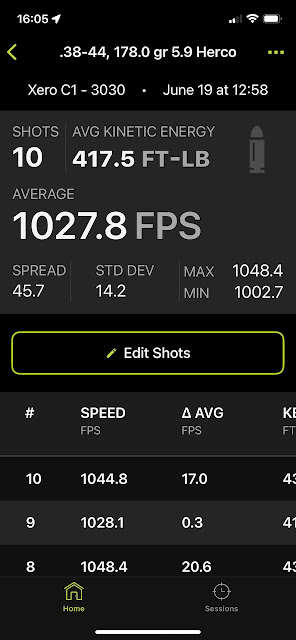
  • Average muzzle velocity: 1028 FPS
  • Average muzzle energy: 417.5 ft. lbs.

For the IPSC shooters, this load has a power factor of 183, so it easily makes major. This would make an excellent load for a woods walking gun, good for defense against most animals in the Lower 48 states.

The original .38/44 factory loads all used 158 grain bullets at 1125 FPS from a 6.5" barrel. I'm planning to load some with the same 5.9 grains of Herco under a 158 grain LSWC. I bet they'll get close to the original ballistics.


Sunday, April 07, 2024

.32-20 Quick Strips

The Tuff Products Quick Strips that I ordered the other day to use with my .32-20 Hand Ejector arrived today. They'll be perfect for packing reloads.


They can hold 8 cartridges each but I'll be loading only 6, which will give me a little more to hang onto while using. They also fit .32 S&W, .32 S&W Long, .32 H&R Magnum, .327 Federal Magnum, and 9x19. So, in the highly unlikely event you're packing a S&W Model 547 which is a 9mm K-Frame that doesn't use moon clips, these have you covered.

Monday, July 31, 2023

Did a Little Shooting Yesterday

Yesterday I was able to get some range time in with my Colt Police Positive and Beretta 71 Jaguar.

The loads I shot in the Colt were mixed .32 S&W Long brass, a Speer 98 grain HBWC, Winchester small pistol primers, and 1.7 grains of Bullseye measured out using the #00 rotor in my RCBS Little Dandy measure. I was able to reliably ding an 8" gong from around 15 yards. One thing I've noticed with the small Colt is that it's much easier for me to see the sights when shooting outside than when indoors under florescent lighting.

The Beretta 71 further cemented my opinion of it as probably the finest compact .22 autoloading pistol ever built. Since I bought it several years ago it's proven to be exceptionally reliable. Yesterday I shot CCI Stingers in it for the first time, along with 100 Remington 36 grain Golden Bullet hollow points. The only malfunctions I had were with a particular magazine that sometimes doesn't present the bullet at the correct angle to feed. This is a magazine and operator issue, not a gun issue. If I'm careful loading the mag it works properly. Otherwise it ran perfectly. None of the rounds failed to fire or eject.

I also intend to try it with a box of Remington Vipers and another of Federal Punch defensive ammo. If I were to toss it in my pocket for a walk I'd load it with Stingers for now.

I'd love to see Beretta bring it back with a few improvements:

  • An adjustable rear sight.
  • A slide-mounted front sight.
  • An ambidextrous safety.
  • Maybe a Picatinny rail on the dust cover.
  • An extended barrel threaded 1/2x28.
While I'm dreaming, make it to use Glock-compatible sights. This would allow it to use a wide variety of easily available aftermarket sights.

Ideally, this would be built in the US so it wouldn't have to be made larger to get enough points for import under the (unconstitutional) GCA of 1968.

Saturday, November 14, 2020

Loaded Some .32 Smith & Wesson Longs

 Today I loaded up 50 rounds of .32 Smith & Wesson Long. My recipe today was:

  • Mixed brass, mostly Fiocchi
  • Sellier & Bellot small pistol primers
  • 2.7 grains of Alliant Bullseye powder
  • 96 grain round nose flat point bullet from Desperado Cowboy Bullets
Actually, since I used a RNFP bullet, I could call them .32 Colt New Police loads. :)


I ran into an issue priming the cases, however. I generally use a Lee hand priming tool, but today it decided it didn't like the combination of Fiocchi brass and S&B primers. Fiocchi brass tends to have snug primer pockets. I would up using my antique Ideal tool for .32 S&W to prime the cases. It's slow, but it works.


According to the data I have from Loaddata.com, this should give about 910 FPS from a 4" barrel. I'll probably shoot this batch from my Ruger Single Six Vacquero, chambered in .32 H&R Magnum.

I have plans to head to a friend's place tomorrow to burn it up.

Monday, January 20, 2020

Range Day, and Presbyopia Sucks

I was off today and went to the range with three wheelguns:


  • H&R Model 733 in .32 S&W Long, with a 2.5" barrel
  • Ruger GP100 in .38 Special, with a 4" barrel
  • Uberti Bisley in .44 WCF, with a 5.5" barrel
Under the florescent lighting, I had a hard time seeing the front sight of the H&R and even the Ruger. When shooting both outside I had better luck being able to see their front sights but today, the H&R's was all but invisible. I have the H&R's front sight painted white but it just disappeared in the range lighting today. I'm going to try hitting both with some hi-viz green to see if that helps.

One of the reasons I ordered the Uberti with a 5.5" barrel was because I thought it might be easier to see the front sight compared with a 4.75" barrel. It was the one gun I shot today with which I didn't have difficulties.

Yay, middle-age.

In other news, I shot some more rounds from the box of .44 WCF handloads I'd put together with 7.0 grains of Hodgdon Universal under a 200 grain RNFP Desperado Cowboy Bullets. Grouping was OK but I had two squibs that blooped the bullet out of the barrel but were definitely underpowered. In both cases the barrel had a lot of unburned powder left in the bore. I'm going to pull down the rest of those rounds.

The only possible causes I can think of are (a) bad primers, or (b) contamination of the powder charge by my case lube. I degreased the cases after resizing but I'm wondering if I didn't do good enough of a job, and the powder was damaged in those rounds.

Even with the aggravation it beat going to work!

Wednesday, January 01, 2020

Harrington and Richardson 733 Range Report

Today I got to shoot the Harrington and Richardson 733 .32 S&W Long revolver I bought a couple of weeks ago.

As mentioned in my last post, a range report was delayed because I had to replace the original hammer spring/strut assembly with a plastic part that shattered. The replacement with a metal part on it dropped right it and the gun functions as it should now.

I went shooting on a friend's property with three other people and was able to put 30 rounds through the gun at an 8" gong. From about 10 yards I hit the gun if I didn't yank the trigger. The double action pull is pretty stiff, but smooth. The single action pull is quite a bit lighter. The front sight is a narrow blade, nickel plated like the rest of the gun. I'd painted it with some white out ahead of time so I could see it.

The ammo I used was Prvi Partizan (PPU) .32 S&W Long with 98 LRN bullets. They claim a muzzle velocity of 787 FPS from a 6" barrel on their website (figures converted from metric). Out of the H&R's 2.5" it's probably making about 650 FPS. All rounds functioned as expected except for the very first shot, which gave me the first problem I've experienced with PPU ammo (and I've shot a lot of 5.56x45 and 7.63x25 from them). That round required three hits before going off.

Recoil was very mild, as expected. The H&R has small grips so in a harder recoiling round it would be unpleasant to shoot, but not with .32 S&W Long.

I don't anticipate putting high round counts through the gun but between it and my Ruger Single Six Vaquero in .32 H&R Mag, I'll probably setup for reloading .32 wadcutter ammo.

Fro the about $160 I have into the gun, I consider it well spent.

Sunday, December 29, 2019

Harrington and Richardson Model 733 Revolver

Recently a local gun shop listed an H&R Model 733 revolver with 2.5" barrel for $125. The going rate on seems to be at least $150 to $300, from what I've seen. The 733 is the chrome (early) or nickel (later) version of the blued Model 732. It's marked ".32 S&W" on the barrel, but is in fact chambered for .32 S&W Long.

I've been on the lookout for a low cost wheelgun in .32 S&W Long and this seemed to fit the bill, so I called and had them hold it for a few days until I could go in to check it out in person.

Upon inspection the gun seems to have been fired very little and wasn't very dirty. I ran it through Jim March's Used Revolver Checkout and it passed, with a good lockup and no endshake, so it came home with me, along with a pound of Alliant Reloder 7 powder for use in my .44-40 rifles.


Note the lack of a cylinder catch. To unlatch the cylinder for loading or unloading, you pull forward on the ejector rod.

The serial number starts with "AH", placing the date of manufacture as 1971. It looks like it was made yesterday and had maybe a box of ammo through it.

After getting it home I ran a few patches through the bore and chambers, and cleaned out some corners with a toothbrush wet with FP-10.

One known weakness of relatively early H&R 732 / 733 is a plastic part on the end of the hammer spring guide rod, which bears on the hammer. Before I bought the gun I'd done some research and apparently, it's not uncommon for it to break. I therefore wanted to remove the grips, make a drawing of the part if mine was plastic, and replicate it in brass.

I found a photo of the offending part on Gunbroker, for reference, with the white part being the weak plastic:


Naturally, it shattered when I removed the grips. Just a little bit of lateral pressure on the assembly while pushing the left side grip off managed to break it.

<sigh>

After much cussing, I went online to search for a replacement. Luckily, Numrich has them, in either plastic or steel. Of course I ordered the metal part. It cost $35.99 after shipping. Even with the cost of the part the overal cost of the gun is in line what they go for nowadays at retail. I got the replacement about a week later and it dropped right in.

If you own or acquire any of the H&R double action revolvers I recommend carefully removing the grips to see if it has the plastic or metal part. If it's plastic getting the metal replacement is advisable.

So why a revolver in .32 S&W Long? They are just fun to shoot, in my opinion. Recoil is minimal with a little more pop than .22 Long Rifle.  Where legal, a lead .32 wadcutter or semiwadcutter performs well on small game without destroying much meat. Unfortunately, that doesn't include PA.

The cost to reload should be minimal, too, especially if you cast your own bullets. Based on the data I've seen good plinking and small game loads should use around 2.0 to 2.5 grains of pistol powder (e.g., Bullseye, HP-38, or Unique) which would make a pound of powder quite awhile.

Also, while on the light side for self defense, .32s beat a pointed stick. If it's all you have or can tolerate recoil-wise, a .32 S&W Long wadcutter will poke a ~5/16" hole about 15" deep in a bad guy.

I should be able to put some rounds through the H&R this week, after which I'll post a range report.