Showing posts with label guns. Show all posts

Saturday, November 07, 2026

Second Range Trip with the Smith & Wesson M&P22 Compact

Yesterday I took the M&P22 back to the range to try several different types of .22LR ammunition. I intended to chronograph them but the battery in my Garmin was dead, so that will have to wait.


After my first range trip I Loctited the rear sight's windage adjustment screw. It stayed in place this time. After I confirmed zero I shot at least my rounds at the 25 yard plate rack.

I fired 380 rounds in total yesterday, in the order below.

In summary, the functioned perfectly with CCI Stingers and Remington Golden Bullets from a bucket I bought around 10 - 15 years ago. It didn't like Remington Vipers and it had some bobbles with Federal Punch. Federal Champion bulk pack and CCI Standard Velocity worked well with one failure of the slide to lock back on empty with each.

Details:

  • Federal Punch 29 grain flat point solid. 50 rounds. 3 or 4 failures to feed (FTF).
  • CCI Stinger 32 grain HP. 50 rounds. No malfunctions.
  • Remington Viper 36 grain truncated cone solid. ~80 rounds. Numerous FTFs and failures to lock back on empty.
  • Federal Champion Value Pack 36 grain HP. 50 rounds. One failure to lock back on empty mag.
  • Remington Golden Bullet 36 grain HP. 100 rounds. No malfunctions. CCI Standard Velocity 40 grain solid. 50 rounds. One failure to lock back on empty mag.

So far I've put 571 rounds through the gun since buying it a little over a week ago. It seems to have a preference for CCI Mini Mags, CCI Stingers, and Remington Golden Bullet HPs.*

I have 5 more magazines on the way, along with a barrel nut to replace the thread adapter, since I'll be shooting this mostly unsuppressed. The barrel nut won't require removal for field stripping.

With two range sessions under my belt with the Smith & Wesson M&P22 Compact I can say that so far I'm very pleased with this pistol. It would make a great little kit gun for those who prefer autoloaders. Also, with the right ammo, it's reliable enough to rely on for self defense for folks who cannot handle a more powerful chambering, or who have hand issues that make racking the slide on a centerfire semiauto difficult.


*A note about Remington Golden Bullet .22s:

At one time I and many other experienced shooters would have considered Remington .22 Golden Bullets to be junk. However, around 15 years ago Remington greatly improved the quallity and I found it to be good, solid, reliable high speed .22 LR ammo. I don't know if that better quality carried over after Remington's bankruptcy in 2020. I'm getting down the last few hundred rounds from the 1400 round bucket I bought around 15 years ago. I'll have to get some current production Golden Bullets to try.


Saturday, October 31, 2026

Smith & Wesson M&P22 Compact

Last month I put several guns on consignment with a local gun store. Yesterday I went to the shop to get the payment for the final gun I sold but I decided to take it in store credit.

I'm a fan of compact .22 autoloading pistols. They often can be easily used by all sizes of shooters, if reliable enough can be secondary defensive arms, and are simply fun to shoot.

So I came home with a Smith & Wesson M&P22 Compact. It is a 10 shot semiautomatic .22 pistol, intended to serve as an understudy to the S&W M&P centerfire pistols. It came with an adjustable rear sight and a thread adaptor to accept a silencer.


The gun weighs about 1 lb. loaded with 10 rounds.

Additionally, it has an ambidextrous manual safety which as a lefty I appreciate, a magazine disconnect, and a Picatinny rail on the dust cover under the barrel. There is a built-in lock with 2 keys supplied, and it also came with a cable lock.

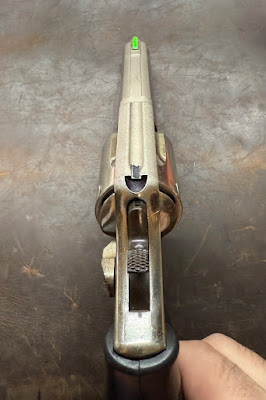
The rear sight is adjustable for windage and elevation, while the front sight is dovetailed into the slide so if you wanted you could replace it with something else like a fiber optic (it has a white dot).

The aluminum slide is not cut for an optic. This may matter to some folks but not to me.

Unlike the centerfire M&P pistols the M&P22 is not striker-fired. It has an internal hammer.

Something I always do when I get a new-to-me gun is field strip it, clean off whatever preservative was put on in the factory, and then lubricate it. On the M&P22 Compact you need to first remove the barrel nut so you can remove the slide.

However, some idiot at Smith & Wesson thought it would be a good idea to put copious amounts of strong threadlocker on the barrel threads, so even with the supplied wrench I couldn't get it to budge at first. I applied Kroil and let it sit for about an hour, then locked back the slide, clamped it in a vise, and used a mallet to smack the wrench to get it turning. WTH, Smith & Wesson? Why would you do this?


The vise jaws are lined with copper sheet. The slide was not marred.

The recoil spring is captive on a plastic guide, which makes removal and reinstallation easy. Racking the slide is very easy.

After getting it apart I cleaned off the threads as much as possible, cleaned and lubed the gun, and when I reassembled it I covered the barrel threads in Shooter's Choice grease as an anti-seize.

Today I took it to an indoor range and put 91 CCI 40 grain Mini Mag solids and 100 Remington Golden Bullet 36 grain HPs. The gun functioned perfectly and none of the ammo misfired. The gun feels smooth when cycling.

The trigger is meh but I’ll put at least 1000 rounds through it before thinking about a trigger job. Unfortunately, couldn’t get any good groups because the windage adjustment screw on the rear sight -- which should've had blue threadlocker -- kept loosening and thus it would lose zero. I put blue Loctite on it after I got home and plan to zero the gun at 10 yards.

I've ordered 5 more magazines for it, and a barrel thread protector to replace the thread adaptor, since I will be mostly shooting it unsuppressed. I'd rather not have to remove the adaptor every time I want to strip the gun for cleaning.

It fits in the El Paso Saddlery M-1942 tanker holster I bought for my S&W M&P9 2.0 Compact, with a little room to spare.


Once I get the M&P22 Compact zeroed it'll make a nice kit gun.


Wednesday, October 21, 2026

Some Overdue Carry Gun Maintenance

 Performing a little overdue maintenance on my carry gun, a Smith & Wesson 432UC in .32 H&R Magnum.


Awhile ago I'd done some practice with .32 S&W Long ammo. The H&R Mag case is a lengthened .32 Long case, so you can safely shoot Longs in it. The problem is that this can cause a ring of crud to get deposited in the chamber, which can and did cause sticky extraction when shooting Magnums. (This also applies to firing .38 Specials in .357 Magnum chambers.)

I tried an overnight soak in Kroil to get under the crud rings and then remove them with wet patches but it wasn't enough. So, today I removed the cylinder and then chucked a section of cleaning rod in my drill and mounted a .32 caliber bore brush. With the drill turing I ran the brush in and out of each chamber.

After checking with some cartridges and still getting some stickiness on a couple chambers, I repeated the drill treatment and now have the chambers soaking in Boretech C4 carbon remover. If I need to I'll repeat the cycle.

Brownells sells handgun chamber brushes for .40/10mm, .38/.357/9mm, and .44 Special/Magnum, .45 ACP, and .45 Colt. Unfortunately, they don't list them for .32 Long/Magnum. Chamber brushes are oversized vs. bore brushes and so clean the chambers better. I have them for .38/.357 and they work well.

My remedy to prevent this annoyance in the future will be to load up practice rounds in .32 H&R Mag brass.

Monday, September 14, 2026

More Load Development with the Pedersoli Mississippi Rifle

Today I got the Pedersoli Mississippi Rifle back to the range and tried a few different loads. All groups were 5 shots, fired at 50 yards from a bench rest, using 70 grains of Goex FFg black powder.

I first tried pre-patched .526 ball with tied-on .010 patches lubed with October Country's Bumbling Bear Grease. These were intended to copy the balls loaded in cartridges for the US Army back in the 19th Century.


I loaded these with the "tail" facing up. Even though I used a thinner patch than during my first range trip, I needed to use my short starter.

Unfortunately they didn't work for me. While easy to load for up to 5 shots, accuracy was terrible. Based on the target it looked like at least one impacted the target with the patch still wrapped around the ball, but with the "tail" off-center.

The bullseye is 5.5" in diameter.


I recovered one of these patches, about 25 - 30 yards downrange, which is much further that untied patches travel.


I may try pre-patched balls again but use thread instead of hemp twine, to increase the chance the patches separate from the balls.

My second target was .526 balls in a .010 patch but seated normally. Accuracy was better although not great.

My final target was .520 balls in .018 patch. These seated very easily but still required the short starter, and the accuracy was on par with .526 + .010 combination.


For my last 2 shots of the day I loaded .520 balls in .018 patches and shot them offhand at an ~18" steel gong, both of which were hits.

Load development will continue.

Monday, May 04, 2026

Ruger Security-380

Being in my late 50s and having spent about 26 years in IT using a keyboard a lot, my hands no longer take well to heavy recoiling guns. I recently got a CZ-82 in 9mm Makarov but being a straight blowback, I'm limited to about 50 rounds per session with that gun.

A couple days ago I traded off my SIG P365X, which had gotten unpleasant to shoot, in favor of a Ruger Security-380 Lite Rack. It's based on the Security-9 Compact but chambered for .380 ACP. Size-wise it's comparable to a Beretta 81 or 84 Cheetah .32 or a SIG P365 AXG Legion. Unlike the blowback Berettas, the Ruger is a locked-breech gun so my hope was that it would have mild recoil.


Shown between a 3" S&W Model 10-8 K-Frame and a S&W Model 432UC J-Frame (my EDC):


I tried a few holsters that I have on hand for other guns and found that it fits my El Paso Saddlery M-1942 Tanker made for the S&W M&P M2.0 Compact 9mm:


It's large trigger guard kept it from seating in a Tanker holster for 1911s.

The Ruger came with two 15-round mags (for this RSR-exclusive SKU), a mag loader, chamber flag, owner's manual, and gun lock.

The front sight is a green fiber optic while the rear is blacked out with a U-notch that gives just the right amount of space on the sides of the front when aiming. Sight visibility is excellent.

My hands are medium-sized and I'm able to grip the gun and reach the trigger comfortably.

There is a thumb safety on the left side, but not on the right for us lefties. The safety lever is small and might not be easy to work with gloves on. I plan to ignore it.

One caution I saw in a video review by Honest Outlaw on YouTube is that if you eject magazines and let them fall onto a concrete floor, they may shed their floorplates and possibly break. So, don't do that.

Today was a good day to test my theory that a locked-breech large .380 pistol would be good for folks with hand issues, because they were acting up.

While .380 ACP may not be as powerful as 9mm, the ballistics are similar to those of the Colt 1851 Navy .36 percussion revolver, which put a lot of men in the ground in the late 19th Century. Think of the Ruger as a 15-shot Colt Navy.

I put 137 rounds of .380 FMJ through it (38 Federal American Eagle, 49 CCI Blazer w/aluminum cases, and 50 rounds of PMC). The gun ran perfectly.

The trigger pull is consistent and my SWAG is that it breaks at about 4 - 4.5 lbs. There is zero overtravel due to a stop molded into the trigger guard. There is a little takeup in the pull before you encounter resistance, similar to a two-stage military rifle trigger.

The two 15-round mags that were included with the gun definitely need a magazine loader to fill, especially for the final round. I used my Maglula UpLULA instead of the one included with the gun. The magazines have the same bodies as those for the Security-9, but with a spacer in the back to work with the shorter .380 rounds. Any mag loader meant for double-column 9mm pistol mags will work.

Seating a fully loaded magazine with the slide forward requires you to give it a good whack on the bottom to ensure it's latched in place.

I shot it on paper at 10 yards and on steel at 25 yards. The point of impact is a little to the right at 10, more so at 25. Looking down at the top of the slide it looks like Ruger didn't get the rear sight perfectly centered. It's a hair off to the right. I'm going to center it before I shoot it the next time.

Field stripping is easy but may require a small flat head screwdriver to pull out the takedown pin, if it's dirty or dry. A good accessory for this gun would be a Czech surplus CZ-82 cleaning rod, which has a flat head screwdriver on the tip.

Despite Ruger not getting the rear sight properly centered on my sample, overall I'm very impressed with the Security-380.

The recoil is very soft, similar to the Beretta .32. However, the slide is much easier to rack than the Beretta's, more like a .22 autoloader's. Even after 137 rounds my hands weren't feeling much worse than when I started. If you have hand strength or pain issues, or are just recoil-sensitive, this is a gun to seriously check out.

Saturday, April 18, 2026

A CZ-82 Followed Me Home

A 1988 production CZ82 in 9x18 Makarov followed me home from the gun show yesterday.


The CZ82s are a bit more expensive than they used to be, but what isn't? Like many of these surplus guns the paint finish shows some wear, but the grips are in nice shape and mechanically it seems perfect. The oval bore is bright and shiny.

The gun came in a cardboard box with one 12 round magazine, a gun lock, and a used Falco thumb break holster, which also fits a Beretta 81 or 84. I'm giving it to a friend to use with his Beretta 81. I'm left handed so the holster is useless for me.

The CZ next to my Beretta 81:


The ergonomics of the CZ82 are impressive. It fits my hand very well. The safety and magazine release are ambidextrous, although the mag catch is significantly easier to depress from the left side, which works for me because I'm accustomed to using my left index finger for that.

The CZ field strips just like a Makarov. First, ensure it's empty and the magazine is out of the gun, and the hammer down. Pull down on the front of the trigger guard. Cock the hammer and then pull the slide to the rear and up, and it'll pull off the gun.


To reassemble first put the recoil spring back around the barrel and then reverse the disassembly steps.

I own several DA/SA semiautos but the CZ82 has by far the best DA trigger of any of them. It actually feels like a good DA revolver trigger, under 10 lbs. and smooth. The SA pull has some take up but is light, probably no more than 5 lbs.

I got a couple boxes of Sellier & Bellot and one box of Barnaul 9x18 at the show. Last night I put in an order for 500 rounds of S&B.

After some searching I found some surplus CZ magazines at Royal Tiger Imports for $29.99 each, including a mag pouch, so I ordered three. On eBay I found a correct surplus cleaning rod and separately, a Czech military surplus holster.

The surplus holster I ordered is basically a leather gun case with belt loops, but it's  ambidextrous and completely conceals the gun, while not even looking like a holster. It will hold the gun, cleaning rod, and a spare magazine. I wouldn't use it for around town but it should work well for trail hiking where you want to protect the gun from weather while also not scaring any earthy-crunch granola types you might encounter.

Pic borrowed from an eBay seller in Czechia:


It looks more like an e-tool carrier than a holster, IMO.

The CZ also fits into a commercial Tanker holster for 1911s, which gives me another option.


Today I took the CZ to the range and put 50 Barnaul and 25 S&B through it. The Barnaul ammo gave me two hiccups. The second or third shot in the first magazine misfed and to clear it I had to drop the mag and rack the slide to clear it. On another mag it failed to lock back after the last shot. The S&B ran fine.

Accuracy was good with me able to keep 50 rounds within a few inches offhand at 10 yards. Between presbyopia and shooting indoors under florescent lighting which made it hard to see the front sight so I'm happy with how it grouped. Recoil was a bit snappy, especially compared with the Beretta 81 .32 I also shot today. I have a Wolff spring kit on order to see if the extra power recoil spring can tame that.

It's a neat gun I look forward to shooting more.


Sunday, March 29, 2026

Polish Tokarev Pistol

Yesterday I got together with a friend to do some shooting on his property. One of the guns I brought was one I haven't shot in years, a Polish-made Tokarev TTC chambered for 7.62x25.


The Tokarev pistol was originally designed in 1930 in the USSR and then refined in 1933 to simplify manfacture. After WW2 it was made in several other COMBLOC countries including Poland, Romania, Hungary, North Korea, and the PRC. Yugoslavia built the M57, which has a longer grip and holds 1 more round in the mag (9 vs. 8).

Something I never cared for on the Tokarev pistols was the grip angle. With stock grips it feels like you're holing a carpenter's square. However, you can remedy this with grips that provide a bump at the heel. Years ago I installed a set of Marschal grips which wrap around the back of the frame providing such a bump. The grips are made in Hungary.


We only put about 50 rounds through the gun. It was some old Yugoslavian military surplus ball made by Prvi Partizan. 7.62x25 ball is generally an 85 grain FMJ bullet pushed to about 1400 FPS at the muzzle. This will vary depending on barrel length and the particular lot of ammo. The small diameter high velocity bullet is known for its great penetration and flat trajectory.

I highly recommend treating any surplus 7.62x25 ammo as having corrosive primers, and cleaning accordingly. Thus, before I packed it up for the day I ran a few patches with Hoppe's No.9 through the bore to remove most of the residue and saturate anything left with oil, to prevent any corrosion until I cleaned it today.

Prvi Partizan currently sells 7.62 Tok ammo loaded with an 85 grain JHP. If this expands and holds together it would work well for defense. Alternatively, you can handload the cartridge with Hornady XTP bullets.

The 7.62 Tok round has some bark and flash when fired from a pistol but recoil is not bad at all in the TTC, which weighs around 30 - 31 oz.

Tokarev pistols will also safely chamber and fire 7.63x25 Mauser ammo, as made for the C-96 Broomhandle. I only have a couple hundred rounds of 7.62 Tokarev left but I do have probably close to 1,000 rounds of 7.63 Mauser for future range trips.

As originally built the Tokarev's only safety was the half cock notch on the hammer. To meet import point requirements under the Gun Control Act of 1968, importers have added manual safeties. On my gun it's the lever behind the trigger. To engage the safety raise it, to disengage it push it down.

If the gun is placed on half cock the trigger and slide are locked in place. The only way to work the slide at that point is to first fully cock the gun.

The trigger pull on my pistol is probably around 6 to 8 lbs. but pretty crisp. I prefer it to the spongy triggers on most modern, striker-fired semiautos.

My Tokarev came with two 8-round mags, a cleaning rod, and a leather belt holster. Like many old European military holsters, it's pretty much a gun case you can wear on your belt.


Out of curiosity, I stuck the Tok in this commercial US M-3 Tanker holster and found it to fit well.


I think it'll be seeing some more range time soon.

Saturday, March 14, 2026

Revolver Day

Today I got to the range and put 200 rounds of .38 Special downrange, all fired double action, from a S&W Model 10-8 3" and a S&W Model 64-3 4".


Each bullseye is 50 shots. The bottom targets were shot at 7 yards, while the top were at 10 yards. The left side were with the Model 10 and the right side the Model 64.


Except for the bottom right target, all ammunition was .38 Special full charge wadcutters, 3.5 grains of Bullseye with a 148 grain wadcutter bullet. The lower right was a 158 grain semiwadcutter over the same powder charge. All my handloads.

I'm pushing most of shots a little to the right, something I'm working on. (Not unusual for left handed shooters.)

Kempf Patent Speedloader

This short popped up on my YouTube feed this morning. It shows the 1930s Kempf Patent Revolver Cartridge Clip Corp. speedloader.


I'd like to see a reproduction of this.


Saturday, November 22, 2025

Cylinder Throats on my .32-20

My brother has a set of pin gauges to today I measured the cylinder throats on my .32-20 S&W M-1905, 4th Change Military & Police. I hypothesized that if they were too large it would be the cause of the low velocities I'm seeing with it.

Nope, every one of them measured 0.313". Combined with the barrel/cylinder gap of 0.003" to 0.008" it's in spec. The only thing I can think of is the barrel. Some barrels are just slower than others.

To be fair, this gun is for informal plinking and target shooting for me, since centerfire rifles and handguns aren't legal for small game in PA, and I have much better choices for self defense, so the low velocities don't really matter.

Sunday, November 02, 2025

Found the Real Problem with my .54 Caplock

I shot my Investarm .54 Hawken again today at the Boyertown fun shoot and it turns out that I wasn't having cap problems at all. Rather, it was that the fly in my lock was not working properly and on many of the drops wasn't allowing the hammer to fall past the half cock notch if the trigger was set before firing. I pulled the lock, made sure the fly was moving freely and lubed it with a couple of drops of Ballistol. After I did that I had no more ignition problems.

Tomorrow I'm going to remove the lock and blast it out with brake cleaner, then relube with Shooters Choice FP-10. Unlike Ballistol, FP-10 doesn't gum up and is good down to -40F, which is 50 degrees colder than I ever plan to be out shooting or hunting.

I plan to do that with my other sidelocks as well.

Note:

Sidelocks meant for use on muzzleloading rifles or pistols with set triggers have a part called a "fly." It is a small, pivoting piece that when working correctly, prevents the half cock notch from catching on the sear. A fly is not needed on a lock used with a gun that doesn't have a set trigger, because of how the set trigger kicks the sear when the gun is fired.

Wednesday, October 01, 2025

Casting Sessions

Today I did some bullet casting. The temp was around 70F so I was able to do so out in my shop without sweating like a pig.


I cast up a bunch of .530" round balls for use in my .54 caliber rifles, and a few Lee 578-478M Minie balls to try in my Zouave. I'd forgotten about the Minie ball mould. I think I picked it up used last year at Dixon's.


After I culled the bad ones, I wound up with 106 of the .530 balls and 16 of the Minies.

The Minie mould is a little challenging to cast with. I think it would work better if Lee had used larger blocks to retain the heat better once it's up to temp.

The Lee round ball mould works fine, although I wish it was a 6 cavity instead of the 2 cavity mould I have. In my experience, the 6 bangers maintain temp better and you can cast a large quantity of bullets in a relatively short time.

Zouave Rifle Range Report

Yesterday I shot my Euroarms Remington 1863 "Zouave" rifle with replicas of the Williams cleaner bullet and some Lyman 575213 Minie balls.


My rifle was made in 1986 and I traded into it two years ago.

The original nipple took musket caps as you'd expect on a military rifle, but I found that as a left handed shooter, my right forearm and hand got peppered with debris. That was extremely unpleasant. I put a nipple that takes No.11 caps on it, which still gives reliable ignition but without the annoying spray on my arm.

The Williams cleaner bullets I have came from Gimcrack & Bunkum, a one man shop located in Pennsylvania. They are replicas of those issued during the Civil War. Unlike the Minie balls, they have a disc on a post that's attached to the base of the bullet. The disc expands into the rifling and scrapes out the fouling. These are 487 grains and .574" in diameter. I found them to shoot to about the same point of impact as the Lyman 575213 Minies, which weigh 510 grains, when both were fired over 60 grains of 2Fg Goex. I got the Minies from Track of the Wolf.


Some of my shots showed that the base separated from the body of the bullet and impacted elsewhere on the target. At 50 yards they broke the paper but not the plastic target backer.


When I bought the Williams bullets I chose to get them pre-lubed. The gap between the bottom disc and the base of the bullet has to be lube-free for it to work properly. The Minie was lubed by me a couple years ago with something, I forget what.

Offhand accuracy with this rifle is challenging due to a heavy trigger, probably around 10 lbs. I've considered taking the Zouave out for Pennsylvania's early antlerless-only season in October. I'll be hunting from a blind and will be able to shoot from a rest. But I'll probably use just a .54 caliber Investarm Bridger Hawken which has a nice trigger and is easier to shoot well.

Aside from the conicals I brought some .562" round balls, which shoot well in the rifle. However, I forgot my short starter so I stuck with the Williams and Minie bullets.

Sunday, July 06, 2025

Stainless Wheelgun Sunday

Today I took a couple wheelguns to the range and spent most of my time smacking the 25 yard plate rack.


The guns are a 2.75" Ruger Speed Six in .357 Magnum and a 4" Smith & Wesson Model 64-3 in .38 Special. All the ammo I shot today were my own .38 reloads with Speer 158 grain LSWCs in mixed brass, Servicio Aventuras primers, and Bullseye powder. 100 rounds had 3.3 grains of Bullseye while the other hundred had a more typical 3.5 grains.

With 3.5 grains of Bullseye, a 4" .38 will push a 158 grain bullet to about 775 FPS average, duplicating typical non-plus P performance. It's accurate and very pleasant to shoot in a service sized revolver.

I was also pleased to see that the two other people on the range while I was there were a couple fellow Members of the Tribe. It's always good to see fellow Jews exercising their Second Amendment right to keep and bear arms. One guy was instructing the other. They had some kind of semiatuomatic 9mm with a red dot sight, and learning defensive shooting.

My free PDF book for Jews looking to arm themselves is available from my Google Drive, Guns for Jews v5.0.


(How'd I know they were Jewish? Well, the kippah was the big giveaway. But a lot of us have Jewdar, too. ;) )

Thursday, July 03, 2025

High Desert Cartridge Company .38 Special 148 Grain Wadcutters

Today I ran some High Desert Cartridge Company .38 Special 148 grain HBWCs over my Garmin chronograph from 2 .357 Magnum revolvers.

First, from my S&W 640-1 with a 1-/7/8" (nominal 2") barrel, 10 shots averaged 753 FPS.


Second, from my S&W 66-2 with a 2.5" barrel, 8 shots averaged 788.7 FPS. For some reason 2 shots didn't register.


Everything else being equal, I would expect 25 - 50 FPS more velocity from a gun chambered in .38 Special, due to less freebore.

High Desert Cartridge Company advertises this load at 725 FPS from a 2" snubbie with 18" of penetration in ballistic gelatin.

In my opinion this would be an excellent carry load in .38 Special of .357 Magnum snubbie revolvers. It's controllable in rapid fire but will poke a clean hole all the way into the vitals.


Sunday, June 29, 2025

A Factory Nickel Smith & Wesson Model 10-8

Last year after my father died, my brother and I split up his gun collection. Among the large number of Smith & Wesson double actions was this factory nickel Model 10-8, chambered in .38 Special, of course.


Over on AmericanFightingRevolver.com, "Bryan with a Y" did a video covering the 10-8 variant of the Military & Police and noted it as being one of his favorites, for several reasons. Based on my sample of one he's absolutely right.

The action on this revolver is exceptionally smooth. Dad wasn't one to tinker. His idea of a trigger job on a K-Frame was putting 1,000 rounds through it double action. I don't think he fired this one all that much, though because it was very clean when I got it. In his later years he got less meticulous with cleaning, and this one was pretty much spotless.

As indicated by the "TWC (redacted number)" stamped on the left side of the frame, the gun formerly belonged to The Wackenhutt Corporation, a provider of security services. It appears to have spent most of its time in the armory.


When I got it the gun wore a set of S&W Magnas and I shot it like that for awhile. However, even when fitted with a grip adapter I find the old Uncle Mike's Combat grips more comfortable for long shooting sessions.

When looking at the back of the cylinder you can see that although the gun is nickeled, the ejector star and ratchet are blued. There is an "N" stamped between the top two charge holes, indicating that it came from the factory in nickel.


S&W matted the top of the frame and barrel but for improved visibility I painted the front sight using a white base coat topped with 2 or 3 coats of lime green nail polish. I blacked out the rear sight with a Sharpie marker to reduce glare.


Yesterday I got together with a friend to shoot on his property and put 100 rounds through the Model 10-8. From 10 yards in rapid double action it was easy to blow out the black on a B-8 repair center target.


The loads were a Speer 148 grain BBWC over 2.9 grains of Accurate No.2 in W-W wadcutter brass, and Servicio Aventuras primers. This is a very pleasant load to shoot in a K-Frame, and cleaner burning than the equivalent when loaded with Bullseye.


Wednesday, May 28, 2025

Snubbie Skill Assessment

Courtesy of American Fighting Revolver on Facebook, I came across this Snub Skill Assessment from The Shooting Wire.

In connection with a shot timer, this is a nice way to see how competent you are with a snubbie revolver. Methinks it would work as well with pocket autos like the Ruger LCP and Keltec P32.

The assessment uses NRA B8 centers for targets. You can download a couple variants of the B8 center from Targets4Free, here.

Many trainers are now using B8 centers in classes, because it approximates the size of where you want to place shots on an adult male in a defensive shooting encounter.

Saturday, December 14, 2024

Rossi .410 Single Shot

A few weeks ago I got to shoot an old H&R folding .410 shotgun that belongs to a friend, and instantly got a bad case of the wants. I offered to buy it from him but he's not selling, and I can't blame him. He owns some property and it would be a perfect piece for taking care of varmints in his garden or to tote while he's walking his land.

So, I got to looking for a .410 break barrel on Gunbroker. I lost an auction for a nearly mint condition Stevens 94 but found a gently used Rossi SS4112811. I picked it up from my FFL a couple days ago and it's in even better shape than described in the listing. It's basically new old stock. The only thing that was missing was the OEM cable lock, which is no loss IMHO. This model is no longer listed on Rossi's website.


The barrel is 28" long with a modified choke, which is preferable for my needs to the full choke most .410s have. I think, anyway. I need to pattern it.

The gun weighs about 3.8 lbs. It feels like a toy but it means that you can carry it all day.

Rossi's method of takedown is good. The forearm is held on by the same screw which the front sling swivel is attached to. It's captured so it can't be lost.

Like the H&R single shots made in the past several decades the Rossi has a transfer bar, allowing it to be safely carried loaded with the hammer down. It also has a manual hammer blocking safety mounted on the left side of the receiver. At first my reaction was to regard this as superflous but it will allow me to hunt with the gun cocked, much as one would with a hammerless double or a pump gun. I'm left handed so the safety is easy to push off with my trigger finger. A righty could use his thumb, but for once this is a gun feature that's actually more southpaw-friendly.


The plastic furniture is hollow, which got me thinking about using it to store emergency supplies. There's plenty of room in the stock to hold a bore snake or maybe a collapsible cleaning rod, and a bottle of oil, or a ziplock bag with some shells. The forearm is hollow with reinforcing ribs. If I cut one out it could hold shells. I may just stash some fire starting gear in it.


Since the 2020 pandemic, .410 ammo has been scarce on gun shop shelves, and most of that seems to oriented for defensive use in Taurus Judge or S&W Governor revolvers. My FFL only had shells loaded with No.9 shot. However, I've been able to find a variety of .410 ammo online in both 2.5" and 3" length, and have acquired several boxes to experiment with, ranging from No.9s to No.4s to buck and slugs.

UPS should be bringing a stock cuff for ammo and a repro M1 Carbine sling today.

I'm also planning to fireform some .303 British empties into all-brass shells, using instructions posted elsewhere by @Outpost75. The gun closes on the .303 cases but it's a little tight so first I'll sand a thou or so off the case heads. I also have a box of Magtech 2.4" brass shells on the way from Ballistic Products along with suitable cards and wads. Next weekend there's a gun show and I'll try to pick up some Lil-Gun and/or H-110/W-296 to reload with. Apparently, 2400 is also good for reloading .410 but lately it's pretty much unobtanium. And I can always use the Holy Black.

I have several 12 and 20 gauge shotguns so this acquisition wasn't a need, but it should be fun to experiment with.


Saturday, September 21, 2024

First Range Trip with the Rector Rifle

I took the Rector rifle to the range today.

My load was a .389 ball in a 0.018" pillow ticking patch lubed with Hoppe's No.9 BP Lube and Bore Cleaner, on top of 50 grains of Goex 3Fg. This seated easily with only thumb pressure in the muzzle. It shot several inches high at 50 yards from the bench but unfortunately did not group well. I think it's too loose a patch/ball combination.

So I decided to try a thicker patch on my 12th shot. I had some 0.020" patch material with me. I loaded it up and it was noticeably more snug. However, on this shot, the cleanout screw blew out.


The screw didn't go far, landing on the shooting bench. This obviously put an end to shooting the rifle for the day so I cleaned it up and put it away.

After getting home and inspecting the screw closely it looks like the threads stripped out. I think what happened is that was undersized and let go with the higher pressure with the tighter patch.

It looks like I can retap the hole for the cleanout screw hole to accept a 10-32 screw to get the gun back into shooting condition.

Aside from being a bit undersized, the .389 balls didn't look so great. I've had excellent results from Rush Creek balls previously but these didn't look good. I got a Lee .390 mold in and will cast up a bunch to try.

If I can't get the rifle grouping well I'll probably send the barrel to Bobby Hoyt and have it rebored to .45.

Anyway, aside from the Rector rifle I also brought my Numrich Arms H&A Heritage Model underhammer .45. I've always shot .440 balls from it since that what my dad used when he taught me to shoot with it. I decided to try .433 balls for easier loading because I want to shoot it from woods walks without using a mallet to start the balls. With the .433 balls in ticking over 50 grains of Goex 3Fg, all the holes were touching from the 50 yard bench. After I got home I ordered a Lee .433 mold.


After shooting that group I adjusted the sights so POA = POI at 50 yards.


Sunday, September 15, 2024

A Percussion Target Rifle by J.H. Rector

I picked up this original 19th Century target rifle via trade yesterday at Dixon's. The asking price was $850.


From what I've been able to determine, J.H. Rector was active in Syracuse 1845 - 1855, and later moved to Buffalo, NY with a partner. My SWAG is that it was built sometime around 1850.

The .40 caliber barrel is 29.5" long and 1" across the flats. It's held to the stock with a single key. It's rifled with 6 grooves although I haven't checked the twist rate yet. The best thing, is that it's in excellent condition. It had some surface rust in the bore which cleaned up nicely with Hoppe's No.9 and elbow grease. There's no significant pitting.It has a hooked breech, but it's not a patent breech. This is an ideal setup IMO. I borescoped it today and this is the breech face. You can see where the flash channel enters the barrel:


The barrel is marked "J.H. Rector Syracuse" with the serial number. It's also marked "Cut by E.G. Davies".

The nipple is .265" x 28 and in good shape but has a larger hole than I'd like. As it turns out Track carries this size as "oversize" nipples, so I ordered a couple.

A closeup of the lock, which is marked "A.T Russel" (only one L):


A sharp eye will see that the hammer nose is damaged, likely from corrosion. I measured its diameter and I may be able to use the neck of a .44-40 case soldered on as repair.

Very clean inside. It's fitted with a fly, although that's not strictly necessary since it doesn't have set triggers.


It holds solid at full and half cock.

The tang is drilled and tapped for a lollipop-style peep sight, which is missing. Once I figure out the thread size I'll look into making a replacement.


All the furniture is iron (tested with a magnet) except for the brass inlays on both sides of the butt.


That small crack at the heel, along with a small chip behind the tang, along with a few dents are the only stock damage.

The business end:


The ramrod appears to be original or a period replacement. The muzzle end is plain but the bottom is fitted with a reversible tow worm.


The gun weighs 9.1 lbs. on my bathroom scale and 46.5" long overall.

For the past few months I've been casually looking for a shootable 19th Century percussion rifle on Gunbroker and Guns International. So, when I saw this on the rack at Dixon's I found it hard to resist.

It's in fantastic shape for a gun that's potentially 175 - 180 years old. I plan to shoot it. Along with the gun I got a bag of .389" balls and have a Lee .390 mold on the way from Track of the Wolf.

Incidentally, if you search for 19th Century percussion rifles you'll find a lot of them that resemble this one. By the last few decades of the century much of the country was settled so this style was developed for target shooting, not taking large game or fighting. Many gunsmiths along the Eastern seaboard were turning out very high quality guns of this type. You can see some of them in Ned Roberts' The Muzzleloading Caplock Rifle, which is pretty much the Bible for percussion rifles.