Showing posts with label cowboy guns. Show all posts

Friday, March 06, 2026

Food for the Single Six Magnum

Today I loaded up some food for my Ruger Single Six Magnum Vaquero:

  • Missouri Bullet Company .313" 115 RNFP cast bullets
  • 3.2 grains Hodgdon HP-38 powder
  • CCI No.500 primer
  • Starline cases


Yeah, my reloading bench is cluttered.

What looks like a copper wash on the bullets is Hi-Tek coating applied in lieu of a traditional bullet lube. The appearance of the loaded rounds remind me of oversized high velocity .22s, or the old Winchester-Western Lubaloy bullets.


Thursday, March 05, 2026

Ruger Single Six Magnum Vaquero

Several years ago I got this Ruger Single Six Magnum Vaquero chambered for .32 H&R Magnum.  Because of the color case hardening and the faux ivory grips, I nicknamed it the "Cowboy Pimp Gun."


TBH, I haven't shot it a lot because typical .32 H&R loads with 85 - 100 grain bullets shoot low and I didn't want to file the front sight shorter to raise the point of impact. It also had a really stiff trigger. I recently remedied both of those issues.

To fix the heavy trigger pull I got a spring kit from Wolff Gunsprings, which included a reduced power trigger spring and several hammer springs. I installed the Wolff trigger spring and replaced the factory 23 lb. hammer spring with an 18 lb. spring. This is a major improvement giving the gun a light trigger pull. I don't have a trigger pull gauge so I can't really say what it is now.

To raise the point of impact I loaded up some 120 grain cast RNFP bullets from Matt's Bullets over 3.2 grains of HP-38. They probably run around 800 FPS, but I can go up to 3.7 grains of powder. Because I wanted to ensure that the gun will reliably set off whatever ammo I put in it, I used CCI primers which are harder than other brands.

I brought the gun to the range today and did the Old West Shootist's drill, and was pleased that this load shoots to point of aim at 10 yards, and that it reliably set off the CCI primers.


I love it when a plan comes together. Now that I've got the issues worked out with the gun I expect to shoot it a lot more.

Saturday, January 31, 2026

Winchester 94 "Old Red"

I ordered this 1935-vintage Winchester 94 Sporting Rifle from a Gunbroker seller last Saturday and picked it up yesterday, along with a couple boxes of Remington .30-30 170 grain JSP ammo. To pay for it, I put a couple of other guns that were gathering dust on consignment.


It's drilled and tapped to accept a tang sight, one of which I may add.


Overall it's in excellent shape for a 91 year old rifle. The bore is excellent with sharp rifling, no pits, and a good crown. It was very clean. After I hosed out the old congealed oil the action works smoothly. The wood is sound and except for nine decades of dings the original varnish is in very good condition.

It should be a fine shooter and I plan to take it into the woods after whitetail next Fall.

There are 6 notches cut into the bottom of the stock (disclosed in the GB listing). The left side of the butt bears the initials, "RED," so I've named the rifle "Old Red."


Along with the rifle I bought two boxes of Remington .30-30 170 grain Core Lokt JSPs. I have reloading dies, a pound of IMR-3031, a brick of large rifle primers, a box of Hornady Interlock 170 grain JSP bullets, and 250 pieces of Starline brass on the way. I also have fifty 178 grain .310" bullets hand cast from Lyman No.2 alloy on the way from MOD Outfitters that I'm looking forward to loading for the old Winchester.

Today I slugged the bore by driving a .32 caliber bullet through it which allowed me to measure groove diameter. 


The rule of thumb for choosing the diameter of cast bullets for a rifle is to use those that are .001" to .002" over groove diameter. I'll load a few dummies with the .310" bullet to check functioning with, and also to verify that they chamber OK. Assuming all's good there I'll load up small batches of 10 with a couple different powders.


Friday, January 16, 2026

Tanker Holsters for Single Action Carry

I gave this setup a try to see how comfortable it would be for woods carry, although today it got carried on my walk around the subdivision where I live. It's a Cimarron Pistolero .357 Colt SAA clone in a World War Supply canvas tanker holster that's actually intended for S&W Victory Models. It actually works well for the single action and the cartridge loops on the strap make it a nice grab-n-go setup.


It carried comfortably under my coat. Not how I'd normally carry concealed because of the slow draw, but it's not bad for a low threat environment, IMO.

Aside from the canvas holster I have this leather Tanker holster from El Paso Saddlery, built for a 4" S&W N-Frame. I bought it for my Model 28-2 but the Cimarron hogleg fits in it with about a half inch of barrel poking out the end.


You could add a belt slide with cartridge loops to the EPS rig and like the cheaper canvas holster, have a pretty good rig for fast grab-n-go.

Wednesday, January 14, 2026

Wheelgun Wednesday

Today I was able to sneak out to the range for a couple hours for Wheelgun Wednesday. I brought two hoglegs with me: A Cimarron Model P in .44-40 WCF and a Cimarron Pistolero in .357 Magnum, shooting .38 Special ammunition.


First I ran two new-to-me handloads through the Model P. Both were loaded in Starline brass with a CCI No.300 primer and 7.0 grains of Winchester 244 powder. The first batch was loaded with a 200 grain lead round nose flat point (LRNFP) bullet, while the second was loaded with a 215 grain LRNFP.

The results were interesting and the opposite of what you'd expect. I.e., the lighter bullets ran slower than the heavier bullets. I attribute this to higher pressure with the higher bullet. I've seen this before with .38/44 handloads, where 5.9 grains of Herco gave ~100 FPS more muzzle velocity with a 178 grain Keith bullet than a 158 grain LSWC.

With the 200 grain bullet I got an average muzzle velocity of 827.1 FPS for 304 ft.lbs. of energy from the Model P's 5.5" barrel.


The 215 grain bullets ran at an average 903.3 FPS for 389.7 ft.lbs. of energy. About a 76 FPS difference. Both strings were 10 shots.


After running the .44s over the Garmin I changed to 10 yards and ran the Hickock-North drill with both guns, and also 6 shots one-handed on a B-8 center, followed by 10 shots fired two-handed on a B-8 center.


The ammo I used in the Pistolero were handloads with a Lee TL358-158 SWC over 4.7 grains of Unique, which ran about 842 FPS from my 4" S&W Model 15 last week. They should be going around that from the .357-chambered but 4-5/8" barreled Pistolero.


Anyway, I need to continue to work on my one-hand shooting and well as file down the front sight on the Model P, which shoots low.

Monday, January 12, 2026

Winchester 244 in .44-40 WCF

A few years ago when reloading components were hard to come by, one of the powders that was seen relatively frequently on the shelf was Winchester 244, which is just ahead of Alliant Unique on Hodgdon's burn rate chart. When searching for loading data for Win-244 a common theme is that there is not much to be found.

I picked up a pound in 2024 and loaded a box of .38 Special 158 grain LSWCs but didn't do much with it. I mostly use Bullesye, Titegroup, and HP-38 in .38 Special, with some Unique thrown in for variety.

One thing I like about 244 is that like the other ball powders it meters consistently, so I wanted to find a use for it.

Another cartridge I load for is .44-40 WCF, which I shoot in a Cimarron Model P revolver, a Cimarron 1860 Henry rifle, and a Cimarron 1873 Sporting Rifle (all built by Uberti). Loaddata.com has data for Winchester 244 in .44-40, with 200 grain bullets ranging from 6.8 grains to 7.6 grains, and for 223 grain bullets from 6.5 to 7.4 grains, so today I decided to load some up.

Muzzle velocities for these loads range from around 928 FPS to a bit over 1,000 FPS from a 7" Colt Frontier Six Shooter, according to Loaddata.com. That's in the ballpark of what .44-40 will do with full charges of high quality black powder, e.g., Swiss.

I loaded 50 with a 200 grain RNFP from Desperado Cowboy Bullets and 50 with a 215 grain RNFP from Matt's Bullets, both over 7.0 grains of 244, which I dispensed using the No.9 rotor in my RCBS Little Dandy.


Performance of this should be similar to the Skeeter Load of a 250 grain Keith bullet over 7.5 grains of Unique in .44 Special, albeit with lighter bullets.


I'm hoping to try them out next weekend.

NOTE: Make sure you verify the load data before relying upon it, and if you use a Little Dandy do not rely on what my measure throws. Verify that yourself with a scale and your powder measure.

Pietta vs. Uberti Single Action Colt Clones

I came across this video from Brian Pearce today, discussing Pietta single action revolvers. He gives some nice technical information along with comparisons to the Colt originals and also the Uberti replicas. I found it interesting that the Pietta is closer dimensionally to the original Colts, while the Ubertis are a hair larger.


I've posted in the past about my two Colt single actions clones, a 4-5/8" .357 Magnum Cimarron Pistolero built by Pietta, and 5-1/2" ".44-40 Cimarron Model P built by Uberti. The Model P is built on a "black powder" style frame. I.e., the cylinder base pin is retained by a screw instead of a spring loaded plunger, which was introduced by Colt around 1895, IIRC. The plunger makes maintenance easier since removal and replacement of the cylinder doesn't require a tool.

Pietta below on the left, with the Uberti on the right. The lighting makes the color of the Pietta's frame look lighter than it actually is in normal light.


In the video, Mr. Pearce notes that the Pietta clones feature a removable cylinder bushing and a "Swiss safety," i.e., a two-position cylinder base pin that can be used to prevent the hammer from falling completely. My Uberti Model P, which has Colt-style lockwork rather than a floating firing pin, has both of these features as well. Actually, the cylinder bushing in my Pietta is stuck, and may even been peened in place so I'm leaving it be. There's no need to remove it except for replacement, at which time I'll apply judicious force.

Between the two, the Uberti has a nicer blueing job but functionally the two guns are equivalent. I can't compare accuracy since I've never benched them. That said, I'm able to hit what I'm aiming at with either gun if I do my part.

Ruger's New Model Blackhawk is certainly a more modern design, safe to carry with all 6 chambers loaded, but a well-made Colt-pattern single action is still a fine sidearm when you keep its limitations in mind.

Friday, January 09, 2026

Wild Bill Hickok vs. Major Frank North Drill

Hat tip to Gary Hughes for bringing this "Wild Bill Hickok vs. Major Frank North" drill to my attention.

From The American Mercury, October 1937:

"Did you ever see Wild Bill Hickok shoot?"

"Many times."

"Was he pretty good?"

"Yes. But Frank was better.

Even Bill said so."

"Just how well could they shoot?"

You put up a letter envelope ten paces away, and if you could keep all six shots in the envelope you were counted good. One of the sbots had to be in the stamp which was pasted on the back of the en-velope, in the center."

"How big were the envelopes?"

"Five inches square. And the stamp an inch square."

Course of fire:

  • 10 yards
  • Primary hand ONLY
  • Six shots
  • All must hit within the 5" square
  • One must hit the center stamp, 1" square
  • No time limit

I shot it today with three of my pistols. I passed easily with the Ruger 50th Anniversary Blackhawk, shooting my .38 Special black powder handloads.


I did not pass this test shooting two of my double action revolvers: my S&W Model 432UC .32 H&R Mag and my S&W Model 15-3 shooting .38 Specials. Shooting double action with only one hand I have a tendency to push the point of impact to the right, which caused shots to lands outside the 5" square. While I can nail these targets shooting two-handed, I need to work on my one-handed double action shooting.


I actually did better with the 432UC J-Frame than the Model 15 K-Frame, but I shot the Model 15 last and had already done a fair amount of shooting by that point. I.e., I was tired.


Give it a try. You may find it more challenging than you think.

Link to the target: https://thetacticalprofessor.net/wp-content/uploads/2024/08/hickok-v-north-stamp.pdf

Edit: Most likely this is the Major Frank North referred to: https://en.wikipedia.org/wiki/Frank_North 

Sunday, May 11, 2025

Black Powder .32 S&W Loads

Today I loaded up a box of .32 S&W ammo to shoot in an antique S&W No.1-1/2 Single Action revolver that was built in 1878. I cast the bullets yesterday using the mold built into the antique Ideal loading tool. Powder charge was 5 grains of Swiss 3Fg black powder (original .32 S&W BP loads held 9 grains but modern solid head cases have less capacity than the old balloon head cases).


The gun is 147 years old but was properly cared for and works just as well as it did when it left Smith & Wesson's factory.


Sunday, July 07, 2024

More Chronograph Results

Today I got some more use out of my Garmin Xero C1 chronograph. It's so easy to use I may as well chronograph all the things.

All data is for 10 shot strings. Muzzle velocity (MV) is in feet per second, with muzzle energy (ME) is in foot-pounds. The ambient temp was about 94*F and elevation above sea level is about 160 feet.

First up was a selection of 9mm from a Glock 34 with 5.3" barrel:

Wolf Polyformance 9mm 115 grain FMJ:

  • MV: 1154.5 
  • ME: 340.3

This ran about 60 FPS faster than when I shot it in my CZ P07 with a 4.36" barrel.

Sellier & Bellot 124 grain FMJ:

  • MV: 1175.7
  • ME: 380.61

Winchester M1152 115 grain FMJ-FP:

  • MV: 1358.3
  • ME: 471.05

M1152 is the relatively new US military standard issue 9mm Ball. As expected it was a lot hotter than the Wolf and S&B range ammo. I'll have to run some of this through a carbine to see how fast it goes from a 16" barrel.

Next up was some .38 Special, with a Lee TL358-158 SWC on top of 3.8 grains of HP-38. I fired these from a S&W Model 15-3 with a 4" barrel.

  • MV: 743.1 
  • ME: 193.8

This is a nice plinking and target load that's pleasant shooting in a K-Frame with Magnas and a grip adapter.

Finally, I ran some black powder .44-40s over the Garmin. These were shot in my Cimarron Model P (Colt Frontier Six Shooter replica) which has a 5.5" barrel. Both loads used a 219 grain bullet cast in an Accurate Molds 43-215C mold.

First up was a .44 Henry-equivalent load with 1.9cc (~30 grains) of pre-factory explosion Goex 3Fg, sparked by Federal No.150 large pistol primers.

  • MV: 833
  • ME: 337.68

Not bad, and not too far behind .45 ACP Ball.

Finally were some loaded with 2.2cc (~35 grains) of Scheutzen 3Fg, sparked with CCI large pistol primers.

  • MV: 756.1
  • ME: 278.27

I am very surprised at how much slower the Scheutzen loads ran. I was under the impression that it's at least as energetic as Goex, but that didn't seem to be the case with this batch.

I plan to load up some more of each of these loads but with the same primer to remove a variable, but I doubt that the results will be much different. I also need to chronograph some loads with Swiss 3Fg, of which I have a limited supply, along with a pound of some 1990s-vintage Elephant 3Fg. I'm expecting higher velocities with the Swiss and lower velocities with Elephant. 

Sunday, May 07, 2023

Made a Couple of Brass Drifts

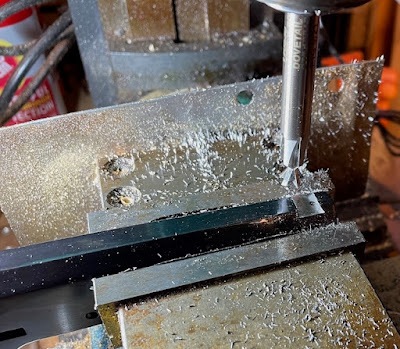
This afternoon I went out to the shop and made a couple drifts from some square brass stock, for use with Colt-style percussion revolvers and also rifles on which the barrel is held on with a key or keys.


Naturally, I could have made these with a file but a milling machine, even a small one like my Grizzly G8689 makes it a lot easier. Don't ever let anyone tell you the table top machines are useless.


Pietta 1860 Army Sheriff Range Report, and Two Useful Accessories

Last night I took a new Pietta 1860 Army Sheriff's Model percussion revolver to the range. Overall, I am quite pleased with the gun. Timing and lockup are tight, wood-to-metal fit is excellent, and overall it's a fine looking and shooting piece.

The session was not without it's difficulties, however. A couple years ago I'd made up 50 paper cartridges loaded with a Hornady .454 ball on top of 25 grains of 3Fg Hodgdon Triple 7 black powder substitute, and had half of them left. The T7 came from a bottle that I bought several years ago. I've read that once you break the seal it begins to deteriorate, but up until now I haven't noticed any problems with it.

I loaded the first cylinder with the paper cartridges and I could only get two to go off, even with recapping. So, I pulled the cylinder out, removed the cones on the unfired chambers, and put about three grains of black powder in each using the flintlock pan primer I keep in my BP revolver shooting box in case I dry ball.

Previously, none of the paper cartridges I've made have had ignition problems, no matter if they were loaded with Triple 7 or black powder.

After reassembling the gun and recapping the chambers, all of them went off.

I have 19 of those cartridges left along with a flask full of the remaining Triple 7. The next time I shoot the gun I'll try them with a black powder initiator charge in the bottom of the chambers. I hate to waste powder.

After I switched over to loose ball and Scheutzen 3Fg black powder and a felt wad lubed with pure neatsfoot oil, the gun gave me no more issues. I fired 5 or 6 cylinders full, with all my shots going into one hole at 7 yards. Elevation was dead on but I was shooting a little to the right, which was probably me pushing the trigger a little.

The cylinder arbor was lubed with Lucas white lithium grease. I've found this to be an excellent lubricant for that purpose. After 30 to 36 shots the cylinder was still turning freely.

The other accessory worth mentioning was a slip-on handle for the loading lever that I made from a short section of PVC pipe a little longer than the lever. The short levers on the "sherriff's model" percussion revolvers make seating the required oversized ball somewhat difficult. The short section of PVC made it a lot easier.


Like my 1851 Navy Sheriff, the 1860 Army Sheriff is a fantasy gun. Colt never made such a piece although it's possible that guns could have been so modified by users or gunsmiths. Porter Rockwell, the Mormon Avenger was known to carry a Colt cut down to snubbie length with the loading lever removed and a new front sight fitted.

Regardless of whether short percussion revolvers are historically correct, they are fun to shoot and easier to carry afield than their full length cousins.

Sunday, April 30, 2023

Installing a New Front Sight on a Pietta 1851 Navy

Several years ago I bought a Pietta 1851 Navy Sheriff's Model .44 caliber percussion revolver. It's strictly a fantasy gun in that Colt never made an 1851 Navy with this short a barrel, nor did they make them in .44. All real Colt Navy revolvers are .36s, with the exception of a very few experimental .40 caliber guns. Regardless, it's a fun little gun but severely handicapped by the factory front sight, which is a miniscule brass cone that's both hard to see and too short, resulting in the gun shooting very high at pistol ranges.

So today, I fixed that by cutting a dovetail in the barrel and installing a taller blade front sight that I'll be able to actually see and also can file to zero the piece.

Here's what the factory front sight looked like, along with the rifle front sight I modified to use:


I have a Grizzly G8689 mini mill. I first used it with a 1/8" end mill to cut the old sight flush with the barrel. Then I cut a slot a bit less than the width of the top of the front sight base. I cut the slot 0.07" deep to match the thickness of the front sight. (The mill has digital readouts fitted to allow me to make precise cuts.)


Then I used a 3/8" dovetail end mill to turn it into a dovetail. You can see the factory hole for the original front sight in the dovetail.


Using a couple files and trial and error, I fit the new sight to the barrel.


I left it extra tall so that I can use a file to raise the point of impact to the point of aim. I'll probably zero it with a load of a .454 ball on top of 30 grains of 3Fg black powder. After it's zeroed I will shape the front of the blade and cold blue it.

Aside from the front sight I plan to slightly enlarge the rear sight notch in the hammer nose, and replace the factory nipples with Tresos that have small flash holes for less blow back and cap fragmenting. An accessory I plan to make is an extension to slip over the loading rod for better leverage. That's not needed on the full length guns but this will benefit from that. Those without machine tools can purchase one from Slix Shot.


Tuesday, April 18, 2023

Update on Percussion Cap Availability

Here's a video update on the availability of percussion caps, from the NRA convention.


Key points:

  • Per Ethan, CCI produces caps in seasonal runs. Next run is in June, reaching shelves in July/August.
  • No real updates on Remington or RWS caps.

My $0.02 is that I recommended stocking up after they become available this summer.


Friday, September 02, 2022

Replaced the Hand in my Rogers and Spencer Percussion Revolver

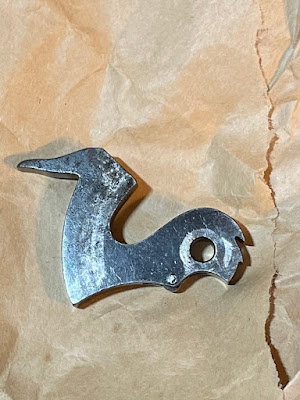
When I last shot my Euroarms of America Rogers and Spencer revolver I managed to chip the tip off the hand, rendering the gun useless. Since EOA has been out of business for several years sourcing a replacement could be challenging. The only website I found that even listed a replacement was S&S Firearms, but they were out of stock. Dixie Gun Works still has a couple R&S spare parts but no hands.


The revolver in question:


Broken hand on the left:


A friend of mine has a TIG welder. I'm going to ask him if he'd try to build up the broken hand after which I'd dress it to shape.

After I bought the gun a number of years ago, I put together a spare parts kit which included a hand. I installed it today, but first I made a detailed drawing of it in case it ever needs to be replicated. 


With a different view of the hand:


I'm sharing these for the benefit of my fellow Rogers and Spencer fans. The drawing of the hand was done by tracing around it. Quarter provided for scale.

Perhaps I was lucky but it required no fitting. The cylinder rotates and locks up nicely. I took it to the range this afternoon and put 30 - 36 shots through it. The gun worked perfectly.

As an aside, detail stripping and reassembly was made with the help of these two videos:


This is how firearms disassembly and reassembly should be done. 


Sunday, August 28, 2022

Crappy Uberti Screws Strike Again

A good part of my gun collection was made by Uberti. However, a pet peeve of mine is that the scews they use to build their guns are apparently made from cheese. For the price of these guns it's reasonable to expect that the screws will be hardened, not cross threaded, and not over-torqued, as they often are.

Today I detail stripped my 1992-vintage Uberti 1851 Navy. It was working fine but filthy inside and in need of a thorough cleaning.

One of the things I found was that the screw that holds the bolt/trigger spring in place was cross threaded at the factory. I lucked out and had an 8-32 tap so I was able to chase the threads in the frame, but I don't have an 8-32 die. (I ordered one from Amazon after discovering this.) However, the screw itself is trashed and even if I had the die I don't know if I'd be able to restore it.

So, I went to VTI Gun Parts and sent them emails to check stock on their set of properly hardened replacement screws, and also a spare hand spring while I was at it. (For whatever reason their website doesn't report live inventory.)

One of the other weaknesses of the Italian replicas is the spring for the bolt and trigger. It's flat steel and prone to breaking. I haven't broken one myself but prevention is good, so I went over to Wolff Gun Springs and ordered wire replacements for my Uberti and Pietta single actions. I'm told that Piettas use the springs for EMF Hartford guns, so I ordered 4 of those along with three Uberti replacements.

<grumble, grumble>


New Hammer for the Marlin 1889

In November of 2020 I bought a Marlin 1889 sporting rifle chambered for .38 WCF (AKA .38-40). The Marlin 1889 was the first side-ejecting lever action, leading to the rifles that Marlin has built ever since. When I got it I discovered that the half cock notch on the hammer was chipped. It held OK at full cock but when placed in half cock, as you'd use it when hunting, the hammer could be pushed off. This was obviously no bueno.

At the time I bought it I was unable to find a replacement. This is a hazard of collecting old guns that have been out of production for decades, or in the case of the 1889, over a century.


Actually, the full cock notch doesn't look so good, either.

At the beginning of July I did an Internet search on a lark and found that Old Arms of Idaho had a few in stock, and I decided to take a chance.


It worked out splendidly, dropping in with no fitting required.

A few days later I took the rifle to the range.


I shot the rifle with my black powder handloads in Starline brass. One oddity of guns chambered for .38 WCF is that the chamber dimensions and cartridge dimensions allow for a lot of case expansion. The British military had a similar situation with the chambers on their Lee-Enfields and .303 British ammunition. The result is that if you full length resize the brass for reloading, it work hardens the brass leading to short case life. To wit:


The good thing is that I didn't know the case split in half until after I tried to eject it and got out only half. The bad thing is that I noticed several other cases had splits and needed to be trashed.

Since I have two rifles in .38 WCF I am now sorting my cases by rifle and will adjust my sizing die to only neck size the brass. This is a hassle, especially given the current scarcity of .38 WCF brass. Unless I run across something I really want at a price I can't pass up, I won't be buying any more guns in this caliber because of the hassle.

Friday, July 08, 2022

Rossi 92 Back Together

A week ago I posted about the Rossi 92 .357 carbine I bought about 10 years ago. The reduced power hammer and ejector springs and new rear sight that I ordered from Steve's Gunz arrived today.

Before reassembling the gun I deburred the parts and applied a little white lithium grease to the wear points. I'll say this one went back together a lot easier than my Interarms 65 did last year. That rifle required another set of hands to get back in one piece.

A .357 functioning dummy helped keep the ejector in place during reassembly. Highly recommended if you have an 1892-type rifle. I function checked the rifle with a few of the dummies and ejection is positive but not as violent as it was originally.

Overall, the action works much more smoothly with less effort than it did before.

I also replaced the factory semi-buckhorn rear sight with a flat top sight made by Marble's. It has an insert that you can flip so that it has either a U- or V-shaped notch. It came with the U in place. I may take a file to it to make it a little larger, which will help in low light and make it faster to use.


Hopefully I'll get to shoot the rifle on Sunday to verify it works properly with live ammunition.

Sizing and Lubing Some Bullets

Recently I picked up 500 215 grain RNFP bullets from Matt's Bullets to be loaded into .44-40 cartridges. Matt uses Carnauba Red lube, which works great with smokeless powder. However, it's not compatible with black powder. So, I specially ordered this batch of bullets as-cast. I.e., unsized and unlubed.

My home cast bullets were lubed using a 50/50 mix of beeswax and mutton tallow. This is a great BP lube. However, my brother offered me the use of his RCBS Lub-A-Matic sizer and tossed in a couple sticks of SPG, a commercial BP lube.


As pictured, the sizer is attached to a Lyman universal heating unit but that's not plugged in. I'm just using the heater as a mount that can be clamped to my workbench.

The bullets from Matt's are similar to those I cast in the Accurate Molds 43-215C but with a slightly shorter ogive and the groove doesn't hold quite as much lubricant. However, it should hold enough, especially for my .44 Henry-equivalent loads (~28 grains of BP instead of 35 grains), or for shooting from revolvers. Rifles with barrels over 20" need more lube to prevent the bore from developing a hard fouling ring in the bore near the muzzle. It's less of an issue with carbines or revolvers.

Compared with my home mix, SPG is a lot softer. I was working out in my shop with the temperature in the uppers 80s and using SPG was messier than I expected.

BTW, I've placed several orders with Matt's Bullets over the past few years.. He's a pleasure to work with who delivers a top quality product. Unlike most commercial casters he doesn't make his bullets from hard alloy. Rather, he chooses alloys suitable for a particular bullet's application, which often is relatively soft. This often results in less leading because the bullets better fit the bore and so don't experience gas cutting.

Friday, July 01, 2022

Revisiting my Rossi 92 .357 Magnum Lever Action Carbine

Back in 2012 I bought a Rossi 92 carbine with a 20" barrel chambered for .357 Magnum. A few years ago my daughter expressed an interest in deer hunting so I set it up with a Bushnell TRS-25 mounted on an NOE Bullets scout rail. Since giving hunting a couple tries my daughter lost interest, so I am revisiting the Rossi's configuration.

Although functional, the rail mounted red dot spoiled the clean lines of the rifle. Also, I wasn't satisfied with the bolt mounted peep that replaced the firing pin blocking safety. It wasn't really solid, IMO. So, I've decided to go back to open irons.

This week I finally got around to installing quick detach sling studs, made by GrovTec. I had a lace-on sling intended for muzzleloaders on the rifle but it wasn't ideal. For one thing if it got wet it was a pain to remove so the buttplate and stock could dry. For a sling I got the same Hunter Company 220-1 carrying strap. Aesthetically, it looks like a simplified USGI M1907 sling, which goes nicely with a traditional levergun. I also have one each on my Interarms 65 (Rossi 92) .44-40 and my Cabela's Hawken .50 percussion muzzleloader.

I swapped out the peep for the safety delete plug I put in the rifle shortly after I bought it. While I can see the utility of the safety when unloading the rifle it's too easy to actuate. I also put the original rear sight back on the barrel.

However, the OEM rear sight is a buckhorn that blocks a lot of the target. So, tonight I put in an order with Steve's Gunz for a flat top rear sight, along with reduced power hammer and ejector springs.

The Interarms 64 has the reduced power springs and they really help slick up the action. The lighter hammer spring still ignites even hard CCI primers, and the lighter ejector spring makes the bolt easier to close and keeps the gun from sending empties into orbit. Ejected cases land near your feet, making it a lot easier to recover the brass for reloading.

While I'm waiting for the parts I have the rifle disassembled on my bench. I'll slick up the innards but making sure there aren't any burs and polishing contact points.

Incidentally, a good friend picked up a new stainless 20" Rossi 92 in .357. This is one of the guns made in the new factory and I am extremely impressed. Right out of the box it was very smooth and the external finish was excellent, with good wood to metal fit. He's an engineer and a tinkerer, so he took it down to do an action job and replace the ejector spring. Unlike the older Rossis, he said that this resulted in minimal improvement. It appears that with their new factory, Rossi has really upped their game.
Aside from recreational shooting, my friend lives on property in one of PA's special regulations areas for hunting. This was formerly a muzzleloader, shotgun, or archery only area. However, the PA Game Commission is now allowing the use of straight walled cartridges, so he's planning to use it for deer. 35 yards would be a long shot on his land so a .357 carbine is just about perfect. If I can get out there during the appropriate season I'll probably be carrying my .357.