Showing posts with label black powder guns shooting. Show all posts

Monday, September 14, 2026

More Load Development with the Pedersoli Mississippi Rifle

Today I got the Pedersoli Mississippi Rifle back to the range and tried a few different loads. All groups were 5 shots, fired at 50 yards from a bench rest, using 70 grains of Goex FFg black powder.

I first tried pre-patched .526 ball with tied-on .010 patches lubed with October Country's Bumbling Bear Grease. These were intended to copy the balls loaded in cartridges for the US Army back in the 19th Century.


I loaded these with the "tail" facing up. Even though I used a thinner patch than during my first range trip, I needed to use my short starter.

Unfortunately they didn't work for me. While easy to load for up to 5 shots, accuracy was terrible. Based on the target it looked like at least one impacted the target with the patch still wrapped around the ball, but with the "tail" off-center.

The bullseye is 5.5" in diameter.


I recovered one of these patches, about 25 - 30 yards downrange, which is much further that untied patches travel.


I may try pre-patched balls again but use thread instead of hemp twine, to increase the chance the patches separate from the balls.

My second target was .526 balls in a .010 patch but seated normally. Accuracy was better although not great.

My final target was .520 balls in .018 patch. These seated very easily but still required the short starter, and the accuracy was on par with .526 + .010 combination.


For my last 2 shots of the day I loaded .520 balls in .018 patches and shot them offhand at an ~18" steel gong, both of which were hits.

Load development will continue.

Wednesday, September 09, 2026

Pedersoli Mississippi Rifle

One rifle I've always liked is the US M1841 "Mississippi" Rifle. It's one if the handsomest US martial firearms and saw service in the Mexican War, on the frontier, and in the American Civil War.

During the 1840s and 1850s, the US government sold many M1841 rifles to pioneers heading west. It was a robust, powerful, and reliable rifle well suited for frontier service.

I ordered a Pedersoli replica in .54 caliber from Dixie Gun Works on Sunday and received it this morning. (I splurged for UPS next day shipping to minimize the chance of shenanigans during transit.)

The .54 caliber barrel is 33" long with a 1:48 rifling twist, with 7 grooves. According to Dixie the grooves are .006" deep. On my bathroom scale it weighs 9.3 lbs.

Dixie packaged the rifle nicely. Upon receipt I had to run a bunch of patches down the bore to remove whatever preservative crud Pedersoli applied. I also removed the lock for inspection, and hosed it out with oil, then blew out the excess with compressed air.

A close inspection didn't reveal any flaws, except that the rear sight was not centered. I used a Wyoming Sight Drifter tool to push it over to the left before my first range trip.

From what I've read and seen in videos on the "capandball" YouTube channel, the original service load was a patched .525" ball over 75 grains of "rifle" powder, i.e., FFFg. I decided to start with a slightly larger .526" ball over 80 grains of Goex FFg, with a 0.018" patch and Hoppe's No.9 Plus for lube.


In my gun this is a fairly tight combination. Shooting at an 8" bull from the bench at 50 yards my group was a couple inches high and right, with most of my shots in a 2" to 3" group. I'm sure with some load development and practice I'll be able to shrink this.


Pedersoli actually recommends a patched .530" ball, which would've required a mallet to start.

I was able to get my second group centered with a couple more whacks on the rear side with the Wyoming Sight Drifter.

My final two shots of the day were taken offhand at a ~16" steel plate, offhand at 50 yards, getting two hits. The big .526" ball makes a satisfying CLANG when it connects.

Ignition was provided by Scheutzen musket caps, which are very hot. I shoot left handed so my support (right) hand was unpleasantly splattered. I also have a 1984-vintage Euroarms Zouave which did the same thing, so I changed the nipple to one that takes No.11 caps.

After I got home I put in an order with Track of the Wolf for some .520" balls, .010" and .015" patching, and a nipple to take No.11 caps.

I'm also waiting for a package from S&S Firearms with a Mississippi Rifle shooting pouch and sling. That should arrive tomorrow.

Now that I have some hands-on with it I can see why the Mississippi Rifle was popular with troops, and also among civilians on the mid-19th Century frontier.

Thursday, June 25, 2026

Load Development for my Caywood Northwest Trade Gun

A few years ago I bought this 20 gauge flintlock Caywood Northwest Trade Gun smoothbore. Because I want this primarily for shooting ball and don't care about NMLRA trade gun match rules, I dovetailed a rear sight into the barrel. (A lot of originals had them added, so it's historically correct anyway.)


Today I took it to my club with the intention of finding an accurate load that is powerful enough for deer hunting. It didn't take long, shooting at 50 yards from the bench.

My first target was using a .600" ball, .010" patch lubed with October Country Bumbing Bear Grease, 80 grains of Scheutzen FFg black powder. It's certainly minute-of-whitetail.


I then shot a group with .015" patches and couldn't believe my eyes. It put three shots into about 2", from a smoothbore. When I viewed it through my spotting scope I was wondering where 2 of the shots went because I was not expecting such a small group from what's basically a shotgun. I had to walk downrange to confirm it. (Luckily, I had the place to myself today.)


After this I used a Wyoming Sight Drifter* to move the rear sight over, and also took a finer bead with the front sight buried in the rear notch to drop the POI. After moving the rear sight I repeated the small group 2 or 3 more times.

My point of aim on both of the targets was at 6:00 to ensure I got as precise a sight picture as possible.

I made this gun holder several years ago for when I'm doing small home gunsmithing jobs. I brought it along today because it makes sight drifting or filing at the range a lot easier.


I'm very close to having this dialed in for deer out to 50 yards. I need to get some more offhand practice in but I'm looking forward to carrying it in the Fall.


* If you shoot a muzzleloader or lever action rifle with traditional drift-adjustable sights, buy a Wyoming Sight Drifter. It's been worth every penny, IMHO.

Friday, January 09, 2026

Some .38 Special Chronograph Results

Today I took several .38 handloads up to the range, along with my Ruger 50th Anniversary Blackhawk chambered for .357 Magnum, and my S&W Model 15-3 Combat Masterpiece, chambered for .38 Special. Here are the results:

All strings below are 10 shots.

From a Ruger 50th Anniversary Blackhawk .357 with 4-5/8" barrel:

.38 Special
21 grains Swiss 3Fg black powder
Missouri Bullet Company 158 grain LRNFP with BP lube
Mixed brass
Servicios Aventuras primers

MV 845.5 FPS
250.9 Ft-lbs.
ES 61
Max 881 FPS
Min 820 FPS
SD 16.7

.38 Special
21 grains Schuetzen 3Fg black powder
Missouri Bullet Company 158 grain LRNFP with BP lube
Mixed brass
Servicios Aventuras primers

MV 655.9 FPS (Weak sauce)
151.2 Ft-lbs.
ES 94.7
Max 712.9 FPS
Min 618.2 FPS
SD 27.8

From a Smith & Wesson Model 15-3 Combat Masterpiece with a 4" barrel:

.38 Special
Lee TL158-SWC, 158 grains
4.7 grains of Unique
Mixed brass
Servicios Aventuras primers

MV 842.5 FPS
249.8 Ft-lbs.
ES 162
Max 906.1 FPS
Min 744.1 (WTF?)
SD 47.8

.38 Special
Lee TL158-SWC, 158 grains
4.4 grains BE-86
Mixed brass
Servicios Aventuras primers

821.1 FPS
236.6 Ft.-lbs.
ES 42.8
Max 842.8
Min 800
SD 14


The BP load with Swiss would be decent for defense. This is probably comparable to the original black powder .38 Special round in muzzle velocity, with the same weight bullte. In contrast the Schuetzen load is so slow it performs closer to the weaker .38 Smith & Wesson round.

I crunched the numbers on the Unique load after dropping the low shot. It gave an average muzzle velocity of  853.5 FPS for 256 Ft.-lbs. of energy. Bumped up to 5.0 grains it averages 925.4 FPS and 301.2 Ft.lbs. of energy. That's a very solid woods or defense load.

The load with BE-86 exceeds most standard pressure 158 grain .38 Special loads in performance. Not bad at all. With a couple extra tenths of a grain it could probably exceed 900 FPS and give .38 +P levels of performance.

Monday, November 03, 2025

Removing a Stuck Ball in a Muzzleloader

If you shoot a muzzleloader long enough at some point you'll "dry ball," i.e., load the ball without a powder charge. At that point you'll need to remove it.

Note that the following applies to traditional muzzleloaders, not inlines with easily removable breech plugs.

Some guns allow you to remove the nipple or flash hole liner and dribble in a little bit of fine grained powder, then shoot the ball out. E.g., if you do this in a percussion revolver it's pretty straightforward to remove the cylinder, remove the nipple, dribble in a small amount of powder, reassemble, cap and shoot the ball out.

However, many times you can't easily get enough powder behind the ball to bloop it out.

One option is a CO2 ball discharger. This uses CO2 from a cylinder to shoot out the ball using gas pressure. Many guys like these to unload a gun after hunting if they haven't fired it.

Otherwise, you need to pull the ball, for which you need a stout range rod or ramrod and a ball screw.

I've setup my rifles with Delrin ramrods that have threaded brass tips on both ends. The tips are both glued and cross-pinned to the rod so they don't pull off. (They will eventually come off if you don't cross-pin them.)

When I'm hunting or shooting a woods walk with a muzzleloader, I keep a small leather bag in my shooting pouch that contains a few items to keep my rifle running in the field:


L to R are:

  • Nipple wrench
  • Ball screw
  • Patch pulling worm
  • 8-32 male to 10-32 female thread adapter
  • Cleaning jag
  • Replica US M-1817 tow worm

Note how the ball screw has a brass collar around it. It's just smaller than the bore and serves to keep it centered as you screw it into the ball. 

The corkscrew-type worm is for pulling patches from the bore if one slips off a jag. The M-1817 worm will do that, but can also be used to scrub the bore with tow fiber wrapped around it like a primitive bore brush.

I've made up similar sets for .45, .50, .54, and .58. I may omit the thread adapter and don't usually carry both types of worm. 

You can get most if not all those accessories from Track of the Wolf, Dixie Gun Works, October Country, Crazy Crow Trading Post, Muzzle-loaders.com, The Possible Shop, or even Amazon.

Along with the bag of ramrod tips I also carry an aluminum T-handle from Track of the Wolf in my bag. This screws onto the other end of the rod and gives you something to grab onto.


To pull a ball here's how I do it:

  1. If the bore is fouled run a damp patch down it to remove most of the crud, then run an oiled patch down to lube the patched ball on the way out.

  2. Screw the T-handle and ball screw onto the rod.

  3. Optionally, put a small drop of oil or smear some bullet lube onto the tip of the ball screw to make it easier to screw into the lead ball.

  4. Put the ramrod down the barrel and using some pressure, drill into the stuck ball with the ball screw. You'll want to ensure you have good engagement but don't overdo it and strip it out

    Note: Once you start drilling the screw into the ball never turn the ramrod counter-clockwise because the ball screw will come off the end of your ramrod.

  5. Give the ramrod a sharp tug to get it started. If necessary, invert the rifle and hold the T-handle between your feet then give the rifle a sharp upwards tug. This usually gets it moving.

If the ball is really stuck, tie the T-handle to a tree or other immovable object and then yank on the rifle.

If the ball screw strips out of the ball you can retry it but at that point you may need to resort to a CO2 discharger or in a worst case scenario, unbreech the barrel. This is known as a bad day.

If you pull the ball from an unused hunting charge you may be able to dump some of the powder immediately, but you may need to break it up with the ball screw and/or worm first, because it'll be compacted in the breech.

Knowing how to pull a ball is an important skill for muzzleloader shooters. Aside from dry balls, you may want to pull a ball after an unsuccessful hunt rather than shooting it out and fouling your gun.

And yes, you can shoot a ball that you've pulled. It's basically a hollowpoint now if you load it with the hole facing up. AAMOF, yesterday I fired a ball I pulled after the Pennsylvania early muzzleloader deer season. I shot it at the Boyertown fun shoot and whacked a gong out at about 70 yards with it.

Sunday, November 02, 2025

Found the Real Problem with my .54 Caplock

I shot my Investarm .54 Hawken again today at the Boyertown fun shoot and it turns out that I wasn't having cap problems at all. Rather, it was that the fly in my lock was not working properly and on many of the drops wasn't allowing the hammer to fall past the half cock notch if the trigger was set before firing. I pulled the lock, made sure the fly was moving freely and lubed it with a couple of drops of Ballistol. After I did that I had no more ignition problems.

Tomorrow I'm going to remove the lock and blast it out with brake cleaner, then relube with Shooters Choice FP-10. Unlike Ballistol, FP-10 doesn't gum up and is good down to -40F, which is 50 degrees colder than I ever plan to be out shooting or hunting.

I plan to do that with my other sidelocks as well.

Note:

Sidelocks meant for use on muzzleloading rifles or pistols with set triggers have a part called a "fly." It is a small, pivoting piece that when working correctly, prevents the half cock notch from catching on the sear. A fly is not needed on a lock used with a gun that doesn't have a set trigger, because of how the set trigger kicks the sear when the gun is fired.

Sunday, October 19, 2025

Glad I Shot a Woodswalk Today

I shot the Boulder Valley woods walk course today with my .54 caplock and I'm really glad I did. I opened a new batch of CCI #11s and half of them were really snug on the nipple. About half my shots required multiple strikes to set off the cap. I even tried changing the nipple (I keep a spare in the cap box) but it was about as bad.

On the last target I hit the cap 4 times and it didn't go off. I replaced it and that one went off.


The rifle is a Cabela's (Investarm) Hawken that was originally a .50. I took a huge doe with it three years ago but even though the shot was good and did a massive amount of damage to both lungs, there was no exit wound and the blood trail was poor. So, last year I bought a replacement barrel in .54 in the hopes that the heavier ball will be more likely to completely pass through the deer and give a better blood trail if it runs.

After I got home I chucked both nipples in my drill and filed them down to accept RWS No.1075+ caps. I want to make sure I'm using known-good caps when I go hunting later this week. It's Pennsylvania's early muzzleloader, antlerless-only season.

My loads today were a .530 home cast ball in a pillow ticking patch lubed with Mr. Flintlock, over 70 grains of 2Fg Goex black powder. My hunting load for the rifle is 80 grains of powder but I wanted to save the steel targets a little wear and tear.

Anyway, even with the cap frustrations I shot an 18/20, one better than the match last weekend in which I took first place. (I shot my Slotter rifle replica in the match, as usual.)

Wednesday, October 01, 2025

Casting Sessions

Today I did some bullet casting. The temp was around 70F so I was able to do so out in my shop without sweating like a pig.


I cast up a bunch of .530" round balls for use in my .54 caliber rifles, and a few Lee 578-478M Minie balls to try in my Zouave. I'd forgotten about the Minie ball mould. I think I picked it up used last year at Dixon's.


After I culled the bad ones, I wound up with 106 of the .530 balls and 16 of the Minies.

The Minie mould is a little challenging to cast with. I think it would work better if Lee had used larger blocks to retain the heat better once it's up to temp.

The Lee round ball mould works fine, although I wish it was a 6 cavity instead of the 2 cavity mould I have. In my experience, the 6 bangers maintain temp better and you can cast a large quantity of bullets in a relatively short time.

Zouave Rifle Range Report

Yesterday I shot my Euroarms Remington 1863 "Zouave" rifle with replicas of the Williams cleaner bullet and some Lyman 575213 Minie balls.


My rifle was made in 1986 and I traded into it two years ago.

The original nipple took musket caps as you'd expect on a military rifle, but I found that as a left handed shooter, my right forearm and hand got peppered with debris. That was extremely unpleasant. I put a nipple that takes No.11 caps on it, which still gives reliable ignition but without the annoying spray on my arm.

The Williams cleaner bullets I have came from Gimcrack & Bunkum, a one man shop located in Pennsylvania. They are replicas of those issued during the Civil War. Unlike the Minie balls, they have a disc on a post that's attached to the base of the bullet. The disc expands into the rifling and scrapes out the fouling. These are 487 grains and .574" in diameter. I found them to shoot to about the same point of impact as the Lyman 575213 Minies, which weigh 510 grains, when both were fired over 60 grains of 2Fg Goex. I got the Minies from Track of the Wolf.


Some of my shots showed that the base separated from the body of the bullet and impacted elsewhere on the target. At 50 yards they broke the paper but not the plastic target backer.


When I bought the Williams bullets I chose to get them pre-lubed. The gap between the bottom disc and the base of the bullet has to be lube-free for it to work properly. The Minie was lubed by me a couple years ago with something, I forget what.

Offhand accuracy with this rifle is challenging due to a heavy trigger, probably around 10 lbs. I've considered taking the Zouave out for Pennsylvania's early antlerless-only season in October. I'll be hunting from a blind and will be able to shoot from a rest. But I'll probably use just a .54 caliber Investarm Bridger Hawken which has a nice trigger and is easier to shoot well.

Aside from the conicals I brought some .562" round balls, which shoot well in the rifle. However, I forgot my short starter so I stuck with the Williams and Minie bullets.

Friday, August 29, 2025

On a Percussion Revolver Kick Again

Lately I've been on a percussion revolver kick again, and chronographing several different loads. With the Garmin Xero C1 chronograph I got last year it's very easy to measure the velocity of your loads. Among other things, this tells you the relative strength of different powders. I've put my results into a spreadsheet hosted on my Google Drive here:

https://docs.google.com/spreadsheets/d/1DUpnrvYi4rrXWYR4gLM9YhW5mkkv1WjWNZwE3c2W0sM/edit?usp=drive_link

I'll update the spreadsheet as I get more data, but as you can see, from least to most energetic are Scheutzen 3Fg, Goex 3Fg, Swiss 3Fg, and Hodgdon Triple 7 3Fg.

Incidentally, I've read in several places that Triple 7 begins to lose power once you open the bottle, due to it absorbing atmospheric moisture. If that's true then it must've really been energetic because this is from a bottle I bought at least 10 years ago. Up until a couple months ago the T7 powder had remained in the bottle with the lid screwed on tightly, inside my house with central air conditioning. A few months ago I put the remaining T7 into a powder flask, which doesn't seal nearly as well as the factory bottle.

For the most part, I use loose powder and ball, but have experimented with combustible paper cartridges. The cartridges can be handy but many modern replica revolvers have loading ports which make using them difficult, unless you grind away some excess metal.

A good compromise between the convenience of cartridges and loose powder and ball are the Quick Load tubes sold by Dixie Gun Works. I've seen them in the Dixie catalog for years (really, decades) and more recently on Blackie Thomas's YouTube channel. I finally bought a couple bags, one each for .36 and .44 caliber.

Dixie tubes: https://www.dixiegunworks.com/index/page/search?FullText=dixie+tubes

I got the target tubes. In .44 caliber the maximum charge they'll hold and securely hold a roundball is 40 grains of black powder. Likewise, Dixie lists 25 grains as the maximum charge for the .36 tubes but I found 20 grains to be the most it can hold with a .380 ball. It's possible the batch I got are shorter than older batches.


(Yeah, my workbench is a mess.)

Compared with combustible cartridges in a properly setup revolver they're a bit slower to use but they are much quicker to load at home, and also more robust. That "properly setup" part is important. While the 19th Century revolvers were setup with the proper dimensions around the loading port to accept cartridges, many modern revolvers won't without some grinding. If you don't want to modify the loading port on your gun, the Dixie tubes are a nice alternative.

The Dixie tubes should also be more water resistant than combustible cartridges.

The .36 caliber tubes will fit into an MTM flip top cartridge box for .38 Special or .357 Magnum cartridges. The .44 tubes are a little too fat to fit into the MTM .44 Mag boxes but fit well in the MTM box for .500 S&W.


Another good option for field carry of pre-measured black powder charges are flip-top centrifuge tubes. I've been using them for several years to carry reloads for my rifle during the muzzleloader deer season. Patches balls are carried in a loading block.

Sunday, July 27, 2025

Musket Capper and Powder Can Spout

Yesterday I went up to the Gunmakers Fair at Kempton and drooled over a bunch of guns I cannot currently afford. However, I did pick up a couple items that will be handy when shooting my smokepoles.


The first is a musket capper. It doesn't have any markings on it except for "ITALY" but it appears to be the same capper that Dixie Gun Works used to sell as item # NA0401. When I got my Euroarms Zouave a few years ago I wanted to get one of these but they appear to be out of production, or at least nobody is importing them into the USA.

Dixie's description on how to load the caps is incorrect. You don't remove the lid, which is riveted on. Rather there is a sliding door through which you feed the caps.


I found it at one of the vendor's tables for $20. It even had seven musket caps in it. I've removed them for storage in a test tube since the make and whether they're any good is unknown. I'll pop them on the nipple to clear it of any oil before loading, saving a few of my known-good caps.

Incidentally, you can see why musket caps are sometimes called "top hat" caps.

The capper was a bit grungy so I rubbed it down with 0000 steel wool, just enough to remove any bumpy verdigris but not the patina.

The second item is a valve to install on a powder can lid for use at the range. The spout itself is a recycled 7.62 NATO blank, mated with a brass nipple, a couple washers, and a spring loaded cap.

EDIT: I discovered that you can unscrew the top of the capper. What I thought was a rivet is actually a threaded stud. I think though that using the sliding door on the side is how you're meant to fill it.


Saturday, September 21, 2024

First Range Trip with the Rector Rifle

I took the Rector rifle to the range today.

My load was a .389 ball in a 0.018" pillow ticking patch lubed with Hoppe's No.9 BP Lube and Bore Cleaner, on top of 50 grains of Goex 3Fg. This seated easily with only thumb pressure in the muzzle. It shot several inches high at 50 yards from the bench but unfortunately did not group well. I think it's too loose a patch/ball combination.

So I decided to try a thicker patch on my 12th shot. I had some 0.020" patch material with me. I loaded it up and it was noticeably more snug. However, on this shot, the cleanout screw blew out.


The screw didn't go far, landing on the shooting bench. This obviously put an end to shooting the rifle for the day so I cleaned it up and put it away.

After getting home and inspecting the screw closely it looks like the threads stripped out. I think what happened is that was undersized and let go with the higher pressure with the tighter patch.

It looks like I can retap the hole for the cleanout screw hole to accept a 10-32 screw to get the gun back into shooting condition.

Aside from being a bit undersized, the .389 balls didn't look so great. I've had excellent results from Rush Creek balls previously but these didn't look good. I got a Lee .390 mold in and will cast up a bunch to try.

If I can't get the rifle grouping well I'll probably send the barrel to Bobby Hoyt and have it rebored to .45.

Anyway, aside from the Rector rifle I also brought my Numrich Arms H&A Heritage Model underhammer .45. I've always shot .440 balls from it since that what my dad used when he taught me to shoot with it. I decided to try .433 balls for easier loading because I want to shoot it from woods walks without using a mallet to start the balls. With the .433 balls in ticking over 50 grains of Goex 3Fg, all the holes were touching from the 50 yard bench. After I got home I ordered a Lee .433 mold.


After shooting that group I adjusted the sights so POA = POI at 50 yards.


Sunday, September 15, 2024

A Percussion Target Rifle by J.H. Rector

I picked up this original 19th Century target rifle via trade yesterday at Dixon's. The asking price was $850.


From what I've been able to determine, J.H. Rector was active in Syracuse 1845 - 1855, and later moved to Buffalo, NY with a partner. My SWAG is that it was built sometime around 1850.

The .40 caliber barrel is 29.5" long and 1" across the flats. It's held to the stock with a single key. It's rifled with 6 grooves although I haven't checked the twist rate yet. The best thing, is that it's in excellent condition. It had some surface rust in the bore which cleaned up nicely with Hoppe's No.9 and elbow grease. There's no significant pitting.It has a hooked breech, but it's not a patent breech. This is an ideal setup IMO. I borescoped it today and this is the breech face. You can see where the flash channel enters the barrel:


The barrel is marked "J.H. Rector Syracuse" with the serial number. It's also marked "Cut by E.G. Davies".

The nipple is .265" x 28 and in good shape but has a larger hole than I'd like. As it turns out Track carries this size as "oversize" nipples, so I ordered a couple.

A closeup of the lock, which is marked "A.T Russel" (only one L):


A sharp eye will see that the hammer nose is damaged, likely from corrosion. I measured its diameter and I may be able to use the neck of a .44-40 case soldered on as repair.

Very clean inside. It's fitted with a fly, although that's not strictly necessary since it doesn't have set triggers.


It holds solid at full and half cock.

The tang is drilled and tapped for a lollipop-style peep sight, which is missing. Once I figure out the thread size I'll look into making a replacement.


All the furniture is iron (tested with a magnet) except for the brass inlays on both sides of the butt.


That small crack at the heel, along with a small chip behind the tang, along with a few dents are the only stock damage.

The business end:


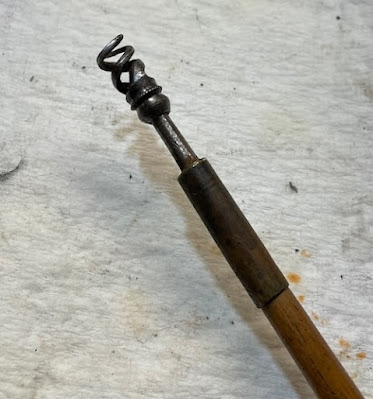
The ramrod appears to be original or a period replacement. The muzzle end is plain but the bottom is fitted with a reversible tow worm.


The gun weighs 9.1 lbs. on my bathroom scale and 46.5" long overall.

For the past few months I've been casually looking for a shootable 19th Century percussion rifle on Gunbroker and Guns International. So, when I saw this on the rack at Dixon's I found it hard to resist.

It's in fantastic shape for a gun that's potentially 175 - 180 years old. I plan to shoot it. Along with the gun I got a bag of .389" balls and have a Lee .390 mold on the way from Track of the Wolf.
Incidentally, if you search for 19th Century percussion rifles you'll find a lot of them that resemble this one. By the last few decades of the century much of the country was settled so this style was developed for target shooting, not taking large game or fighting. Many gunsmiths along the Eastern seaboard were turning out very high quality guns of this type. You can see some of them in Ned Roberts' The Muzzleloading Caplock Rifle, which is pretty much the Bible for percussion rifles.

Friday, September 13, 2024

Replica Hawksley Flask from Veteran Arms

I just received this copper Hawksley flask replica today from Veteran Arms. Shown with my Zouave or Peace flask for scale on the left. The originals were made in England in the 19th Century.


Closeup of the adjustable valve. It's marked in drams. One dram = 27.348 grains. I will leave it at the smallest setting of 2-1/2 drams and dispense into a separate powder measure, for safety's sake. If you pour the powder into the gun directly from the flask, you risk of having it go off like a bomb in front of your face if there is a spark down the bore.


A nice feature of the Hawksley-style flasks is that the entire valve assembly unscrews for filling, which is nicer than the American-style flasks that fill through the pour opening, requiring you to use a funnel and hold open the valve. I filled the new flask with some Scheutzen 2Fg. I'm not sure of the capacity, probably about a half pound, but it should hold enough for a woods walk or day of shooting at the range.

Wednesday, September 04, 2024

New .54 Caliber Barrel for my Cabela's Hawken Rifle

Two years ago I took a very large doe in Tioga County, PA with my left handed .50 Cabela's (Investarm) Hawken. The ball was loaded over 70g grains of 3Fg black powder and impacted at about 55 yards. It was a high chest cavity broadside shot with the ball impacting a few inches behind the right shoulder. It made a mess of the chest cavity but the deer ran, which is normal. What I wasn't happy with was the minimal blood trail, which was difficult to follow with the forest floor covered in leaves. A complete pass-through would've have let more blood out faster and made the blood trail easier to follow.

I thought about experimenting with conicals like a Hornady Great Plains or Lee REAL bullet, but then I saw that muzzle-loaders.com carries replacement barrels for this rifle in .54 caliber. They sell it as the Bridger Hawken. Since I like shooting patched round balls I decided to get the larger caliber barrel.

It came well packed and included a replacement tang, which I didn't use. The barrel came with sights and a nipple. The gun as it now looks:


Monday I took it to my club and zeroed the sights for 50 yards. Like my Investarm Gemmer Hawken, it likes a .530 patched ball on top of 80 grains of 2Fg Scheutzen black powder. I used CCI No.11 caps for ignition.

The first two shots were in one hole at the bottom right. After some sight adjustments I put 6 rounds into the group in the center. POA was 6:00 on the bullseye. This is an SR-1 target. The black is 8" in diameter. Of note is that the barrel doesn't seem sensitive to lube. Most of my shots were lubed with Mr. Flintlock, since that allows me to shoot many rounds without swabbing. However, I also shot some rounds lubed with Track of the Wolf's Mink Oil Tallow, which I'll use when hunting. The 6 shot group I circled was 3 shots with Mr. Flintlock and 3 with Mink Oil Tallow.


I recovered about half the patches I used. None showed signs of burnout or cuts. The edge fraying is normal for fired patches, IME.


I lost count of how many rounds I shot but it was around 25 - 30. I shot my last 5 offhand at 50 yards. By this time I was tired and the recoil was getting to me, but this would still put a deer in the freezer.


Speaking of deer, this fawn was hanging out at the range. I took this from about 100 yards with my iPhone 12 before I started shooting. He moved to another part of the property while I was shooting but I saw him nearby on my way out.


Hopefully I'll get to connect with a deer during the October anterless-only season. While I'm not expecting any deer I shoot to drop on the spot, I'm hopeful that the larger, heavier ball will create an exit wound that causes the animal to bleed out more and sooner, for a more humane kill and less tracking.

Saturday, August 10, 2024

Finally Shot the Gemmer Hawken

Back in January I got a .54 caliber flint Investarm Gemmer Hawken. It's the current version of the Lyman Great Plains Rifle that was sold for almost 50 years here in the US. I bought this rifle for a couple reasons. First, I wanted something a bit shorter than my longrifle for hunting. Second, I wanted the power of a .54. The deer we hunt up in Tioga get big and I would really like a complete pass-through to maximize blood trails. The huge doe I shot in 2022 stopped the .50 caliber ball I shot and the blood trail was very hard to follow. Bigger holes and two of them mean more blood out and air in, so hopefully blood trails will be a lot shorter.

Anyway, life got in the way and I didn't not shoot he rifle until today.


This is my first five shots, fired off the bench, from 50 yards. My point of aim was 6:00 on the top bullseye. As expected, it shot low because these rifles come with an extra tall front sight.


The lowest shot was the first, with the rest clustered into a couple inches. This is about as good as I can shoot from the bench with open iron sights, even with a cartridge gun, much less a flintlock. I'm quite happy with the group.

The load consisted of:

  • Hornady .530" round ball
  • 0.018" ticking patches lubed with October Country's Bumbling Bear Grease
  • 80 grains of Scheutzen 2Fg black powder
Ignition was perfect the whole day. As long as I got spark there were no flashes in the pan and ignition was quick. I had to reverse the agate flint that came with the gun after 5 shots, and it last another 5 after that. I then replaced it with a real flint.

To raise the point of impact I needed to shorten the front sight. The file I had with me was too fine to remove enough metal in a reasonable amount of time so after awhile I gave up on it. After I got home I took the barrel out to my shop where I had a coarser file and took some off the top of the front sight.

If you know the sight radius of your gun, the distance to the target, and how much you need to move the point of impact, you can use this formula to determine how much to move an adjustable sight or file a fixed sight:

(Sight radius / Distance to target) (POI change needed) = Adjustment needed

All units must be the same. E.g., my rifle has a sight radius of 21.125" and 50 yards = 1800 inches. I needed to remove a bit over a tenth of an inch from the front sight to bring up the point of impact.

Something I noticed is that with this powder charge, ball size, and patch/lube combination, I can load a second shot without wiping but it's tough. After I get it zeroed I'll try with a liquid lube to see if that makes it easier. But I may look into a thinner patch for reloads while hunting, or bring a jag and patches wet with rubbing alcohol in my shooting patch when hunting. 

Tomorrow I'm planning to get together with a friend for some shooting and I'm bringing the Gemmer Hawken. Hunting season is coming up soon so I want to verify the zero get some practice in.


Sunday, July 07, 2024

More Chronograph Results

Today I got some more use out of my Garmin Xero C1 chronograph. It's so easy to use I may as well chronograph all the things.

All data is for 10 shot strings. Muzzle velocity (MV) is in feet per second, with muzzle energy (ME) is in foot-pounds. The ambient temp was about 94*F and elevation above sea level is about 160 feet.

First up was a selection of 9mm from a Glock 34 with 5.3" barrel:

Wolf Polyformance 9mm 115 grain FMJ:

  • MV: 1154.5 
  • ME: 340.3

This ran about 60 FPS faster than when I shot it in my CZ P07 with a 4.36" barrel.

Sellier & Bellot 124 grain FMJ:

  • MV: 1175.7
  • ME: 380.61

Winchester M1152 115 grain FMJ-FP:

  • MV: 1358.3
  • ME: 471.05

M1152 is the relatively new US military standard issue 9mm Ball. As expected it was a lot hotter than the Wolf and S&B range ammo. I'll have to run some of this through a carbine to see how fast it goes from a 16" barrel.

Next up was some .38 Special, with a Lee TL358-158 SWC on top of 3.8 grains of HP-38. I fired these from a S&W Model 15-3 with a 4" barrel.

  • MV: 743.1 
  • ME: 193.8

This is a nice plinking and target load that's pleasant shooting in a K-Frame with Magnas and a grip adapter.

Finally, I ran some black powder .44-40s over the Garmin. These were shot in my Cimarron Model P (Colt Frontier Six Shooter replica) which has a 5.5" barrel. Both loads used a 219 grain bullet cast in an Accurate Molds 43-215C mold.

First up was a .44 Henry-equivalent load with 1.9cc (~30 grains) of pre-factory explosion Goex 3Fg, sparked by Federal No.150 large pistol primers.

  • MV: 833
  • ME: 337.68

Not bad, and not too far behind .45 ACP Ball.

Finally were some loaded with 2.2cc (~35 grains) of Scheutzen 3Fg, sparked with CCI large pistol primers.

  • MV: 756.1
  • ME: 278.27

I am very surprised at how much slower the Scheutzen loads ran. I was under the impression that it's at least as energetic as Goex, but that didn't seem to be the case with this batch.

I plan to load up some more of each of these loads but with the same primer to remove a variable, but I doubt that the results will be much different. I also need to chronograph some loads with Swiss 3Fg, of which I have a limited supply, along with a pound of some 1990s-vintage Elephant 3Fg. I'm expecting higher velocities with the Swiss and lower velocities with Elephant. 

Friday, May 24, 2024

Any day you get to go in the woods and

...make smoke, is a good day.


Today I took off from work and went up to my club and shot the woods walk course. It's getting overgrown so some of the targets were blocked by weeds but I still had a good time. The rifle was my "California Rifle," really a gun styled after rifles made by Slotter in Philadelphia for the California trade in the mid 19th Century. I bought it from Track of the Wolf in February 2023 and it's become my favorite rifle, even if the lock is on the wrong side.

I shot my normal match load of  55 grains of 3Fg Goex, a 0.018" patch lubed with Mr. Flintlock Lube, and a .490 ball. Today I used home cast balls. This combination allowed me to shoot 25 rounds without cleaning the bore and loading the last shot was as easy as the first.

Friday, January 12, 2024

Got a Lathe Spider

A couple weeks ago I ordered a spider for my 7x14 minilathe, something I should have bought years ago. Little Machine Shop had it as their weekly special so I finally pulled the trigger on it.

Link to minilathe spider: https://littlemachineshop.com/products/product_view.php?ProductID=1136

The spider threads onto the end of the spindle and provides additional support to long workpieces, to prevent them from whipping around.


To install the spider you remove the gear cover on the end of the headstock and simply thread it onto the end of the spindle.


I used it today while drilling and tapping the flared end of the factory ramrod that came with my Investarm Gemmer Hawken. Even though I bought an unbreakable Delrin rod for it from Track of the Wolf, which is threaded on both ends, I want to keep the OEM wood rod as a spare.

This shows the ramrod mounted through the spindle bore.


And here I was using the lathe as a tapping guide to keep the 10-32 tap straight. I did not do this under power. Instead, I used the chuck key as a handle and rotated the chuck manually. Power to the lathe was off when I did this.


Aside from drilling and tapping the end of the OEM ramrod to accept 10-32 accessories like cleaning jags, worms, and bullet pullers, both ends of both rods got drilled and cross-pinned. To drill the holes I used my minimill.

Always cross-pin your ramrod tips! Failing to do so can result in the ends pulling off the rod if you get a jag stuck or need to pull a ball. It's simple to do so:

  1. Drill a hole through the rod crossways. I used a #40 drill because for my pin I used some brass rod 0.098" in diameter.
  2. Chamfer both ends of the hole.
  3. Drive the rod through the hole and cut it off. I used side cutters.
  4. Using a hammer, peen over both ends on a metal surface. I used the anvil on my bench vise.
  5. File the ends of the pin smooth.
One end of the Delrin rod from Track is tapped 10-32 and the other is 8-32. I will use 10-32 jags, etc. and have an aluminum T-handle with an 8-32 stud on the end. I have qualms about using it for cleaning or ball pulling.

Just another example of how my small, tabletop machines help me out with gunsmithing tasks.

Saturday, January 06, 2024

Investarm Gemmer Hawken Rifle

With Lyman getting out of the black powder business, Muzzle-loaders.com has taken over as an importer of Investarm guns. I had a 10% off coupon from them that expired at the end of last year, so on 12/26/23  I put it towards a left handed .54 flintlock Gemmer Hawken. It arrived this past Wednesday. The Gemmer Hawken is the current incarnation of the Lyman Great Plains Rifle, which for decades has been very highly regarded for a production muzzleloader.

Back in the 1990s I had a LH flint .54 Lyman GPR but sold it off after a few years. At the time I wasn't hunting and my shooting interests were more along the lines of milsurps and S&W revolvers. I wish that I had kept it. Let's just say that the Investarm rifles made today are not as nice as those made even 10 years ago, much less my old GPR. In particular, the triggers were horrendous. Rough, difficult to set, and so heavy when unset as to be unusable. So, I ordered a Davis Deerslayer from the Log Cabin Shop and it arrived today. The Deerslayer was originally designed for use in  the T/C Hawken and Renegade, rifles but it also works in similar guns like the GPR/GH.

Installation was painless and while the instructions mention removing wood, that wasn't required. (Doing so may be required on a T/C.) The rifle now has an easy to set trigger that would be usable even when unset. Dry firing it feels like I'm holding one of my custom muzzleloaders. In my opinion the Davis triggers are worth the $80 asking price (although it shouldn't be necessary to replace the triggers on a factory rifle to get something usable).

Pic before installing the new triggers:


Yesterday I added a couple coats of clear Watco Danish Oil to the stock, which is some unspecified European hardwood that was lightly finished. Older Investarm guns, including the Cabela's Hawken I took a big doe with in 2022, had walnut stocks. I also replaced the vent liner with an RMC unit that uses an Allen wrench for removal. It's coned internally as well on the outside so it should help ignition.

The lock sparks well even with the cut agate flint that it came with. L&R now makes left handed RPL replacement flintlocks to fit the GPR/GH but I'll give the factory lock a solid workout before thinking of replacing it.

The only other modification I have planned it to put slots in the barrel keys and install pins held in by the escutcheons so they can't fall out and get lost.

I may not be able to shoot it until next weekend, due to the weather. I'm hopeful that it will shoot well with 70 - 80 grains of 3Fg and a patched .530 ball. I'm also going to try some .526 balls which should make for easier loading in the field. My reason for getting a .54 is to improve my chances of a complete pass-through on the large whitetail deer up in Tioga County, compared with the .50s I've been using.

As an aside along those lines, I'm hoping to work up a good conical load for my percussion Cabela's Hawken .50 that I can use during the early antlerless season. I have some Hornady Great Plains bullets that should shoot well in the gun and be really effective on deer.

Aside from the larger ball, the Gemmer Hawken will give me a flintlock rifle that's easier to handle inside a deer blind, since it's significantly shorter than the longrifle I toted last week.

More to follow after I shoot it ...