Showing posts with label hawken. Show all posts

Sunday, August 28, 2022

Offhand Practice with my Cabela's Hawken

Last weekend I took my Cabela's Hawken to the range for some offhand practice on both Saturday and Sunday.

The rifle was built by Investarms in Italy and is very similar to the Lyman Trade Rifle, which was also built by Ivestarms. I'd wanted a LTR for years but it was never offered in a left handed version, so I got the Cabela's rifle instead. A very similar or identical rifle is also sold by Dixie Gun Works, as well as muzzle-loaders.com.


A few years ago I replaced the factory sights with a Lyman white bead front sight and a 57 SML aperture sight. I also replaced the factory nipple with a Hot Shot. I keep the original in the cap box as a spare.
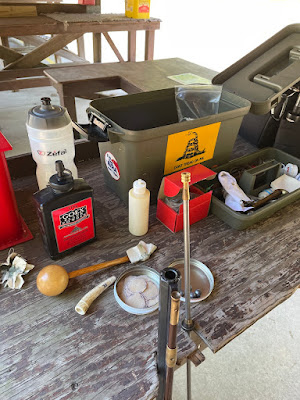


Anyway, it's a caplock .50 caliber muzzleloader. The load I shot both days was:

  • 70 grains of 3Fg Goex black powder
  • 0.020" patch lubed with Bumblin' Bear Grease from October Country
  • Hornady swaged 0.490" round ball
  • CCI No.11 percussion cap
On Saturday, I shot with the peep sight's insert in place. This gives a smaller aperture which should allow better accuracy, at the expense of light transmission.


Decent, except for that one flyer above the bull.

When I went back on Sunday I removed the sight insert and used it as a ghost ring. This is what I'd do if hunting with the rifle.


Not quite as good but still minute of deer at the ranges I'd be shooting at. My final shot of the day was at a steel gong approximately six inches square, and I got a good solid hit.


Sunday, November 03, 2019

Makin' Smoke

Today I made some smoke with my Cabela's / Investarm Hawken.


The rifle is a .50 caliber with a 1:48 twist. Last Winter, I installed a Lyman 57 SML aperture sight along with a Lyman white bead front sight. I'd shot the gun with a different, higher front sight, but not with the current sight. So, my first order of business was to zero it because with the lower front sight, it was shooting about 18" high at 50 yards.


The initial zero was with Hornady .490 round balls, 0.018" pillow ticking patches, and 80 grains of Swiss 3Fg black powder sparked by CCI No.11 caps. The patches were lubed with October Country's Bumblin Bear Grease.

I settled on a slightly different load: 70 grains of Swiss 3Fg and 0.020" patches. The 15-shot target below is actually two groups as marked by the brackets. The second, lower group is 7 shots all in the 10 ring.


I like this ball / patch / lube combination. I only swabbed after every fifth shot and the combination of the tight patch and the Bumblin Bear Grease remained easy to load. The temperature was around 50 degrees F. and the BBG remained easy to apply to the patches.

I recovered some of my fired patches, which show no signs of cutting or burning:


Another change I'd made to the rifle since the last time I shot it was to swap out the factory nipple in favor of a Hot Shot nipple, which has two small vents in the cone. The theory behind this is to allow the air contained inside the cone to escape when the flash of the cap hits it, improving ignition. My main reason for trying this was to improve first round ignition if I haven't popped a cap on the nipple to clear out the patent breech's flash channel.

I noticed that the Hot Shot nipple got a lot dirtier on its outside after multiple shots. There were a couple times when the accumulated exterior fouling prevented me from properly seating the cap, causing the cap to fail to ignite on the first hit. This would only be a problem in extended shot strings, not while  hunting.

For cleaning at the range I used moose milk made up of a Ballistol/water mix. I've found this to be very good at removing black powder fouling. In theory, if you run a few patches wet with this through the barrel and can't clean it all out, it should leave a light film of oil behind when the water evaporates.

To complete cleaning after I got home I used a flush nipple from Track of the Wolf. The Cabela's Hawken has a hooked patent breech allowing easy removal of the barrel from the stock. However, because the tang sight isn't mounted to the barrel I don't want to remove it to dunk the breech end in a bucket of water, because I don't know if it'll return to zero. The flush nipple allows you to pump water through the barrel using a piece of vinyl tube. The tube that came with it is a bit on the short side so I'll probably pick up a longer piece at a hardware store.

The blue painter's tape it hold the tube in the water.


I may get this rifle out in the woods for buck season.

Sunday, January 06, 2019

Neatsfoot Oil as a Patch Lube

My preferred lube for several years has been Track of the Wolf's Mink Oil, which is actually more of a grease. It's what I used last week when zeroing the Lyman peep sight I installed on my Cabela's Hawken.

However, I recently read on the Muzzleloading Forum and the American Longrifles Forum about using neatsfoot oil as a lube when shooting patched round balls. A couple guys reported being able to shoot all day with no swabbing between shots. Neatsfoot oil is good to have around for treating leather and it's cheap enough, so I figured it would be interesting to try.

On Thursday I took delivery of a quart of Fiebing's 100% pure neatsfoot oil from Amazon. The first thing I did with it was treat the sling on my 1860 Henry. It slightly darkened the leather and softened it noticeably.

Today I took the Hawken back to the range with 30 ticking patches pre-soaked in the neatsfoot oil.


It was in the upper 40s but not ideal for shooting round balls since it was very windy. As you can see from the target, accuracy was very meh. The wind was definitely a factor in the group, as was the varying light on my front sight.

On the other hand, I was able to load 30 shots without any swabbing. The last shot loaded as easily as the first.

On the gripping hand. there was a nasty ring of crud down in the breech that really grabbed my cleaning patch until I floated the bore with some Windex to dissolve it.

So, in conclusion, I haven't concluded if neatsfoot oil is a good patch lube in this rifle. I need to experiment with different powder charges, maybe .495 balls, and a thicker patch.


Tuesday, January 01, 2019

Zeroed the Hawken

Today I took advantage of unusually warm weather for January 1st and got the Cabela's Hawken out to the range and got it zeroed with its new sights.


It was shooting about 18" low and a little left at 50 yards with my initial load of 60 grains of 2Fg Goex, a .490 round ball, a 0.018" ticking patch lubed with Track of the Wolf's mink oil tallow, and a CCI No.11 cap.

Grouping with the 60 grain load was 3 to 4" from the bench. IOW, not very good. So, I increased the charge to 70 grains and the rifle started grouping nicely. My last three shot group is below. It's the one hole in the center.


That's 2 in the X-ring and one just outside it in the 10. I can certainly live with that. (The target is full of .22 holes from taking my daughter to the range.)

I still want to experiment with different charges, patch thicknesses, and ball size.

Monday, December 31, 2018

New Rear Sight for my Hawken

Several years ago I bought a Cabela's Traditional Hawken rifle in .50 caliber. It isn't a faithful copy of the real Hawken rifles of the 19th Century, but nevertheless, it's a well made and nice shooting gun. It's more or less a variant of the Lyman Trade Rifle, but fitted with a cap box on the stock and double set trigger. Also, unlike the Lyman, it was available with a left handed stock and lock. Both the Lyman and Cabela's rifles were made by Investarms in Italy.

One thing I did not like about the rifle was the sights. The rear sight, in particular, was a poor design. The adjustable rear notch was a wide open "V". IIRC, the Lymans's have rear sights that are dovetailed in, which makes replacement with a fixed but better sight easy. Unfortunately, the Cabela's rear sight was held on with two screws and nobody made a good replacement.

So, I decided to install a Lyman Model 66SML aperture sight, made for the Lyman Great Plains Rifle, Trade Rifle, sidelock Thompson-Centers, and similar rifles.

The Model 66SML is mounted on the tang with two screws. It uses the rear wood screw which goes through the tang into the stock, plus an 8-32 screw into the metal of the tang. The tang on my rifle wasn't drilled and tapped so I did that today.

Using a #29 drill on the tang:


Before drilling the hole, I located it by mounting the sight on the tang and marking the spot with a transfer punch. I then dismounted the tang from the rifle and used a pilot drill to ensure the #29 drill wouldn't skip. Only then did I put the twist bit in the chuck.

I then tapped the hole with 8-32 threads. I used #3 Morse taper lathe center held in the mill's head to guide the tap so it started off straight:


I used a little Tap Magic on the tap, but I could probably have done it dry with no problems. OTH, there's no reason not to use a lube and save a little wear on the tap.

A closeup of the newly mounted sight:


And finally, the whole rifle:


This rifle has a 1:48 twist, so it can shoot either patched round balls or conicals like a Hornady Great Plains Bullet or T/C Maxi balls. So far, I've just shot it with PRB and it did well.

Simple work like this is a main reason I bought a small lathe and mill back in 2013. It took me about 45 minutes to do this, which included digging out the rifle and rear sight, schlepping them out to my shop, and doing the work. In contrast, to have a gunsmith mount the sight it would require locating a 'smith locally or shipping the rifle, getting onto his wait list, and probably paying about $75 to $100. Since shooting is my hobby, I will eventually do enough jobs like this to largely offset the cost of the tools.

Of course, that doesn't even account for the satisfaction of doing it myself.