Showing posts with label lever actions. Show all posts

Saturday, January 31, 2026

Winchester 94 "Old Red"

I ordered this 1935-vintage Winchester 94 Sporting Rifle from a Gunbroker seller last Saturday and picked it up yesterday, along with a couple boxes of Remington .30-30 170 grain JSP ammo. To pay for it, I put a couple of other guns that were gathering dust on consignment.


It's drilled and tapped to accept a tang sight, one of which I may add.


Overall it's in excellent shape for a 91 year old rifle. The bore is excellent with sharp rifling, no pits, and a good crown. It was very clean. After I hosed out the old congealed oil the action works smoothly. The wood is sound and except for nine decades of dings the original varnish is in very good condition.

It should be a fine shooter and I plan to take it into the woods after whitetail next Fall.

There are 6 notches cut into the bottom of the stock (disclosed in the GB listing). The left side of the butt bears the initials, "RED," so I've named the rifle "Old Red."


Along with the rifle I bought two boxes of Remington .30-30 170 grain Core Lokt JSPs. I have reloading dies, a pound of IMR-3031, a brick of large rifle primers, a box of Hornady Interlock 170 grain JSP bullets, and 250 pieces of Starline brass on the way. I also have fifty 178 grain .310" bullets hand cast from Lyman No.2 alloy on the way from MOD Outfitters that I'm looking forward to loading for the old Winchester.

Today I slugged the bore by driving a .32 caliber bullet through it which allowed me to measure groove diameter. 


The rule of thumb for choosing the diameter of cast bullets for a rifle is to use those that are .001" to .002" over groove diameter. I'll load a few dummies with the .310" bullet to check functioning with, and also to verify that they chamber OK. Assuming all's good there I'll load up small batches of 10 with a couple different powders.


Sunday, August 28, 2022

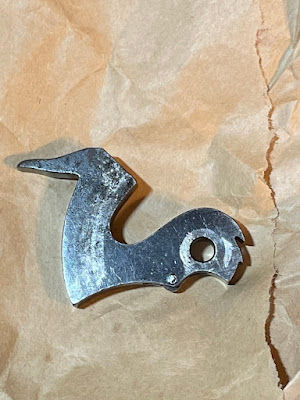
New Hammer for the Marlin 1889

In November of 2020 I bought a Marlin 1889 sporting rifle chambered for .38 WCF (AKA .38-40). The Marlin 1889 was the first side-ejecting lever action, leading to the rifles that Marlin has built ever since. When I got it I discovered that the half cock notch on the hammer was chipped. It held OK at full cock but when placed in half cock, as you'd use it when hunting, the hammer could be pushed off. This was obviously no bueno.

At the time I bought it I was unable to find a replacement. This is a hazard of collecting old guns that have been out of production for decades, or in the case of the 1889, over a century.


Actually, the full cock notch doesn't look so good, either.

At the beginning of July I did an Internet search on a lark and found that Old Arms of Idaho had a few in stock, and I decided to take a chance.


It worked out splendidly, dropping in with no fitting required.

A few days later I took the rifle to the range.


I shot the rifle with my black powder handloads in Starline brass. One oddity of guns chambered for .38 WCF is that the chamber dimensions and cartridge dimensions allow for a lot of case expansion. The British military had a similar situation with the chambers on their Lee-Enfields and .303 British ammunition. The result is that if you full length resize the brass for reloading, it work hardens the brass leading to short case life. To wit:


The good thing is that I didn't know the case split in half until after I tried to eject it and got out only half. The bad thing is that I noticed several other cases had splits and needed to be trashed.

Since I have two rifles in .38 WCF I am now sorting my cases by rifle and will adjust my sizing die to only neck size the brass. This is a hassle, especially given the current scarcity of .38 WCF brass. Unless I run across something I really want at a price I can't pass up, I won't be buying any more guns in this caliber because of the hassle.

Friday, July 08, 2022

Rossi 92 Back Together

A week ago I posted about the Rossi 92 .357 carbine I bought about 10 years ago. The reduced power hammer and ejector springs and new rear sight that I ordered from Steve's Gunz arrived today.

Before reassembling the gun I deburred the parts and applied a little white lithium grease to the wear points. I'll say this one went back together a lot easier than my Interarms 65 did last year. That rifle required another set of hands to get back in one piece.

A .357 functioning dummy helped keep the ejector in place during reassembly. Highly recommended if you have an 1892-type rifle. I function checked the rifle with a few of the dummies and ejection is positive but not as violent as it was originally.

Overall, the action works much more smoothly with less effort than it did before.

I also replaced the factory semi-buckhorn rear sight with a flat top sight made by Marble's. It has an insert that you can flip so that it has either a U- or V-shaped notch. It came with the U in place. I may take a file to it to make it a little larger, which will help in low light and make it faster to use.


Hopefully I'll get to shoot the rifle on Sunday to verify it works properly with live ammunition.

Friday, July 01, 2022

Revisiting my Rossi 92 .357 Magnum Lever Action Carbine

Back in 2012 I bought a Rossi 92 carbine with a 20" barrel chambered for .357 Magnum. A few years ago my daughter expressed an interest in deer hunting so I set it up with a Bushnell TRS-25 mounted on an NOE Bullets scout rail. Since giving hunting a couple tries my daughter lost interest, so I am revisiting the Rossi's configuration.

Although functional, the rail mounted red dot spoiled the clean lines of the rifle. Also, I wasn't satisfied with the bolt mounted peep that replaced the firing pin blocking safety. It wasn't really solid, IMO. So, I've decided to go back to open irons.

This week I finally got around to installing quick detach sling studs, made by GrovTec. I had a lace-on sling intended for muzzleloaders on the rifle but it wasn't ideal. For one thing if it got wet it was a pain to remove so the buttplate and stock could dry. For a sling I got the same Hunter Company 220-1 carrying strap. Aesthetically, it looks like a simplified USGI M1907 sling, which goes nicely with a traditional levergun. I also have one each on my Interarms 65 (Rossi 92) .44-40 and my Cabela's Hawken .50 percussion muzzleloader.

I swapped out the peep for the safety delete plug I put in the rifle shortly after I bought it. While I can see the utility of the safety when unloading the rifle it's too easy to actuate. I also put the original rear sight back on the barrel.

However, the OEM rear sight is a buckhorn that blocks a lot of the target. So, tonight I put in an order with Steve's Gunz for a flat top rear sight, along with reduced power hammer and ejector springs.

The Interarms 64 has the reduced power springs and they really help slick up the action. The lighter hammer spring still ignites even hard CCI primers, and the lighter ejector spring makes the bolt easier to close and keeps the gun from sending empties into orbit. Ejected cases land near your feet, making it a lot easier to recover the brass for reloading.

While I'm waiting for the parts I have the rifle disassembled on my bench. I'll slick up the innards but making sure there aren't any burs and polishing contact points.

Incidentally, a good friend picked up a new stainless 20" Rossi 92 in .357. This is one of the guns made in the new factory and I am extremely impressed. Right out of the box it was very smooth and the external finish was excellent, with good wood to metal fit. He's an engineer and a tinkerer, so he took it down to do an action job and replace the ejector spring. Unlike the older Rossis, he said that this resulted in minimal improvement. It appears that with their new factory, Rossi has really upped their game.

Aside from recreational shooting, my friend lives on property in one of PA's special regulations areas for hunting. This was formerly a muzzleloader, shotgun, or archery only area. However, the PA Game Commission is now allowing the use of straight walled cartridges, so he's planning to use it for deer. 35 yards would be a long shot on his land so a .357 carbine is just about perfect. If I can get out there during the appropriate season I'll probably be carrying my .357.

Sunday, April 03, 2022

.357 Magnum / .38 Special Opinions

Over on Bushcraft USA, a member posted the following:

So, I've had this whole .357 magnum revolver idea stuck in my head about long enough now that it's kind of becoming a serious consideration.

I have no interest in concealed carry, this would be strictly a woods bumming gun.

I've owned very few handguns over the years. the two longest running are, a Contender in 7-30 Waters scoped bull barrel for about twenty years. It was fantastically accurate, but awkward to carry and shooting offhand was difficult at best. It was very barrel heavy. I traded it for a milling machine about ten years ago and as much as I enjoyed shooting it I don't miss it. It never really fit my hunting style. For deer I've always been a still hunter in very thick cover. 

I have a Ruger Bearcat .22 that it's only redeeming quality is it is light weight. I hate the fixed sights, to me that ruins the whole gun package. Also we don't have grey squirrels or cotton tails around here except in town pretty much. We can't shoot grouse with anything other than a shotgun. So snowshoe hares are the only thing to shoot with a .22.

In comes the .357.

I seem to think it would be fine for the heavy cover thick brush highly mobile style of deer hunting that I like with shots of 40 yards or less.

Loaded with .38 special it would be enough for the odd coyote or even more rare fox.

Maybe some wadcutter for small game if I wanted or just plinking and fooling around.

And realistically fooling around would probably be its primary job. 

I have most of my reloading stuff yet, so handloads are an option if I decided to go back down that rabbit hole again.

...

To which I replied:

My favorite handgun cartridge is .38 Special. It handles everything I need a pistol to do, with mild recoil, useful power, and excellent accuracy.

In my opinion, the most versatile handgun you can have is a medium frame .357 Magnum double action revolver with a 4" barrel. They a full sized guns but small enough for concealed carry with the right holster.

With the right ammo you can use them for target shooting, hunting game up to deer sized, training new shooters, and self defense.

Reloading .38 Special and .357 Magnum is relatively easy because they are straight walled, rimmed cases. Carbide sizing dies eliminate the need to lubricate cases. They are usable with a wide variety of powders (even black powder, since the .38 was originally designed for it). There is a huge variety of bullets available in cast, swaged, plated, powder coated, and jacketed flavors.

If you're OK with limiting yourself to single actions, Ruger makes the Blackhawk Convertible that comes with .357 and a 9mm cylinders, further increasing versatility. Taurus sells the 692 double action that comes with .357 and 9mm cylinders.

Check out the articles by Ed Harris about the .38 Special (among other things) hosted at https://www.hensleygibbs.com/edharris/backcreekdiary.htm.

And of course, a .357 revolver makes a dandy companion to a lever action in the same caliber. Even full house .357s are mild to shoot in a carbine and firing .38s in a carbine is much like shooting a .22.

Monday, August 30, 2021

First Range Trip with the Interarms 65

Yesterday I got the Interarms 65 to my club for the first time  and tried a few different loads at 50 yards from the bench.

The first was a 200 grain RNFP from Desperado Cowboy Bullets on top of 8.5 grains of Unique. Accuracy was poor. I'll have to try both lighter and heavier charges to see if I can get them to group. Or, it might be that the rifle simply doesn't like the DCB bullet.


I ran a couple patches wet with Ballistol followed by a couple dry patches through the bore before proceeding.

Next up was my .44 Henry rimfire-equivalent load. This is 1.9cc of 3Fg black powder, a 1/8" thick nitro card to take up air space, and a 219 grain bullet cast from an Accurate Molds 43-15C mold. This gave pretty good accuracy. The flier was my fault.


Finally, I shot some of my full power .44 WCF: 2.2cc of 3Fg Swiss BP, no wad or card, and the same 43-215C bullet. Accuracy was on par with the Henry-equivalent load, with noticeably more smoke, noise, and recoil.

I put 30 rounds loaded with black powder through the rifle. I cleaned it before leaving the range using patches wet with a Ballistol/water mix (mostly water). The 5th patch came out clean. Because .44 WCF brass seals the chamber so well, no fouling got back into the action.

Between working the action at home and shooting it, plus the internal work we did, the action is slicking up nicely.

I might have to take this into the woods this Fall.

D4 Guns Lever Wrap Kit

Lever action rifles function best when you work the action authoritatively. Some more so than others, for example my Interarms 65 (a rebadged Rossi 92) really needs to be worked like it owes you money. That can be hard on your fingers, so something that cowboy actions shooters have created is a lever wrap made from leather (or paracord if you want a more tacticool look).

So, the other day I ordered a D4 Guns Lever Wrap Kit. it includes materials for doing two levers, so I wound up putting one on the Interarms and the second on my Cimarron 1873 Sporting Rifle.

The included instructions are OK but D4 Guns has an excellent video on how to do the stitching, which I recommend. Click here.

Here are a couple views of the Interarms Rossi:


And the 1873:


One downside is that they aren't easily removed in case they get wet. You'd have to cut the stitching and redo it. The thread is artificial sinew, like this stuff.


Friday, March 13, 2020

Yellowboy Range Report

I took some time off today and got the chance to shoot my new Yellowboy rifle this afternoon.

Function was 100% with cowboy action shooting loads from Black Hills and Ultramax. Accuracy with them was poor. I expected this based on my prior experience with factory CAS .44 WCF ammo in my Henry and 1873.


The Ultramax actually shot a little better than the Black Hills loads.

I'm not sure if the commercial manufacturers use bullets that are too hard for optimum accuracy, or if they dont' shoot all that well since they are downloaded. In the case of .44-40, Black Hills uses bullets that are too small to shoot well in modern Uberti barrels (.427 vs. .429). Anyway, I get groups with BH .44 WCF like the one shown above, but the same rifle with group into 2" with my handloads.

On the other hand, function was very rough using some black powder handloads I had put together using an original 19th Century Ideal tong tool, with bullets cast in that tool's integrated mold. I loaded these a couple years ago intending to shoot them in my Winchester 1892, but never got the chance to before that rifle was stolen.

Anyway, the cartridge OAL wasn't correct on all of them so several times the action bound up, requiring excessive force to function. If I don't pull the remainder of them I'll load them singly. However, accuracy flat out sucked with those rounds so they'll probably just get pulled, rather than wasting components.

I'm planning to break in the Accurate 40-180E mold this weekend. I expect the rifle to shoot well with bullets cast in it.

The other thing hurting accuracy today was the rifle's trigger pull. While crisp, it's far too heavy, probably around 10 lbs. I'm going to look into some careful work with some slip stones to see if I can't get that down to an acceptable level (4 to 5 lbs. would be ideal).

Finally, I wanted to post this picture of a fired case next to a complete .38-40 cartridge. As you can see, the fired case is very much blown out. This is typical with guns chambered in .38-40. For some reason the specs for unfired cases are much smaller than the chambers. This results in a situation much like that seen with Lee-Enfields in .303 British.


In the case of the Lee-Enfield it was designed to allow military rifles to function with dirty or corroded ammo on a battlefield, but nobody seems to know why it's the case with .38-40.


New Uberti 1866 Yellowboy Sporting Rifle

After work on Wednesday I stopped at my local FFL and picked up an Uberti Model 1866 "Winchester" Sporting Rifle that I'd ordered from Dixie Gun Works.


The original 1866 was the first rifle to bear the Winchester name. Prior to its introduction, the company had been known as the New Haven Arms Company, known for manufacturing the 1860 Henry Rifle. Like the Henry, the 1866 was chambered for the .44 Henry rimfire cartridge.


The '66 was catalogued by Winchester all the way up to 1898 or '99, long after the introduction of its successor, the 1873. It was a bit cheaper and as long as it kept selling, Winchester kept it in the catalog. For a lot of folks in the late 19th Century, the 1866 was good enough even though its .44 rimfire round was less powerful than .44-40.

During the 1860s the Model 1866 was evaluated by the Swiss military, but ultimately not adopted due primarily to "not invented here" syndrome. Six thousand were sold to France for use in the Franco-Prussian War, and they were famously used by the Ottoman Turks against the Russians at the Siege of Plevna in 1877.

The .44 Henry cartridge pushed a 200 grain bullet to around 1100 feet per second, which is nothing to sneeze at for a defensive cartridge. It also worked ok for deer hunting at close range with careful shot placement.

Incidentally, modern Winchester Super-X .44-40 ammo is loaded to .44 Henry ballistics. Several years ago I chronographed Black Hills .44-40 cowboy action shooting ammo from my 1873 Sporting Rifle's 24.25" barrel at about the same velocity. (My full power .44-40 black powder handloads average over 1300 FPS.)

.44 Henry rimfire hasn't been manufactured since the 1930s, so modern reproductions of the Henry and 1866 are chambered for other rounds. Most commonly, these a .44-40, .45 Colt, .38 Special, and .22 LR. Some are made in .44 Special or .32-20, while the one I got is chambered for .38-40 Winchester.

At first, 1866 was known as the "Improved Henry", and like the earlier rifle had a receiver made from bronze. The replicas use brass. Bronze is stronger but brass will work fine with black powder pressure loads.

Like the Henry and later Winchester 1873 and 1876, the 1866 uses a toggle locking system. Compared with the Winchester 1886 or 1892 it isn't as strong, but it is strong enough for the cartridges for which it's chambered.

I generally prefer the toggle locked rifles over the stronger, 1886 and '92 for a few reasons:


  • They are smoother and can be run faster. The top shooters in cowboy action shooting all use tuned up 1866s or 1873.
  • They are simpler and easier to work on.
  • They have a controlled round feed, due to the cartridge being enclosed within the carrier block before it's fed into the chamber.


The downsides are that as mentioned above, they aren't as strong, and also that they are bulkier and heavier.

So why did I get this 1866 in .38-40 instead of .44-40 like I already shoot in my Henry or 1873? Mainly for something different. I was already setup for .38-40 from the Winchester 1892 that I had that was stolen. I had a bunch of brass, some ammo and components, and reloading dies laying around with no use for them until I got this rifle.

The Uberti 1866 is beautifully finished and due to the smaller bore, a bit heavier than my 1873.

After I ordered the rifle, I ordered a 40-180E bullet mold from Accurate Molds. It arrived yesterday and I hope to break it in this weekend. AM builds these to order and it took only 11 days from the time I placed the order until it arrived. Not bad at all!

I am hoping that will a full load of Swiss 3Fg it will drive the ~180 grain slug to about 1200 FPS from the Yellowboy's 24.25" barrel.


Range report to follow.

Wednesday, December 26, 2018

Burned Some Charcoal Today

I'm off this week and made it to the range today with my GL Dech longrifle and my Cimarron 1860 Henry.

I've probably posted this picture before but what the heck.


The rifle started out as a left handed Dixie Gun Works Tennessee Mountain Rifle and then was redone as a Lancaster, Pennsylvania style rifle by George Dech. I bought it off the shelf at Dixon's about 10-1/2 years ago. Aside from the new wood and fittings, the barrel was turned to a half-round configuration, which makes it balance a lot better than a stock TMR.

My load today was 70 grains of Swiss 3Fg propelling a Hornady .480 roundball patched with pillow ticking, and lubed with mink oil tallow from Track of the Wolf. The .480 balls seat much easier than the more typical .490s and still provide minute-of-deer accuracy at 50 yards. AAMOF, I was able to shoot 10 shots without wiping and the smaller balls can be thumb seated. This will make reloading in the field much easier.

My flint broke on the first shot. My first inclination was to replace it but then it occurred to me that it would be interesting to see how it would work as-is. It turned out that I was able to fire nine more shots. All 10 shots went off quickly with no misfires or hangfires.


Now, generally speaking, I do not recommend shooting more than a few shots with a flint missing about 1/3 of it striking edge because it will lead to uneven frizzen wear. But I was curious to see how it would work and the experience reinforced my impression that the Miroku lock is really good.

I'll be replacing the flint tomorrow morning. I'm planning to go out for PA's late flintlock deer season in the afternoon with my brother.

After I cleaned up the smokepole, I put 50 rounds through my Cimarron Firearms 1860 Henry Rifle. They were my .44 Henry Flat-equivalent handholds of a cast 219 grain bullet, 28 grains of Goex 3Fg black powder, with 0.5cc of cornmeal as a spacer. Recoil in the nine pound Henry is about like a .22. (Full power loads with 35 grains recoil more but it's still pretty mild.)


I forgot to bring a .44 caliber cleaning jag with me to the range so I ran a couple wet patches through the bore using a slotted jag, to let it soak on my drive home. After getting home, only another 3 or 4 wet patches were required before they started coming out clean. Cleaning up after shooting black powder .44-40s in a rifle really is no big deal.

Monday, July 23, 2018

New Sights for the Rossi 92

My 14 y/o daughter wants to join me deer hunting this year so I needed something she could shoot well with mild recoil. The Rossi 92 in .357 Magnum I bought several years ago fits the bill, but I wanted to improve her hit probability, which meant mounting an optic.

As a copy of the Winchester 1892, the Rossi 92 is a top-eject design, which complicates optic mounting. You need to either find some kind of a mount offset to the side or use something with long eye relief mounted on the barrel.

Rossi drilled and tapped the barrel for a scope mount. The holes are covered up by the open rear sight, which must be removed to use them.

NOE Bullet Molds makes a very nice Picatanny rail that fits the Rossi. I ordered one and received it in a few days. Before installing it, I degreased the mounting holes in the barrel using denatured alcohol, and put a drop of thread locker on each screw.


The optic I chose was a Bushnell TRS-25 red dot sight. Since my Rossi is in .357 I view it as a 75 yard deer rifle. A non-magnified optic is fine for such ranges.

I have a few other TRS-25s and they've all been very good, with clear lenses, a well-defined dot, and rugged. As a micro-dot sight the TRS-25 hardly affects how a rifle feels. Finally, they are low-priced. I got this one for $45 shipped on Amazon Prime. (I just checked Amazon and it's now listed for $43.24.)

Because the NOE rail required removal of the rear sight the gun is left without backup irons if your optic tanks. So, I ordered a bolt-mounted peep from Steve's Guns. When I first bought the carbine I installed one of his safety replacement plugs. I wish I'd just gone straight to his very slick peep sight.


The resulting package is still light and handy with plenty of firepower, but vastly improved low-light shootability.

Last weekend I took my kids camping and my daughter got to put 50 rounds of Fiochi .357 Magnum 158 grain JHPs through the Rossi. Without zeroing the RDS on paper, she was easily able to keep her shots on a 10" gong, shooting rapidly offhand at 25 - 30 yards.

We're hoping to get to the range next weekend so she can get some more practice in and so we can zero the Bushnell.

The final touch to ready the Rossi for hunting season will be to add quick-detach sling swivel studs and a sling.

Thursday, May 12, 2016

Got My New Bullet Mold

Accurate Molds advertised a 3 week turnaround time but the 43-215C mold I ordered for loading black powder .44-40 ammunition got here in less than 2 weeks. The mold is nicely machined and overall feels like a quality piece.

I cast my first bullets with it tonight. I'll probably cull a few of these but most of them look good. I'm going to have to pin the Lee handles because the wood part started slipping off one handle. (At least they were cheap.)


They are supposed to drop at .430 when cast in 20:1 alloy. I'll measure them tomorrow.

Monday, December 07, 2015

Lever Action Carbines for Defense

Recently I was able to get some shooting in over a friend's house (he lives in the country). One of the guns I shot was my Rossi 92 lever action in .357 Magnum. It's a replica of the Winchester 1892, designed by John Moses Browning. Shooting the R92 got me to thinking about the practical application of this 19th Century design in late 2015, especially in light of current events.


Those of us who live in free states have unfettered access to modern defensive rifles like AR-15s, with full capacity magazines. However, if you live in a ban state such as New York, unless you're willing to break the law, no more standard capacity magazines will be available. If you're just now looking to get a defensive rifle, modern semiautos and acessories may be limited in availability.

In my opinion, a lever action is a viable alternative, even though the basic design is a century and a half old. If we're looking at a rifle for defense against bad guys (as opposed to dangerous animals) the ones to look at are those which fire handgun cartridges. Although there are several other options, if buying a levergun for social purposes I suggest that you choose one in .357 Magnum, .44 Magnum, or .45 Colt. These are currently the most common such cartridges and are easy to reload for.

Of these three, my first pick is the .357 Magnum. Ammunition is widely available at less cost than .44 Magnum or .45 Colt, it provides effective terminal ballistics, and recoil is mild.

From rifle length barrels, magnum revolver cartridges get a big performance boost. For example, a .357 Magnum 158 grain bullet that leaves a 4" revolver barrel at about 1250 FPS will probably be doing at least 1700 - 1800 FPS from a 20" carbine. .357 loads with 125 grain bullets can exceed 2,000 FPS from a rifle! The muzzle energy of a .357 Magnum round fired from a rifle can be double that of the same load fired from a handgun.

Compared with a shotgun, lever action carbines have less recoil, smaller and lighter ammo, and greater magazine capacity (generally speaking).

Currently, the Rossi 92 is probably the most commonly available pistol caliber levergun. The Marlin 1894 is still around, but 1894s in .357 seem to scarce as hen's teeth. There are also Winchester 1894s in .357, .44, and .45 available on the used gun market, if you can find one.

Some features that I like about the Rossi 92 include:


  • The 20" barreled models hold 10 cartridges in the under barrel magazine. The 16" models hold 8, while the 24" rifles hold 12 rounds.
  • In the 20" barreled version, it weighs in at about 5 pounds. Even my 11 year old daughter is able to shoulder it.
  • The .357 Magnum carbines have very mild recoil, even with full power loads. I've single loaded .38 wadcutters, which recoil like and sound like a .22 when fired from the 20" barreled carbine. This is great for familiarization firing for new shooters, and can also be used for small game.
  • The design includes a built-in gunlock incorporated into the hammer. It is unobtrusive and is locked/unlocked with a key included with the rifle. If you want to secure a loaded rifle outside of a safe, it's one of the better solutions I've seen. IMO, it's safer than gun locks that go in the trigger guard.
  • Rossi 92s are reasonably priced and readily available, although you might need to order one through a local FFL or from an online retailer. 
  • While my rifle is blued steel, Rossi also makes the 92 in stainless steel. If you need a rifle for a boat or other humid environment this is definitely a big plus.


Some things I don't care for:


  • There are some rough edges inside the loading gate that I need to debur. They can chew on your fingers when loading the magazine.
  • Several years ago Rossi added a manual safety on top of the bolt to John Browning's original design. It feels cheap and cheezy. I removed mine and replaced it with a plug from Steve's Gunz. The gun still has the original half cock on the hammer.
  • The magazine follower is a cheap piece of plastic. I replaced mine with a steel follower from Steve's Gunz.
  • The finish on the wood was not only bland, but it didn't seal the wood well, either. I gave it a couple coats of Watco Danish Oil to better protect the stocks. Boiled linseed oil, tung oil, or a sprayed on polyurethane would also work well.
  • Browning's design does not lend itself to easy takedown. The good thing is that takedown is rarely required. Marlins are much better in this regard.

Steve's Gunz has a good DVD on slicking up the Rossi 92s.

As an aside, Rossi's quality control can sometimes be a little spotty. Years ago I had an 1892 Short Rifle in .357 made by Rossi for EMF. It had a 20" octagonal barrel, crescent buttplate, and no barrel band around the forearm. It was a beautiful rifle but when I first got it, it gave me extraction problems. Rossi had me send it in and they fixed it, but this was a hassle. At some point I traded it off but I do regret that.

The pistol caliber lever actions give you a light, fast handling rifle that fires an effective cartridge, can be operated quickly, and especially in .357 and .45 Colt, has mild recoil. It's worth a look for home or property defense if you can't have a modern rifle.