Showing posts with label handloading. Show all posts

Saturday, May 30, 2026

Reloaded Some .380 ACP Today

Today for the first time I reloaded .380 ACP cartridges. They will be used in my Ruger Security-380.


I used a mix of PMC and Sellier & Bellot brass, Aguila primers, 3.4 grains of Winchester 244 powder, and Berry's 100 grain plated lead bullets. The data I consulted suggests that this will give around 900 - 925 FPS at the muzzle.

Assuming it functions well and is accurate in my gun it will make a good practice load.

I also figured out the approximate cost per round of this ammo, not including sales tax, shipping, or HAZMAT fees for shipping powder and primers.

  • Cases: Free (Saved from fired factory ammo.)
  • Powder: $0.02
  • Bullet: $0.12
  • Primer: $0.07
  • Total: $0.21

Comparable S&B factory .380 FMJ ammo: $0.40 per round.

After I was done out in the shop I ordered a 6-cavity Lee TL356-95-RF mold. This will cast 95 grain round nose, flat point bullets suitable for use in .380 and could also be used in 9mm, although I generally like 115 - 124 grain bullets for 9mm. This will drive my cost per round down even more.

Friday, March 06, 2026

Food for the Single Six Magnum

Today I loaded up some food for my Ruger Single Six Magnum Vaquero:

  • Missouri Bullet Company .313" 115 RNFP cast bullets
  • 3.2 grains Hodgdon HP-38 powder
  • CCI No.500 primer
  • Starline cases


Yeah, my reloading bench is cluttered.

What looks like a copper wash on the bullets is Hi-Tek coating applied in lieu of a traditional bullet lube. The appearance of the loaded rounds remind me of oversized high velocity .22s, or the old Winchester-Western Lubaloy bullets.


Thursday, March 05, 2026

Ruger Single Six Magnum Vaquero

Several years ago I got this Ruger Single Six Magnum Vaquero chambered for .32 H&R Magnum.  Because of the color case hardening and the faux ivory grips, I nicknamed it the "Cowboy Pimp Gun."


TBH, I haven't shot it a lot because typical .32 H&R loads with 85 - 100 grain bullets shoot low and I didn't want to file the front sight shorter to raise the point of impact. It also had a really stiff trigger. I recently remedied both of those issues.

To fix the heavy trigger pull I got a spring kit from Wolff Gunsprings, which included a reduced power trigger spring and several hammer springs. I installed the Wolff trigger spring and replaced the factory 23 lb. hammer spring with an 18 lb. spring. This is a major improvement giving the gun a light trigger pull. I don't have a trigger pull gauge so I can't really say what it is now.

To raise the point of impact I loaded up some 120 grain cast RNFP bullets from Matt's Bullets over 3.2 grains of HP-38. They probably run around 800 FPS, but I can go up to 3.7 grains of powder. Because I wanted to ensure that the gun will reliably set off whatever ammo I put in it, I used CCI primers which are harder than other brands.

I brought the gun to the range today and did the Old West Shootist's drill, and was pleased that this load shoots to point of aim at 10 yards, and that it reliably set off the CCI primers.


I love it when a plan comes together. Now that I've got the issues worked out with the gun I expect to shoot it a lot more.

Tuesday, February 17, 2026

Put Together Some Reduced .30-30 Handloads Today

Today I loaded up 50 rounds of .30-30 (.30 WCF) reduced loads with lead bullets and Unique powder. These will primarily be fired in a late 1940s-vintage Stevens 325-B bolt action.


The bullets were 1990s-vintage Alberts Scheutzen Plinker 154 grain swaged lead from my late father's stash. I used some Federal No.210 large rifle primers I bought back then when I was loading .30-06 for shooting in an M-1 Garand in Service Rifle competition back in the 90s. I haven't loaded much high power rifle since then.

After seating but before crimping:


Aesthetically, I really like the retro look of these loads.

I chose a mild charge of 9.0 grains of Unique, which should drive the bullet to around 1200 - 1300 FPS, but I'll run some over a chronograph to be sure. I've see data for 150 grain lead bullets with up to 11.0 grains of Unique.


I also inventoried my .30 caliber cast bullets. I have a box of Lasercast 170 grain RNFPs. They are designed to use a gas check but those aren't installed. I  have a bag of gas checks which I can add using my Lee sizer, and did that for 20 bullets. I also have some Lee 178 grain RNFP gas checked bullets from MOD Outfitters, sized .310. I should be able to drive the gas checked bullets close to 2,000 FPS. I'll try using Winchester 748 powder or IMR 3031 for that.

Saturday, January 31, 2026

Winchester 94 "Old Red"

I ordered this 1935-vintage Winchester 94 Sporting Rifle from a Gunbroker seller last Saturday and picked it up yesterday, along with a couple boxes of Remington .30-30 170 grain JSP ammo. To pay for it, I put a couple of other guns that were gathering dust on consignment.


It's drilled and tapped to accept a tang sight, one of which I may add.


Overall it's in excellent shape for a 91 year old rifle. The bore is excellent with sharp rifling, no pits, and a good crown. It was very clean. After I hosed out the old congealed oil the action works smoothly. The wood is sound and except for nine decades of dings the original varnish is in very good condition.

It should be a fine shooter and I plan to take it into the woods after whitetail next Fall.

There are 6 notches cut into the bottom of the stock (disclosed in the GB listing). The left side of the butt bears the initials, "RED," so I've named the rifle "Old Red."


Along with the rifle I bought two boxes of Remington .30-30 170 grain Core Lokt JSPs. I have reloading dies, a pound of IMR-3031, a brick of large rifle primers, a box of Hornady Interlock 170 grain JSP bullets, and 250 pieces of Starline brass on the way. I also have fifty 178 grain .310" bullets hand cast from Lyman No.2 alloy on the way from MOD Outfitters that I'm looking forward to loading for the old Winchester.

Today I slugged the bore by driving a .32 caliber bullet through it which allowed me to measure groove diameter. 


The rule of thumb for choosing the diameter of cast bullets for a rifle is to use those that are .001" to .002" over groove diameter. I'll load a few dummies with the .310" bullet to check functioning with, and also to verify that they chamber OK. Assuming all's good there I'll load up small batches of 10 with a couple different powders.


Wednesday, January 14, 2026

Wheelgun Wednesday

Today I was able to sneak out to the range for a couple hours for Wheelgun Wednesday. I brought two hoglegs with me: A Cimarron Model P in .44-40 WCF and a Cimarron Pistolero in .357 Magnum, shooting .38 Special ammunition.


First I ran two new-to-me handloads through the Model P. Both were loaded in Starline brass with a CCI No.300 primer and 7.0 grains of Winchester 244 powder. The first batch was loaded with a 200 grain lead round nose flat point (LRNFP) bullet, while the second was loaded with a 215 grain LRNFP.

The results were interesting and the opposite of what you'd expect. I.e., the lighter bullets ran slower than the heavier bullets. I attribute this to higher pressure with the higher bullet. I've seen this before with .38/44 handloads, where 5.9 grains of Herco gave ~100 FPS more muzzle velocity with a 178 grain Keith bullet than a 158 grain LSWC.

With the 200 grain bullet I got an average muzzle velocity of 827.1 FPS for 304 ft.lbs. of energy from the Model P's 5.5" barrel.


The 215 grain bullets ran at an average 903.3 FPS for 389.7 ft.lbs. of energy. About a 76 FPS difference. Both strings were 10 shots.


After running the .44s over the Garmin I changed to 10 yards and ran the Hickock-North drill with both guns, and also 6 shots one-handed on a B-8 center, followed by 10 shots fired two-handed on a B-8 center.


The ammo I used in the Pistolero were handloads with a Lee TL358-158 SWC over 4.7 grains of Unique, which ran about 842 FPS from my 4" S&W Model 15 last week. They should be going around that from the .357-chambered but 4-5/8" barreled Pistolero.


Anyway, I need to continue to work on my one-hand shooting and well as file down the front sight on the Model P, which shoots low.

Monday, January 12, 2026

Powder Dippers

I got in the mail today this set of 3D printed dippers from eBay seller "3dReloaded." They fill in some gaps in the Lee powder dipper set. Note that the capacities are 0.20cc to 1.10cc. For whatever reason the maker didn't include the decimal points in his designs. 


A major reason why I got this set is because I think they'll be especially useful with powders that don't meter consistently with small charges, where a difference of 0.1 or 0.2 grains can make a big difference (e.g, Red Dot and Unique).

To start I'll probably measure each dipper with Bullseye, Titegroup, Red Dot, and Unique.

Winchester 244 in .44-40 WCF

A few years ago when reloading components were hard to come by, one of the powders that was seen relatively frequently on the shelf was Winchester 244, which is just ahead of Alliant Unique on Hodgdon's burn rate chart. When searching for loading data for Win-244 a common theme is that there is not much to be found.

I picked up a pound in 2024 and loaded a box of .38 Special 158 grain LSWCs but didn't do much with it. I mostly use Bullesye, Titegroup, and HP-38 in .38 Special, with some Unique thrown in for variety.

One thing I like about 244 is that like the other ball powders it meters consistently, so I wanted to find a use for it.

Another cartridge I load for is .44-40 WCF, which I shoot in a Cimarron Model P revolver, a Cimarron 1860 Henry rifle, and a Cimarron 1873 Sporting Rifle (all built by Uberti). Loaddata.com has data for Winchester 244 in .44-40, with 200 grain bullets ranging from 6.8 grains to 7.6 grains, and for 223 grain bullets from 6.5 to 7.4 grains, so today I decided to load some up.

Muzzle velocities for these loads range from around 928 FPS to a bit over 1,000 FPS from a 7" Colt Frontier Six Shooter, according to Loaddata.com. That's in the ballpark of what .44-40 will do with full charges of high quality black powder, e.g., Swiss.

I loaded 50 with a 200 grain RNFP from Desperado Cowboy Bullets and 50 with a 215 grain RNFP from Matt's Bullets, both over 7.0 grains of 244, which I dispensed using the No.9 rotor in my RCBS Little Dandy.


Performance of this should be similar to the Skeeter Load of a 250 grain Keith bullet over 7.5 grains of Unique in .44 Special, albeit with lighter bullets.


I'm hoping to try them out next weekend.

NOTE: Make sure you verify the load data before relying upon it, and if you use a Little Dandy do not rely on what my measure throws. Verify that yourself with a scale and your powder measure.

Monday, November 24, 2025

More .38 Special Chronograph Results

Yesterday I loaded up 250 rounds of .38 Special. I used up the final 150 Speer 158 grain LSWCs I got when my brother and I split my dad's reloading components last year. These were loaded over 3.5 grains of Titegroup with Aguila No.1-1/2 small pistol primers. I've chronographed that load in the past and from a 4" .38 Special revolver it goes about 775 - 780 FPS, which is comparable to what factory 158 grain lead loads do.

I also had my first dud primer in quite some time today. It was one of the Aguilas. I hit it two or three times in a S&W Model 10-8 and then once more for good measure in a Pietta Pistolero (Colt SAA replica). No dice, so I'll put down that round and punch out the dud primer.

Aside from the Titegroup loads, I also put together 100 rounds with a Lee TL358-158SWC cast bullet over 4.7 grains of Unique, with Servicios Aventuras primers.

Results:


That's a large standard deviation and extreme spread, but not unusual with Unique. It's positionally dependent in the case which can lead to large spreads. That said, it shot well, albeit with a lot of smoke. The combination of the Lee Liquid Alox bullet lubricant and Unique powder makes for a very smokey smokeless load.

I don't have the ability to measure chamber pressure but the performance is definitely in the +P category. IMO, this would make a good woods load for Pennsylvania, and with proper shot placement would likely do well if defending yourself against a criminal. Even though the Lee SWC is not a hollowpoint it's got a very wide meplat and will penetrate well.

Edit: I'm a dope. This batch was loaded with 5.0 grains of Unique, not 4.7. That explains the average MV of over 900 FPS.


Friday, November 21, 2025

Full charge wadcutters in .38 Special

I've previously mentioned the use of "full charge" wadcutters in .38 Special. As with much of the stuff I do, I got the idea from C.E. Harris. Read his article here.

Today I ran 10 such loads over my Garmin Xero C1 Pro chronograph with the following results:


Full specs for my handloads:

  • .358 powder coated 148 grain double end wadcutters from Missouri Bullet Company
  • 3.5 grains of Alliant Bullseye powder
  • Winchester WSP small pistol primer
  • Mixed .38 brass
I fired them from a Ruger Police Service Six chambered for .357 Magnum, with a 4" barrel.


Substituting 3.5 grains of Hodgdon Titegroup for the Bullseye should give similar results but be cleaner burning.


Chronographed the .32-20

Today I took the M-1905 Military & Police .32-20 to the range and ran a couple different loads over my Garmin Xero C1 chronograph.

First up were 10 of the rounds I loaded last week with an antique Ideal tong tool. These had a 107 grain RNFP bullet over 3.85 grains of Unique.


Next were 10 rounds from a box of HSM .32-20 cowboy action shooting ammo, which have a 115 grain RNFP bullet that's rated at 850 FPS, though HSM doesn't specify on the box or their website from what barrel length. I suspect it's from a rifle or at least a 7.5" revolver.


When I've chronographed this gun before it's been on the slow side. After I got home and cleaned it I measured the barrel/cylinder gap for each chamber using feeler gauges. They ranged from .003" to .008", so the gaps are in spec.

I need to measure the cylinder throats. I have a feeling they're a bit large and that's why the muzzle velocities I'm seeing are slower than load data suggests.


Wednesday, November 12, 2025

Loading .32-20 WCF Ammunition with an Antique Ideal Tong Tool

Over the weekend I cast some bullets in an antique Ideal reloading tool, so I thought I'd put together a post on how to actually use these things.


From what I can tell it's a No.4 although it differs a little from other No.4s I've seen, in regards to how priming is handled. Anyway, here it is:


With this one tool, you can do the following:

  1. Cast bullets and size them
  2. Decap spent cases
  3. Reprime empty cases
  4. Flare the case mouth
  5. Seat a new bullet in place

Originally it came in a cardboard box with a powder scoop for the right amount of black powder, and a decapping pin. The scoop and decapping pin are usually missing when you find these tools today. For a decapping pin you can use a Lee Precision case length guide intended for trimming brass.

If you need to decap, place the decapper inside a spent case the put the case into the bullet seating chamber, and close the handles. This will pop out the spent primer. The extractor claw on the right side handle will pull the case out a bit so you can remove it from the tool.

I got 49 usable bullets from this session. You need to get and keep the mold hot which is challenging because of the small bullet and the mass of the tool, which is made from cast iron. The entire tool acts like a heat sink. Despite this, when I weighed the bullets they were pretty consistent at 107 grains plus or minus a grain, using soft lead. Only visibly wrinkled bullets weighed less.


The bullets are of a round nosed, flat pointed design, intended for use in lever action rifles and revolvers. It would make a good small game bullet.

To flare the case mouths, I used the outside of the bullet seating chamber as shown here:


Next up I needed to prime the cases. As you can see there's a position on the end of the mold blocks for this.


I was not happy how the Ideal tool handled the combination of virgin Starline .32-20 brass and Aguila No.1-1/2 primers. I couldn't really get the primers flush or below flush. The pin that drives the primers into the pockets needed to be a couple thousands longer. It may be worn down from use. So, I only did a couple then resorted to using a modern Frankford Arsenal hand priming tool to prime the rest of the brass. Another option would be to finish seating the primers flush using a dowel inserted in the case and tapping the case down onto a metal surface like an anvil. (This is how primers are seated using a Lee Loader.)

With bullets and primed cases in hand, the next step is to charge the cases with powder. I'll be shooting this ammo in a 1920s S&W Model 1905, 4th Change Military & Police revolver. I don't want to clean up black powder fouling so instead, I used Alliant Unique. (One of my better pre-election year purchases was an 8 lb. keg of Unique in the Fall of 2019.) Unique could easily have been used by early Ideal customers since it was introduced in 1900 and has been in production ever since.


To measure the powder I used a Lee 0.5cc dipper. With my technique and this batch of Unique, I get an average charge of 3.85 grains per scoop. I could use a slightly higher charge but since I'll just be paper punching or plinking with this ammo there's no need to hot rod a 100 year old gun.


OK, now it's time to seat the bullets. That large lube groove is there to handle a good amount of grease, e.g., tallow or a beeswax/tallow mix, which you need when shooting black powder. Since I'm shooting smokeless I just lubed the bullets with Lee Liquid Alox.

Charged case with bullet in the seating chamber:


And the extractor claw pulling the complete round of ammo out of the seating chamber:


The cartridge on the left is what they look like after the previous step. Something to keep in mind with this sort of tool is that it does not apply a strong crimp. When loaded of a full charge of black powder the bullet cannot telescope back into the case. That's not true with smokeless which leaves a mostly empty case, so as a final step I ran the assembled rounds through a Lee Carbide Factory Crimp Die on my press to fully secure the bullet in the case mouth.


There are some downsides to handloading using this kind of tool:

  • It's slow.
  • It works only with the bullet cast in the integral mold, since seating depth isn't adjustable. However, the bullets from the mold are well suited to the cartridge.
  • The aforementioned lack of crimp.
  • Because the entire tool including the handles is made from cast iron, it acts as a heat sink so getting good bullets from the mold can be a challenge.

That said, now I have 49 more rounds of .32-20 ammo, mostly loaded using late 19th Century technology.

BTW, here's what I'll be firing this ammo in, a 1920s vintage S&W Model 1905, 4th Change, Military & Police revolver. I replaced the original service grips with a set of later Magnas plus a Robertson Trading post grip adapter (copy of the Tyler T-Grip) to make it easier to hold onto when shooting double action. The paint on the front sight is to make it easier to see with 57 year old eyes. The M-1905 is the predecessor to the familiar Model 10, most commonly chambered for .38 Special.


Saturday, March 29, 2025

Lee TL314-90-SWC Mold

After having good luck with the Lee TL358-158 mold in casting bullets for .38 Special, I recently picked up a TL314-90-SWC mold to use for my .32 caliber revolvers. The weather was nice today so I decided to break it in.

Waiting for the lead to melt:


I used dead soft lead. I won't be pushing these very fast in .32 S&W Long, .32 H&R Mag, or .32-20.


Here's one of the bullets from the new mold along with one cast in my TL358-158 mold, which is already lubed with Lee Liquid Alox:


This bullet is a little pointer than I'd like. I'd rather it have a wider meplat like the .38 caliber bullet but for plinking or paper punching it'll be fine.

The new mold was especially easy to cast with. The bullets dropped freely from the cavities with at most one rap with a mallet on the bolt holding the handles together.


Saturday, December 14, 2024

Rossi .410 Single Shot

A few weeks ago I got to shoot an old H&R folding .410 shotgun that belongs to a friend, and instantly got a bad case of the wants. I offered to buy it from him but he's not selling, and I can't blame him. He owns some property and it would be a perfect piece for taking care of varmints in his garden or to tote while he's walking his land.

So, I got to looking for a .410 break barrel on Gunbroker. I lost an auction for a nearly mint condition Stevens 94 but found a gently used Rossi SS4112811. I picked it up from my FFL a couple days ago and it's in even better shape than described in the listing. It's basically new old stock. The only thing that was missing was the OEM cable lock, which is no loss IMHO. This model is no longer listed on Rossi's website.


The barrel is 28" long with a modified choke, which is preferable for my needs to the full choke most .410s have. I think, anyway. I need to pattern it.

The gun weighs about 3.8 lbs. It feels like a toy but it means that you can carry it all day.

Rossi's method of takedown is good. The forearm is held on by the same screw which the front sling swivel is attached to. It's captured so it can't be lost.

Like the H&R single shots made in the past several decades the Rossi has a transfer bar, allowing it to be safely carried loaded with the hammer down. It also has a manual hammer blocking safety mounted on the left side of the receiver. At first my reaction was to regard this as superflous but it will allow me to hunt with the gun cocked, much as one would with a hammerless double or a pump gun. I'm left handed so the safety is easy to push off with my trigger finger. A righty could use his thumb, but for once this is a gun feature that's actually more southpaw-friendly.


The plastic furniture is hollow, which got me thinking about using it to store emergency supplies. There's plenty of room in the stock to hold a bore snake or maybe a collapsible cleaning rod, and a bottle of oil, or a ziplock bag with some shells. The forearm is hollow with reinforcing ribs. If I cut one out it could hold shells. I may just stash some fire starting gear in it.


Since the 2020 pandemic, .410 ammo has been scarce on gun shop shelves, and most of that seems to oriented for defensive use in Taurus Judge or S&W Governor revolvers. My FFL only had shells loaded with No.9 shot. However, I've been able to find a variety of .410 ammo online in both 2.5" and 3" length, and have acquired several boxes to experiment with, ranging from No.9s to No.4s to buck and slugs.

UPS should be bringing a stock cuff for ammo and a repro M1 Carbine sling today.

I'm also planning to fireform some .303 British empties into all-brass shells, using instructions posted elsewhere by @Outpost75. The gun closes on the .303 cases but it's a little tight so first I'll sand a thou or so off the case heads. I also have a box of Magtech 2.4" brass shells on the way from Ballistic Products along with suitable cards and wads. Next weekend there's a gun show and I'll try to pick up some Lil-Gun and/or H-110/W-296 to reload with. Apparently, 2400 is also good for reloading .410 but lately it's pretty much unobtanium. And I can always use the Holy Black.

I have several 12 and 20 gauge shotguns so this acquisition wasn't a need, but it should be fun to experiment with.


Tuesday, July 16, 2024

Prime Day Deal on Frankford Arsenal Hand Priming Tool

It's Prime Day at Amazon and something that's on sale is the Frankford Arsenal Hand Priming Tool. I bought one a couple months ago and have primed at least 500 cases with it. Compared with the Lee Hand Priming Tool I used for years, the FA is much better built, robust, and also allows adjusting the primer seating depth.

Using the Lee tool I'd usually lose 1 or 2 primers out of 100 due to them seating sideways. I haven't lost one primer yet with the Frankford Arsenal tool.

Normally it's priced at $79.99 but for Prime Day it's $59.99. It's worth it at the normal price. The Prime Day price is a great deal.

Saturday, June 22, 2024

Garmin Xero C1 Professional Chronograph

Many serious shooters, especially handloaders use a chronograph to measure the velocity of bullets. This allows you to get a better understanding of what the bullets you're shooting are actually doing. Ammunition manufacturers and reloading manuals provide velocity data, but the only way to see what ammunition really does in your gun is to measure it yourself.

Up until recently, most chronographs used optical sensors to calculate velocity. These devices work but have some disadvantages:

  1. They must be placed in front of the firing line. So, if you're on a range with other people you need to coordinate setup and teardown, and tweaking the position.
  2. Because they're in front of the gun, they are at risk of being hit. This is not uncommon. I know a couple people who've shot their chronographs.
  3. They can be finicky depending on the lighting. Sometimes it's too bright. Other times it's too dim. Very shiny bullets may not register well. (A potential fix for that is to color them with a black marker.)

Several years ago the Lab Radar chronograph was introduced, using Doppler RADAR to calculate velocities. From what I've read it works well. More recently, Garmin came out with the Xero C1 Pro Chronograph, which also uses Doppler RADAR. I bought one last week and tried it for the first time on Wednesday. I am completely blown away by it.

The only criticism I have so far of the Garmin is that it doesn't come with a carrying case, so I got one of these for it.

Here's a picture of the Garmin on the shooting bench at my club along with a couple of the guns I shot. That little thing on the tripod is the entire unit.


A close up:


According to the instructions that Garmin shipped, when measuring pistol bullet velocity you should have the pistol 5" - 15" over the unit. When shooting a rifle, it should be 5" - 15" to the side and behind the muzzle. Also, the bullet needs to be able to travel at least 20 yards to the target.

The bottom of the unit is threaded to accept a standard 1/4-20 camera tripod mount, so if where you shoot doesn't have a suitable bench, you have an alternative. I've also seen mounts that allow you to attach it to a rifle.

I fired a total of 70 rounds over the Garmin with no errors. Before going to the range I downloaded the Garmin ShotView app to my iPhone 12. The app and the unit sync via Bluetooth.


I measured several different handloads in a variety of revolvers.

Colt Police Positive with 4" barrel in .32 Smith & Wesson Long

  • 96 grain RNFP from Desperado Cowboy Bullets
  • 3.8 grains of Alliant Unique
  • Servicios Aventuras small pistol primer
  • PPU brass
  • Average muzzle velocity: 1058 FPS
  • Average muzzle energy: 239 ft. lbs.

I was surprised at how fast this load shot, although it's not maximum according to some data I've seen. It wasn't particularly pleasant to shoot in the little Colt.

S&W Model 1905 Military & Police, 4th Change in .32-20 (.32 WCF).

  • 96 grain RNFP from Desperado Cowboy Bullets
  • 4.7 grains of Winchester AutoComp
  • CCI small pistol primer
  • Starline brass
  • Average muzzle velocity: 746 FPS
  • Average muzzle energy:  119 ft. lbs.

The low velocity surprised me here. AutoComp is specifically designed to generate a lot of gas for pistols fitted with compensators. As such, it's rather blasty. I'll be figuring out other loads to use, probably with Bullseye and/or HP-38.

Next up were some .38 Special full charge wadcutters in two guns, a S&W Model 64-2 .38 with a 1-7/8" barrel, and a Model 66-3 .357 Magnum with a 4" barrel.

Model 64-2 in .38 Special

  • 148 grain #35891 button-nose, bevel-base wadcutter from Matt's bullets
  • 3.5 grains Alliant Bullseye
  • Winchester wadcutter brass
  • Average muzzle velocity: 757 FPS
  • Average muzzle energy: 188 ft. lbs.

I also fired the same load in the Model 66-3 in .357 Magnum.

  • Average muzzle velocity: 844 FPS
  • Average muzzle energy: 234 ft. lbs.

You can see that the longer barrel gives an extra 87 FPS and 46 ft. lbs. of energy.

Most standard pressure .38 Special 158 grain loads give around 750 FPS from a 4" barreled revolver. I had a box of .38s loaded with a Speer 158 grain LSWC on top of 3.5 grains of Bullseye. Let's see how they did in the two K-Frames:

Model 64-2 snub:

  • Average muzzle velocity: 680 FPS
  • Average muzzle energy: 163 ft. lbs.

Model 66-3:

  • Average muzzle velocity: 774 FPS
  • Average muzzle energy: 210 ft. lbs.

That's a noticeable difference. This load is quite comfortable to shoot in a K-Frame.

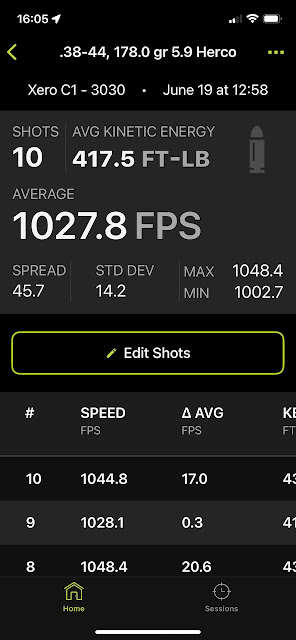
Last up were some .38 Specials loaded to duplicate the power of the .38/44, which was the predecessor of the .357 Magnum. Note that this load develops +P or +P+ level pressures and should never be fired in J-Frame or K-Frame .38 Special revolvers, or comparable guns from other makers. It should only be fired in guns chambered for .357 Magnum, or old S&W .38/44s or guns designed to handle these loads. I shot them in the Model 66-3 .357 Magnum.

Model 66-3:

  • 178 grain #358429 Keith from Matt's bullets
  • 5.9 grains of Alliant Herco
  • Winchester Small Pistol primer
  • Mixed brass
  • Average muzzle velocity: 1028 FPS
  • Average muzzle energy: 417.5 ft. lbs.

For the IPSC shooters, this load has a power factor of 183, so it easily makes major. This would make an excellent load for a woods walking gun, good for defense against most animals in the Lower 48 states.

The original .38/44 factory loads all used 158 grain bullets at 1125 FPS from a 6.5" barrel. I'm planning to load some with the same 5.9 grains of Herco under a 158 grain LSWC. I bet they'll get close to the original ballistics.


Sunday, May 12, 2024

Lee TL358-158SWC Bullet Mold

Over the past month I've done a couple bullet casting sessions, mostly making 158 grain (nominally) lead semiwadcutters in a 2-cavity Lee TL358-158SWC mold. I also cast a couple hundred .490 round balls for my .50 caliber muzzleloading rifles.

Bullets cast from this Lee mold have a nice reputation for accuracy in .38 Special and mild .357 Magnum loads. I also like that the design incorporates a wide meplat that will perform well if I shoot anything besides paper or steel with it.

This image swiped borrowed from the Lee Precision website shows was they look like:


Aside from that wide meplat, the tumble lube design makes for easy casting and prep. I cast them from soft alloy since I'll be keeping them under 950 FPS. I used pure lead with some old, unneeded cast bullets added to the mix to add some tin for better mold fill-out and stretch the melt a little. I can still scratch the bullets with a thumbnail, however.

To lube, I put a batch in a small container and then dribble some Lee Liquid Alox on, then mix them all up until the lube is evenly distributed over all the bullets. LLA comes out of the bottle brown but you only need a very light coating, such that the bullets are still mostly silver colored.

You can also thin the LLA with some mineral spirits to stretch it out and speed drying.

White Label Lube's Liquid Xlox is a substitute for LLA and may be more cost effective than LLA, but I haven't tried it.

The wet bullets are then set on a sheet of wax paper to dry. They're good to go in about 12 hours.


Tumble lube designs are also good for powder coating if that's your thing.

Lee sells several other tumble lube designs, and I've read on forums devoted to cast bullet shooting that others get good results tumble lubing conventional designs as well.

I don't size the bullets before loading. Instead, I make sure that my case mouths are adequately flared. I seat them, then in a separate operation I run the loaded rounds through a Lee Factory Carbide Crimp Die, which also sizes the case down to factory dimensions. Thus, if the bullets are a bit oversized and caused a bulged case, it gets sized back down to the correct dimensions.

Yesterday I put 50 of the Lee bullets through a 3" Model 64, loaded on top of 4.1 grains of HP-38 in mixed brass, with CCI small pistol primers. In a 4" barrel and depending on barrel/cylinder gap, this load should run around 850 FPS +/-. It's probably closer to 800 from a 3" tube.

There was very minimal leading, if any. The lube leaves a bit of soot on the gun and is smokey. Many peopple don't like either but to me it's a part of shooting a revolver. The soot wipes right off with a rag anyway.

My late father's favorite .38 Special handload was a 158 grain LSWC, usually Remington swaged bullets, on top of 4.3 grains of HP-38 in mixed brass and usually with Winchester small pistol primers. It's very accurate but when I got the S&W Model 15 that he shot a lot of these through I had to remove quite a bit of leading. The front edges of the cylinder were actually covered in lead deposits. He shot a lot and got lazy with cleaning in his later years, what can I say?

The next batch of these I load will probably be a bit slower, with either 3.9 grains of HP-38, 3.5 grains of Bullseye, or some other charge. The paper or steel targets I shoot won't know the difference and recoil will be a little less, which is good for my hands.

I've recently acquired a pound each of Accurate No.2, Hodgdon Titegroup, and Winchester 244, none of which I've previously used. The No.2 and Titegroup should good for light target loads while the 244 is closer to Unique and may be good for heavier loads suitable for woods carry.

IMHO, bullet casting is not only fun but it's a good prep. Yes, it's time consuming but it helps insulate you from component shortages that happen every election cycle or artificially generated panic. Cast bullets are old fashioned but remain effective projectiles.

Wednesday, February 22, 2023

Converting Rifle Brass to Use No.209 Shotshell Primers

AKA, “Yet another reason to have a small lathe.”

Obligatory disclaimer: We don’t guarantee that these will be safe in your rifle or with your components. Do this at your own risk.

The cartridge cases converted using this method are NOT safe to use with full loads. Read that again. They are only safe to use with low pressure reduced loads. Use at your own risk.

My friend N. has recently delved into shooting his M-1891/59 Mosin-Nagant and No.4 Mk.I Lee-Enfield with "mousefart" loads. These are even less powerful than Ed Harris’s “The Load” of 13 grains of Red Dot under a 150 - 180 grain bullet. N. is loading a 115 or 125 grain cast bullet on top of 5.0 grains of Bullseye. (His first try in 7.62R used 6 grains of Bullseye but accuracy was horrible. Backing off to 5 grains shrank the groups.)

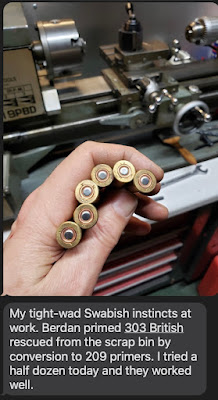
He has a good stock of No.209 shotshell primers but not a lot of large rifle primers. He also has a lathe in his basement workshop, as you can see in the picture. It’s an older Jet unit with a 7” swing (not sure how long it is). He took some Berdan primed .303 cases that he’d stashed away and drilled out the primer pockets so they will accept No.209 primers.


Per N., he used three drill bits to modify each case:

"Center drill to keep main drill from following the firing pin dent, letter C for the main body, 21/64 to countersink the flange on the battery cup.  Be careful!  My Fiocchi primers are .002" larger than my Cheddite, and I understand the Cheddites are larger than most Yankee brands."

So measure the No.209 primers you have and pick drill sizes to match.

We haven't tried this with Boxer-primed brass but I don't see why it wouldn't work. This project was primarily to make something useful from what otherwise would be trash.

Something else to consider is how your rifle will handle escaping gas if something goes wrong. I have been present when someone experienced complete case head separations in a No.4 Lee-Enfield and another time in a Mosin-Nagant. The Lee-Enfield shooter didn't notice anything awry until he opened the bolt. The Mosin shooter got gas back in his face but was uninjured because he wore eye protection.

Also note that a lot of milsurp .303 and all 7.62x54R were corrosively primed. Make sure to clean your rifle accordingly when shooting that ammo. You also need to rinse out the brass with water if you plan to reuse it. (The No.209 primers are not corrosive. I'm only referring to the initial firing with the original primers.)