Saturday, August 01, 2015

Euroarms Magnum Cape Gun Range Report

Today I got the chance to shoot the Euroarms Magnum Cape Gun percussion shotgun that I picked up last week at Dixon's. Like last week, I shot it over at a friend's place, this time after we installed a trailer hitch on my Nissan Xterra, so I can mount a bike rack or cargo carrier. That took about 45 minutes and afterwards we drove to the back of his yard where he has a short range for pistols and black powder guns.

Earlier this week I'd ordered some .690 cast lead round balls, 0.020" thick patches, and a few other items, from Track of the Wolf. I'd also ordered a 10 lb. bag each of Lawrence copper plated No. 5 and No. 7.5 birdshot from Rotometals, via their Amazon shop. Both orders came yesterday.

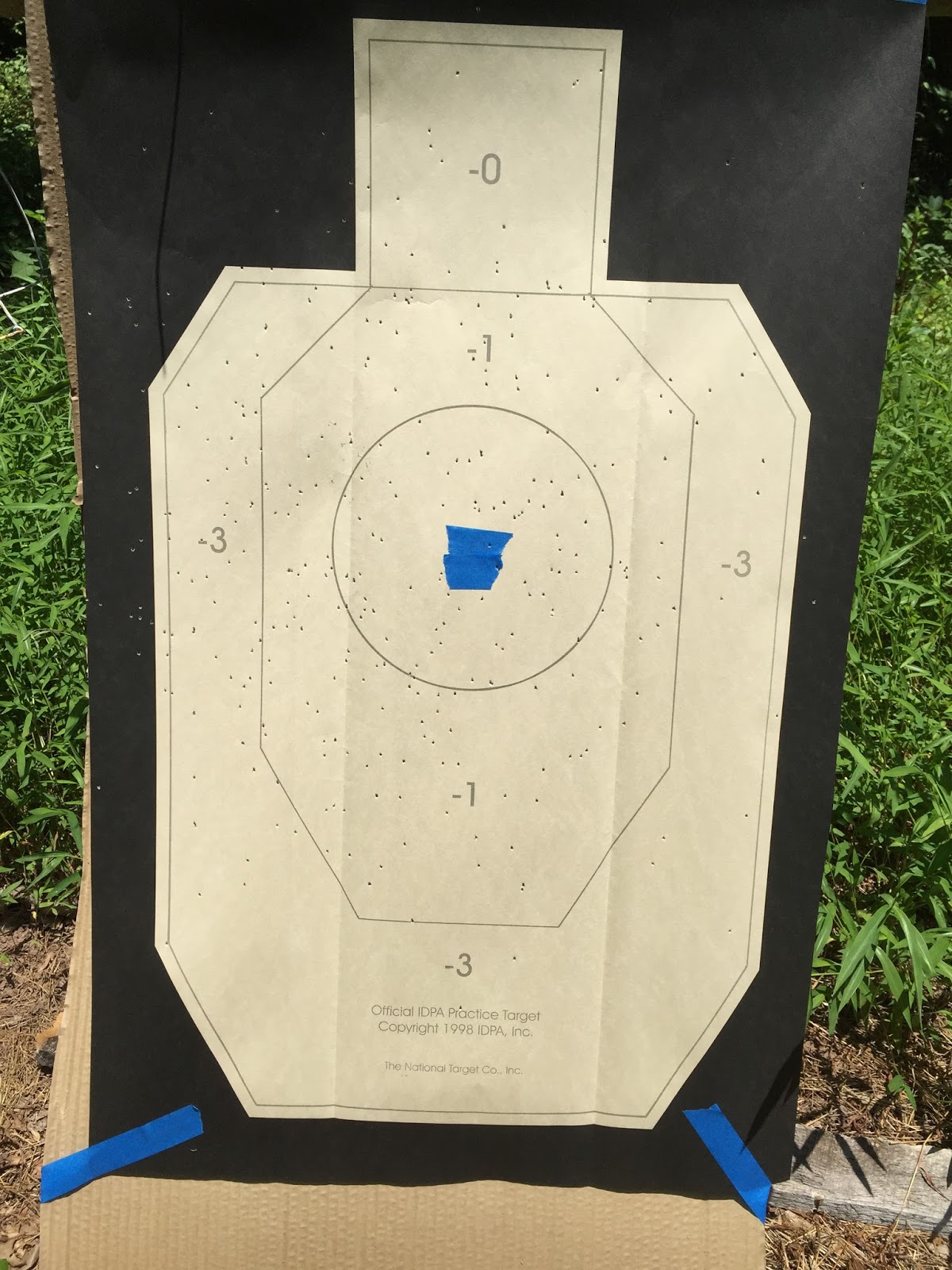
I patterned both sizes of shot at ~15 yards. The birdshot loads were 80 grains of 2Fg Goex and an equivalent volume of shot (i.e., a "square load"). On top of the powder I put a corrugated cardboard wad and a 1/8" thick lubricated felt wad. The shot was secured in place with a second corrugated cardboard wad. The wads were punched out using a 3/4" arch punch that I got from Amazon, which I chucked in my mill, with a piece of wood held in the mill vise under the wad material. I put the mill on a low speed, and the wads were cut out easily. Beats using a hammer!

We used IDPA paper targets for patterning. I put some blue painter's tape in the middle for a well-defined aiming point.

First, the No. 7.5s, used for informal trap shooting:


I pulled that shot a little to the left.

Next, the No. 5s, which I'll use for upland birds and small game:


(The bullet hole in the top right was from my friend's .45 caliber Euroarms Kentuckian flintlock carbine. The hole in the left of the -1 ring is from a wad.)

We then took some shots with patched round balls on the above target from ~25 yards, but I forgot to take pictures. My load was 80 grains of 2Fg Goex, a 0.020" patch lubed with Bore Butter, and a .690" lead round ball. At that range, the gun shoots a couple inches high but is easily minute-of-whitetail.

I took three more shots, recycling the target I used when I patterned the No. 7.5 shot.


You can really see the difference in the .45 and .69 caliber holes. I yanked the first shot, which is the one to the left of the tape. Point of aim was 6 o'clock on the blue tape, so it shoots a little high with this load at 50 yards.

I recovered a couple of my patches, which show a perfect fouling pattern with no cutting, as expected.


This load looks like a winner for close range deer hunting. It's accurate enough to 50 yards and even after 11 shots with no wiping, seated easily. In fact, the balls can be started in the muzzle with only thumb pressure.

I noticed that fouling was starting to build up in the breech after about 9 shots. I could've continued shooting after 11 shots if I wiped the bore, but by then it was lunchtime and we called it quits.

One thing that helped make loading easier was that last night I'd measured out all my powder and shot loads, and put them in speed loader tubes from TOTW. Likewise, I'd prelubed my shooting patches, which saved a lot of mess, since Bore Butter gets runny when it's 90 degrees out.

Aside from preparing my powder and shot charges and lubing my patches, I'd prepared a Ziploc bag of cleaning patches by soaking them in water with a little Windex squirted in. I used a few of these after shooting, then completed cleaning once I got home. At home I took advantage of the gun's patent breech and dunked the breech end in a bucket of hot soapy water, so I could pump it through the bore. I then followed up with some dry patches, and then a few with WD40 to make sure that there wasn't any water left inside. Finally, I left the bore with a good coat of Ballistol to prevent rust.

I am really looking forward to carrying the Euroarms Magnum Cape Gun afield this fall.

Tuesday, July 28, 2015

Concealed Carry Permit Holders Across the United States

Edit: Welcome Twitter users! Please poke around the blog. If you came here because of this post, you'll probably find something else of interest.

Back in 2004, I posted Percentage of Adults With Carry Permits in "Shall Issue" States. It's been probably the most popular post on this blog, and several times I've been asked if there's an update. Well, now there is.

Concealed Carry Permit Holders Across the United States is a new scholarly paper by John R.Lott, John E. Whitley, and Rebekah C. Riley. Here's the summary:

Since President Obama’s election the number of concealed handgun permits has soared, growing from 4.6 million in 2007 to over 12.8 million this year. Among the findings in our report:


  • The number of concealed handgun permits is increasing at an ever- increasing rate. Over the past year, 1.7 million additional new permits have been issued – a 15.4% increase in just one single year. This is the largest ever single-year increase in the number of concealed handgun permits.
  • 5.2% of the total adult population has a permit.
  • Five states now have more than 10% of their adult population withconcealed handgun permits.
  • In ten states, a permit is no longer required to carry in all or virtually all of the state. This is a major reason why legal carrying handguns is growing so much faster than the number of permits.
  • Since 2007, permits for women has increased by 270% and for men by 156%.
  • Some evidence suggests that permit holding by minorities is increasing more than twice as fast as for whites.
  • Between 2007 and 2014, murder rates have fallen from 5.6 to 4.2 (preliminary estimates) per 100,000. This represents a 25% drop in the murder rate at the same time that the percentage of the adult population with permits soared by 178%. Overall violent crime also fell by 25 percent over that period of time.
  • Regression estimates show that even after accounting for the per capita number of police and people admitted to prison and demographics, the adult population with permits is significantly associated with a drop in murder and violent crime rates.
  • Concealed handgun permit holders are extremely law-abiding. In Florida and Texas, permit holders are convicted of misdemeanors or felonies at one- sixth the rate that police officers are convicted.
Well, that sure doesn't fit the president's or Bloomberg's narratives, does it? Especially the points about women and minorities.

Digging into the data, the state with the largest numbers of permits is Florida with about 1.4 million, followed by Pennsylvania with about 1.1M. C'mon PA folks, we're slacking.

If you look at percentages, the top five states are
  • Alabama 12.64%
  • South Dakota 12.3%
  • Indiana 11.62%
  • Pennsylvania 10.64%
  • Tennessee 10.21%

From my post of 11 years ago, the top five states in 2004 were :
  • 7.45% South Dakota 
  • 6.79% Indiana 
  • 6.76% Pennsylvania 
  • 5.23% Connecticut 
  • 5.12% Washington


If the Democrats are upset by this I have two things to say:

  1. Good.
  2. You have only yourselves to blame. You've been simultaneously beating the drum for more gun control, fanning the flames of racial tension, and tearing down our country's institutions. Don't be surprised when people decided they need to take affirmative steps to preserve their own security.

Monday, July 27, 2015

First Shots With the EOA Magnum Cape Gun

Yesterday I was able to shoot a few rounds through the Euroarms gun at a friend's place. I don't know where I have my stash of 12 gauge wads and shot leftover from when I had my Pedersoli 12 gauge double, so I just tried some of the .662 balls I'd bought when I got my MVTC .69 caliber M-1717 musket. I used 80 grains of 2Fg Goex and pillow ticking patches lubed with Bore Butter. At about 20 - 25 yards I kept 6 shots inside an 8" bull, with POI = POA.

Not bad for a way undersized ball and a gun with only a bead front sight.

For 3 of the shots I used a single patch, while the other 3 I double patched it due to the small ball. POI at that range seemed the same but I was definitely getting a better gas seal with the double patch, based on slightly more recoil. For my last shot I retrieved a patch, relubed it and shot it again.

While I was reloading in between a couple shots, a fawn came barreling out of the woods and screeched to a halt about 15 feet away. We stood still and he hung out for about five minutes, trying to figure out what we were. Eventually, he took off and we went back to shooting.

Tonight I put in an order with Track of the Wolf for some .690 balls, .020" cotton shooting patches, a 12 gauge jag to fit my cleaning rod, a spare nipple, and a few other accessories.

This looks like it'll be a really fun gun to shoot and useful for anything I can hunt in PA.


Sunday, July 26, 2015

Muzzleloading Single Barrel Smoothbores

One of the most common (possibly the most common) types of civilian arms from the 1600s up through the beginning of the 20th Century was some kind of single shot smoothbore gun. They were highly valued as meat getters and weapons for both defense and offense. Such guns were traded in large quantities to the Indians as well as other indigenous peoples around the globe. Probably the best known of these guns in North American was the Northwest or Hudson's Bay gun.


(Pic found on the 'net.)

Another well known muzzleloading smoothbore was the French Fusil de Chasse. I have one in 20 gauge from Middlesex Village Trading Company.


(Pic borrowed from MVTC.)

Being smoothbores, they can shoot birdshot, buckshot, or a single ball, making them useful for any game from birds and squirrels on up to moose. They also saw a lot of use as fighting weapons. The modern equivalent would be a single shot shotgun like my old H&R 20 gauge.


When the muzzleloading single barrel shotguns were state of the art, most were produced in smaller gauges -- 24 to 20 gauge. They were cheaper to load, requiring less powder and shot, important when you are weeks or months away from resupply.

Most of the currently produced muzzleloading shotguns are 12 gauge doubles, and most of the single barrels are flintlocks. Pedersoli lists a percussion version of their Mortimer 12 gauge shotgun.

One percussion single barrel smoothbore that was imported for awhile but is no longer was the Euroarms of America "Magnum Cape Gun." Normally, a cape gun is a double with one rifled and one smoothbore barrel, but I guess EOA thought the name sounds cool. The gun was made by Investarms* and is still listed on their website as the "Gallyon," but doesn't appear to be imported into the US at present.

One of the Magnum Cape Guns has been on my want list for awhile and I found one in excellent shape yesterday at Dixon's for a reasonable price, so it came home with me.


Closeups of the lock and breech area:


It's a 12 gauge percussion smoothbore shotgun with a cylinder bore, i.e., no choke. The bore appears to be chrome lined, which will help cleanup. The barrel is fitted with a hooked patent breech, so if you remove the ramrod, drive out the barrel wedge, and put the hammer on half cock, you can lift it out of the stock. You can then dunk the breech end in a bucket of water and using a wet patch, pump water through the bore to clean it.

The Magnum Cape Gun is very well made with a nice polish on the metal parts, and a deep, beautiful blueing job on the barrel, but, and trigger guard. The lock was left in the white. The wood is fairly plain but serviceable, and the checkering was well executed. The inletting of the buttplate could have been better, though. This specimen was well cared for, with only some wear on the buttplate where it rested on the ground while being loaded, and only a few handling marks on the wood.

My plans for this gun include small game, upland bird, and maybe even deer hunting. For deer I'll use a patched round ball. For shot, I plan to get a punch and make felt wads from the same felt I use to make wads for my percussion revolvers. (According to this article, felt wads perform better than card and fiber wads.)

Once I get the chance to try the gun out I'll post some more thoughts.


*Investarms makes the Lyman Great Plains Rifle, Lyman Trade Rifle, and Lyman Great Plains Pistol. They also make the Cabela's Traditional Hawken, one of which I have.

Saturday, July 25, 2015

Pole Lathe

This morning I went up to Dixon's Muzzleloading Shop in Kempton, PA, for their annual Gunmakers' Fair. Among the more interesting things I saw was this pole lathe, which was being used for turning the wooden ends for powder horns.


Back of the lathe, showing some of the linkage:


Closeup of wooden spring:


Closeup of the mandrel, which holds the piece being worked on. The wooden block visible behind the work and the mandrel is the tool rest. You can also see the wooden bar the operator steps on to run the lathe.


And finally, a gratuitous shot of some old farm machinery.


Tuesday, July 21, 2015

Gun Training in Nasty Weather

Over on gundigest.com, Dave Morelli has an article in which he advocates gun training in bad weather.

I see nothing in the article with which I disagree. The author isn't advocating going out in crappy weather to learn the fundamentals. He's telling you to get out there in sub-optimal conditions to learn what your gun does -- and what you do -- when it's windy, rainy, or cold.

Based on my own experience in shooting practical rifle matches at my club, operating your gun in extreme weather conditions stresses the shooter in ways not experienced when it's 75 and sunny. If it's humid, lenses (both eye glasses and scope lenses when you accidentally breathe on them) get fogged. If it's snowing ice can form on your gun while you're waiting to shoot, rendering it slippery. When it's hot, your sweat gets in your eyes and on the gun.

Or step in a 10" deep puddle of ice water while your waterproof boots are only 8" high, then go on to finish the stage.

In cold weather your clothing limits your movement and makes working fine controls more difficult.

Get the basics down in good weather. Then go see what happens when it's shitty out.

It was about 12 degrees out when this pic of me was taken back in January.


Under stress you will default to the level of your training. If you train easy, you will fail get life gets hard.

Saturday, July 18, 2015

New Scanner

This week I got a Uniden BC396XT scanner from Amazon. I have a couple posts up about it over on Survival Preps, here and here.

Thursday, July 09, 2015

"Technical Glitches." Uh huh.

Unless you were under a rock, you know about the following three things:

  1. The Chinese stock market dive.
  2. "Technical glitches" grounding all United Airlines flights in the US yesterday.
  3. "Technical glitches" causing all trading to be halted for several hours on the New York Stock Exchange yesterday.


Unless the network and system admins at UAL and the NYSE are totally incompetent, they have major redundancy in place to prevent shutdowns like this from happening. There's simply too much money at stake to have single points of failure.

Now, was Anonymous responsible? Perhaps it was someone looking to divert attention from the Chinese stock market meltdown. Whatever really happened I doubt that the powers that be would share the truth, for fear of upsetting the apple cart.

My tinfoil hat feels a bit warm. It would be a good time to revisit your emergency preparations.

Saturday, July 04, 2015

Rimfire Range Day Number 4

Amanda and I hit the range again yesterday. She shot her Savage Rascal and my 10/22, while this time I brought my Remington Apache Nylon 77. Here's an older pic of it with my Remington 550-1.


Amanda mostly shot Aguila Super Extra SV loads from the same brick we'd tapped into earlier. This time, however, she had several rounds that failed to go off the first time they were hit by the firing pin. This happened in both rifles she shot. All went off when loaded back into the gun but rotated so that a different part of the rim was hit. After blowing through a couple hundred of the Aguilas she shot some Federal Automatch, which didn't give her any problems.

In the Nylon 77 I mostly shot Remington Golden Bullets from a 550 count box that I bought several years ago. It functioned perfectly with them and accuracy was good. I also tried some Federal Automatch, which did not shoot as accurately as the GBs, and with which I had a couple stovepipes.

I have to admit that after shooting at least 500 Golden Bullets in a few different rifles this week, I am reassessing my opinion of it. I do know that my Ruger 22/45 Lite and Norinco ATD do not like it, and my Beretta Jaguar isn't as reliable with it as with CCI Mini Mags, but it does work well in a few other .22s I own. I'll keep buying it when I run across it at a reasonable price, since it's one type of .22 LR ammo that seems to be more available than CCIs, and generally cheaper.

On the other hand, I'm underwhelmed with Federal Automatch. It's one of the .22 LR loads that I've noticed becoming more available, but I get more malfunctions with it in several of my guns than other loads, and accuracy is nothing to get excited about. Also, the waxy lube gets gummy if it's over 90 degrees or the gun is hot. My daughter's Savage Rascal will start getting stuck cases if she shoots a lot of Automatch when it's hot. The remedy is a quick chamber cleaning using a Q-Tip with some gun oil on it, or running a Boresnake through the barrel.

.22s in general tend to be finicky as to what loads they shoot accurately, and semi autos often function better with some loads than others. The only way to find out what shoots and functions well in any given .22 firearm is to try a variety of loads in it.

Thursday, July 02, 2015

Another Rimfire Range Day

I made it to the range again today, this time with my 11 year old in tow. This was her first chance to try shooting my Ruger 10/22 fitted with Tech Sights and a Choate M4-style stock.

She did well with the Ruger. With the stock fully collapsed, it is short enough for her to shoulder and get a proper sight picture.

We shot the Ruger with Aguila Super Extra standard velocity .22 LR. It runs well in the Ruger but the powder does have a funny smell, similar to that of a lot of Russian ammo that I've fired. We had a few failures to feed but I tracked them down to an old 10 round magazine we were using. It also caused FTFs with CCI Mini Mags. That particular mag dates to the late 1970s and belonged to my father. Considering how much my brother and I shot his old 10/22 when we were kids, G-d only knows how many rounds have been through it. I'll try taking it apart and cleaning it to see if that'll make a difference.

I also brought my Remington 550-1 again, and this time grabbed a half-full brick of Winchester Xpert .22 LRs to try in it. I bought the Xperts the year before my daughter was born. The reason it lasted so long is because it was the worst, gummiest, dirtiest .22 LR I'd ever tried. The last time I tried it in the 10/22 the rifle choked on it. I'd shot it in my Old Model Ruger Single Six and a S&W Model 18 (both revolvers) and it gummed them up.

However, the waxy lube seemed to have dried out a little over the years. I was pleasantly surprised to see that the Remington 550 fed them with only a few hiccups. I did get a few stovepipe failures to eject, but for the most part it functioned OK with the XPerts, and shot them fairly well. I wanted to burn up the rest of XPerts so when I noticed the FTEs starting to increase I added some additional FP10 to the bolt and inside the action, and the rifle kept going.

That Remington 550-1 has become my favorite .22 semiauto rifle. It's accurate, reliable, and handles even .22 CB Shorts as a semiauto.

Wednesday, July 01, 2015

The Williams Floating Chamber

Yesterday, I mentioned shooting some .22 CB Shorts in my Remington 550-1. The rifle is designed to feed .22 Shorts, Longs, and Long Rifles interchangeably. The mass of the bolt and the strength of the mainspring are balanced for .22 LR, so in order to feed .22 Shorts as a semi auto, they need a boost.

This is accomplished by the inclusion of a Williams floating chamber in the breech end of the barrel. When installed and shooting .22 Longs or LRs, the seam between the end of the floating chamber and the rest of the barrel is sealed by the cartridge case. However, it's uncovered when shooting Shorts, so some of the gas from the cartridge goes into the gap and floats the chamber, allowing it to recoil a short distance, giving additional impetus to the bolt. If you go over to Numrich Arms' website and look at their exploded diagram of a Remington 550-1, the floating chamber is part #50.

I thought it would be a good idea to give my Remington a thorough cleaning, since I'd never removed the floating chamber, and since I bought it about 2.5 years ago it's seen close to 1,000 rounds through it, including 60 or so CB Shorts yesterday. It was filthy inside. After I got the floating chamber out and cleaned up I took some pics, here are a couple that came out halfway decent.


There was a fair amount of lead buildup on the shoulder of the piece, which I was able to scrape off with a small screwdriver.

Before being used in the Remington 550, the Williams floating chamber was used in the Colt Ace and .22 conversion kits, which were designed to mimic the recoil of a M1911 in .45 ACP.


It's a really clever solution to a couple interesting engineering task: make a semi auto that can feed .22 S, L. or LR interchangeably, and make a .22 pistol recoil more like a .45.

Tuesday, June 30, 2015

Another Rimfire Day at the Range

I was able to put some more .22 LR downrange today, from both my Ruger 10/22 and my Remington 550-1. Most of my shooting was done from the bench at some NRA 50 yard small bore targets that I printed up this morning. The 50 yard target has a 4" diameter bullseye. At 50 yards, the bullseye appears to be the same diameter as bead front sight on the Remington. IOW, it looks like a black dot at that range. The rear sight on the rifle is an open rear notch.


The top left target was shot with Federal Automatch 40 grain solids, the top right with Winchester Super-X 37 grain HPs, and the lower left with CCI Mini Mag 36 grain solids. (The holes in between the top two bulls were leftover from someone else.) I figure that with a scope I should be able to get the rifle grouping in about an inch or less at 50 yards with the right ammo. It definitely likes the Mini Mags.

I also put 20 rounds into an AQT-type target at 25 yards, offhand. This target is a 100 yard target scaled for shooting at 25 yards. The lower edge of the black is about 6.5" wide.


The front sight needs to be drifted a little left to move the POI to the right, but I'm pleased with the group. The Remington has a nice balance for offhand shooting.

I wrapped up the afternoon by doing some plinking at some 50 yard gongs. The largest of these are about 8" in diameter and I was able to hit them most of the time.

The Remington has a Williams floating chamber designed to allow it to function with .22 Short, Long, or Long Rifle, so I tried some CCI .22 Short CBs in the Remington and was happy to see that the rifle functioned most of the time with them.  I did get a number of stovepipes with the CBs, though. I suspect it would function better with regular .22 Shorts, either standard or high velocity loads. The tubular magazine will hold 20 .22 Shorts, which is fun for plinking. Shooting the CBs, the Remington sounds like an air rifle and no hearing protection is needed. The CBs dropped about a foot more at 50 yards than the HV .22 LR loads I shot earlier.

Today I Met a Real GI Joe

This afternoon I was at my club to send some .22 LR downrange. While I was there an older gentleman was also on the line and I saw that he needed to be reminded of our current cease fire procedures. After he packed up his stuff I walked up to him and introduced myself, and politely went over some range rules with him.

We got to talking and I saw that he was wearing a 75th Infantry Division cap, so I asked Joe where he was sent during World War 2. He told me Europe and that he went through the Battle of the Bulge.

Joe told me that during the Bulge, his company of 182 men got down to 16 men, before they got replacements. He said that a lot of the casualties were from trench foot.

One of the things Joe recounted to me how if you qualified as Expert with one of the small arms issued to the Army, you would get a three-day pass. He was issued an M1 Garand, but he qualified Expert with an M1 Carbine.

Joe's still pretty spry at 92 years old, but it's hard to imagine this old man who is maybe five feet tall slogging his way across Europe carrying an M1 Garand and fighting the Wehrmacht. God bless him and all those who served.

Monday, June 29, 2015

Rimfire Range Day

I had a very therapeutic day at the range shooting two of my .22 rifles: a Ruger 10/22 and a Norinco ATD.

The Ruger is one that I bought in the early '00s, largely out of nostalgia. My father had a 10/22 that my brother and I shot quite a bit when we were kids in the late '70s/early '80s. I bought mine with the intention of leaving it mostly stock, sans a Power Custom hammer to improve the awful factory trigger. However, over the years it's picked up several mods:

  • The Power Custom Hammer,
  • A Volquartsen oversized left handed safety,
  • "Slingshot" mod for the bolt release,
  • An extended mag catch,
  • A Butler Creek folding stock, which has now been replaced by
  • A Choate Machine and Tool M4-style telescoping stock, and
  • Tech Sights.
So much for leaving the rifle mostly stock.

I installed the Choate stock and Tech Sights last week so that my almost-11 year old daughter could shoot it. She's been wanting to move up from her Savage Rascal single shot, but most .22 rifles have a  stock that's too long for her. She should be able to shoot the Ruger from a rest with the stock in the fully collapsed position.


I really like the Choate M4-type stock. Stylistically, it looks like a cross between an M1 Carbine stock and an M4 stock. It feels solid and the shape of the buttstock gives a good cheek weld. The stock has two storage tubes for batteries or whatever. The texture of the stock gives a good grip. It installed easily, although I did need to relieve an area inside the stock to accommodate the oversized lefty safety.

I installed Tech Sights because my daughter didn't want to use a scope or red dot. She likes peep sights. Shooting with iron sights is a valuable skill so far be it from me to discourage her. I got the TSR200 which is fully adjustable.

I bought the stock and Tech Sights from E. Arthur Brown Co. They were great to deal with and I'll probably order more gun stuff from them in the future.

One mod I did to the Tech Sights was to replace the front post with a Hi Viz fiber optic unit. At 47, it's not as easy to see iron sights as it used to be, especially in low lighting. The Hi Viz fiber optic from post is an improvement over a plain black post.

I got the Tech Sights zeroed at 25 yards with Remington Golden Bullets. I figured that if the rifle shoots the cheap Golden Bullets well, my daughter can use them for plinking. I also tried Federal Automatch and Aguila Super Extra subsonics in the Ruger. They also shot well.

Along with zeroing the Ruger I was able to run plenty of rounds through my three Ruger BX-25 magazines to wring them out. The BX-25s are the mags to get if you want high capacity magazines for the 10/22. Last year I found this Rothco pouch at Amazon, which hold three BX-25 magazines and has a small pocket to hold accessories like a sight adjustment tool or basic cleaning kit. It has a belt loop on the back.


The Rothco 2-pocket ammo pouch is inexpensive but fairly well made from canvas. It's a good choice for long .22 magazines.

After I got the Ruger's sights zeroed I switch to my Norinco ATD, which is a copy of the Browning SA-22 that's been in production since 1914 or so. (I previously posted about the ATD here and here.) I wanted to try the Federal Automatch and Aguila Super Extra in the Norinco. It shoots very well with both rounds, although I had a couple failures to eject with the Automatch. Accuracy with both loads was good. Each target is 20 shots.


The sights on the Norinco consist of a bead front with a buckhorn rear. Frankly, they suck. I am very pleased with this accuracy.

Since I'm on vacation this week I'm hoping to get to the range at least one more time.

Sunday, June 21, 2015

Lathe Cross Slide Digital Readout

Over on Dave Markowitz's Machine Shop, I posted a short piece on how I added a digital readout (DRO) to my mini lathe.


This should make it a lot easier to turn stock down the desired diameter.

Link.

Sunday, June 07, 2015

PA to MO on 5 Watts

Yesterday I spent some time out back with my Yaesu FT-817ND and laptop, playing with digital modes. I got a new Easy Digi interface from KF5INZ for connecting the FT-817ND to laptops and wanted to get it setup before taking it to Tioga County next weekend. I wound up having a nice rag chew with another ham who is located in Missouri, using the Olivia 16/500 mode.

I did a write up over on Survival Preps, here:

Backyard Digital Radio Practice

I also did a separate post on configuring a Mac to use the Easy Digi, FT-817ND, and Fldigi:

Configuring Fldigi on a Mac for use with an Easy Digi Radio Interface

Thursday, May 28, 2015

CZ P-09 Initial Review

Several years ago I had a CZ-85 Combat in 9mm, but it had some issues related to the slide stop and also its grip was too large for my hand. I wound up trading it off. However, I retained a desire to own a CZ handgun, and two nights ago I came home with one of CZ's newer polymer-framed models, a P-09 Duty. Price was $566 OTD.


CZ introduced the compact P-07 a few years ago, and the P-09 a couple years later. Both combine a CZ-75 type mechanism with a more modern polymer frame. This allowed CZ to cram large magazine capacities into slim grips. In 9mm, the P-07 has a 16 round mag, while the P-09 holds 19 in its flush fit magazine.


The P-09 came in a plastic case with a test target, manual, warranty info, cleaning brush, cleaning rod with patch loop, two magazines, a gun lock, replacement back straps, and safety.


As configured from the factory, the P-09 is a DA/SA design with a decocker. However, by replacing the decocker with the safety, the gun can be carried cocked and locked, like a 1911 or Browning High Power. If configured with the safety, you can also carry the gun hammer down on a loaded chamber, but you have to manually lower the hammer to do so. Both sets of controls are rather flat. I don't think this is a problem with the decocker but if I was using the safety, I'd want it to stick out a little more for a better purchase. I'll stick with the decocker.

The interchangeable backstraps allow you to modify the size of the grip to better fit your hand. Mine came with the Small backstrap installed, which I will leave in place.

Like many modern designs, the P-09 sports an M-1913 Picatinny rail under the frame in front of the trigger guard. I'm planning to mount a light there.

The P-09 is pretty thin at a ~1.5" thick, but the height (~5.8") and length (~8.1") make it a full size pistol. It weighs 27.35 oz. unloaded without a magazine.

The sights are typical modern service pistol sights: fixed, well-defined, and have a three-dot pattern. The dots are actually photo-luminescent paint and will glow in the dark if charged by exposing them to light. To me this is a gimmicky substitute for tritium night sights or even fiber optics. I may swap out the front sight for a FO unit.

The DA trigger has a long, creepy takeup but feels less than 10 pounds (I don't have a trigger scale). The SA pull also has some creep and is probably around 5 pounds. Not great but not horrible for a new gun. It will smooth up with use, and I won't think of replacing any parts or doing a trigger job until the gun has a minimum of 500 rounds through it.

For a person like myself with small hands, the P-09 has a very ergonomic grip. The trigger reach is short enough that I can get the pad of my index finger fully on the trigger without stretching. Also, the decocker (or safety if it's installed) are both ambidextrous, and the magazine catch can be reversed for lefties. Even though I'm a southpaw, I'm leaving the mag catch as-is. Long ago I learned to use the middle finger of my left hand for mag catches.

The back of the grip has a nice beavertail that spreads recoil out across the web of your hand.

Before I shoot a new gun for the first time I always field strip it. This is to ensure that everything inside is in good shape, that it's properly lubricated, and it's a good way to familiarize yourself with a new gun. After getting the P-09 home last night I took it out to my shop and following the instruction manual, took it down. Takedown is simple, similar to that of a Browning High Power. The slide stop is still a bit stiff coming out so I needed to use a dowel to get it started. The other things of note were that the gun was bone-dry, and that the recoil spring is captured on its guide rod, so removing and reinstalling it was a snap. After oiling the gun with FP-10 and running a patch through the bore, it went back together easily.


Yesterday I took the P-09 to Langhorne Rod and Gun Club and put 125 rounds of Herter's 9mm 115 FMJ through it. The Herter's ammo was made in the Czech Republic by Sellier & Bellot for Cabela's, so it was only fitting to use it in the CZ.

The magazine springs are very stiff, so I was glad that I had my Butler Creek MagLULA with me. (Seriously, don't leave home without one if you're shooting an autoloader with a double stack magazine.) Getting the 19th round in was very hard, so I called it good at 18. After the mags see some more use I suspect they'll get a bit easier to load.

Accuracy was good. At 10 yards I was able to keep most of my shots inside of a ~3.5" hole, except for called flyers caused by me. There were no malfunctions.

The first 36 shots:


89 more shots:


CZ autoloaders have relatively low bore lines, so muzzle flip wasn't bad at all. And, even though the gun is fairly light, recoil was mild.

Today provided a good test of the P-09's grip stippling. It was hot and humid, so my hands were sweaty. Despite this, I had no problems hanging onto the gun.

With only 125 rounds through the gun so far, it's not even broken in or proven. However, my initial impression is VERY favorable. The reviews I've found online by actual owners have all been favorable, so I'm expecting that I'll remain pleased with it. The CZ P-09 looks like a good choice for range duty and home defense. If I was buying a similar pistol with concealed carry in mind, I'd look to the smaller CZ P-07. That said, one should be able to CCW a P-09 with a good holster, gun belt, and cover garment.

Saturday, May 23, 2015

Redneck Lathe DRO

Having digital read outs (DROs) on my mill has spoiled me, so I've been wanting to add them to my lathe. One idea I've seen has been to adapt inexpensive digital tire depth gauges bought on eBay for under $10. I tried this out tonight. Here's my proof of concept redneck lathe DRO:


I setup the lathe with a 3/4" diameter aluminum rod in the chuck and the DRO affixed to the saddle and cross slide with magnets. My goal was to turn the rod down to 1/2", which would require advancing the tool 1/8". (When turning down stock in lathe, since you're cutting a rotating piece, you divide the amount you want to remove in half, then move the cutting tool that amount. E.g., 0.75" - 0.5" = 0.25" to remove, thus you move the cutter in 0.125", or 1/8".)

Unfortunately, it's not going to work, as it's not accurate enough. I turned the stock down until the DRO read that I'd moved the cutter in 0.125", but when I measured the rod, I got 0.490". It was off by 1/1000" over such a small distance, which in metalworking terms is too coarse.

I'm going to go ahead and try the iGaging DROs, which a lot of mini mill and mini lathe owners have had good results with. I'm planning to install one for the cross slide and another for the compound.

Wednesday, May 20, 2015

Cut My First Single Point Threads

I'll be adding info about this to my machining site, but thought it was worth posting here as well.

Tonight I cut my first single point threads on my mini lathe. One of the advantages that the Chinese-made mini lathes have over the American-made Sherlines and Taigs is that they can be used for thread cutting without any additional attachments. To setup the lathe to cut threads at the desired pitch, you change gears in the headstock. A good explanation of the procedure can be found in the Little Machine Shop Mini Lathe User's Guide (PDF).

After finding my change gears and the reading the threading section of the LMS guide, I was able to cut 1/2x28 threads on the end of this 1/2" 6061 aluminum rod:


1/2x28 is of course the standard thread used for muzzle devices on .22s and 5.56mm firearms. E.g., my Ruger 22/45 Lite's barrel is threaded 1/2x28.

The cutting tool I used was from a set that I got at Harbor Freight shortly after I bought the lathe, with 1/4" shanks. I used some Tap Magic as cutting fluid but I probably could have cut these threads dry. (I've used a lot of WD-40 as cutting fluid when working with aluminum since I got my lathe and mill in 2013.)

Since I'm just learning how to thread on the lathe and wanted to reduce the risk of crashing the tool into the chuck, I got a spindle hand crank from Little Machine Shop. It fits into the spindle the same way a bicycle handlebar stem goes into the head tube.


Aside from safety, the spindle hand crank gives you lots of low speed torque. However, if I ever want to thread a barrel I'll have to do it under power, because the hand crank blocks the spindle bore.

Also shown in the above pics is a chip tray that I fashioned from some sheet steel and attached to the cross slide using a couple existing holes. I ran across this mod on the web somewhere and thought it was a good idea. It should keep the ways a bit cleaner. Here's a better view:


If the chip tray gets in the way of a job it can be easily removed.

Thursday, May 14, 2015

External Battery Packs for Cell Phones, Tablets, Etc.

Most of us rely on cell phones, tablets, and maybe a GPS unit in our daily lives and out in the field. Smart phones are basically pocket computers and it's easy to become reliant on them to augment our own knowledge. Unfortunately, they eat electricity and many of the most popular models don't have replaceable batteries. That's where an external battery pack comes in.

External battery packs range in size from units the size of a lipstick to large blocks. Modern battery technology is allowing manufacturers to cram more amp hours into smaller units, but if you want more than one phone recharge, or need to recharge more than one device, you're going to have to buy one of the larger units.

Last Fall I picked up an EasyACC 15,000 mAh pack from Amazon, and used it on my Fall deer hunting trip. It's about at the limit of what I'd call pocket-sized. The two USB ports can theoretically be used to simultaneously charge two devices, although one port puts out 1.5A and the other puts out 2.1A. However, if one of your devices requires a 2A minimum input then you'll be limited to charging one device at a time.

Aside from the big pack, I also have a smaller unit from Duracell that I picked up when I bought my first iPhone. I carry this one in my EDC bag to and from work, just in case there's a foul up during my commute and I need to give my phone a boost.

Friday, May 08, 2015

Word


Pi Finder

I'm putzing around with my Raspberry Pi again, and came across Ivan X's Raspberry Pi Party site. One of the utilities he has which you may find useful is Pi Finder, a program to find and connect via SSH to your Raspberry Pi running in headless mode, when you don't know its IP address. Pi Finder is an app that runs on Mac OS 10.5+.

If you need a similar app that can run on Windows or Linux (plus Mac OS X), check out Adafruit's Raspberry Pi Finder.


New Commo Blog

Another commo-related blog worth checking out:

Communications Tradecraft


Updates to my Machining Website

I made a couple updates to Dave Markowitz's Machine Shop:


Thursday, April 30, 2015

Redding #2 Powder Scale

After loading up some .308 on Tuesday I came to the conclusion that the Lee scale I've had for several years is a total POS. It's hard to zero, too light so that it moves if you look at it wrong, and just feels cheap. So,  I got a Redding #2 powder scale from Amazon to replace it. It's ~5x the price of the Lee but it's much nicer and easy to zero. Additionally, the Redding will measure up to 505 grains, vs. the 100 grain capacity of the Lee.

I also got a set of Lyman check weights, and according to them, the Redding scale is right on.

Note: A lot of reloading equipment is from Lee. E.g., Classic Turret Press, various sets of dies, hand priming tool, and a bullet sizing die. They work great and fantastic values, but their powder scale just isn't up to snuff, IMHO.

Tuesday, April 21, 2015

Barnett Recruit Recurve Crossbow

The Barnett Recruit Recurve crossbow that I ordered from Amazon came today. Intended quarry include deer, feral cats, and zombies.

Just kidding about the cats.


I went with a recurve crossbow because I wanted a simpler, more user-serviceable design.

The kit included the bow, 3 hex wrenches, red/green dot sight, quiver, 3 Easton XX75 bolts with 100 grain field points, a spare bolt retaining spring, and a tube of string wax the size of a Chapstick. I also ordered 2 x 5 packs of carbon bolts w/100 grain field tips, along with a rope cocking device (RCD) and extra string wax. The RCD and extra wax were shipped separately and got delayed. (I think they are using USPS for the second package. Grrrrr.)

The draw weight is 150 lbs. with a 12.5" power stroke and I'm just able to cock it without the RCD as long as I wear gloves, so I took 3 shots after I put it together. Point of aim was the bullseye on the deer's chest in the pic below. The trigger isn't bad; Barnett advertises it at 3.5 pounds. The distance to target was ~10 yards. I'll zero the sight after I get the RCD. There's a fair amount of vibration when it's shot so I'm glad that I used blue Loctite on the screws when I assembled it.


"Muzzle" velocity is supposed to be ~245 FPS. The minimum weight bolt you can shoot is 340 grains but Barnett recommends a 400 grain bolt (including the point). The fiberglass prod came strung, which greatly eased assembly. I need to pick up a stringer and a spare string.

The crossbow only weighs about 5 pounds as you see it above, a lot less than the compound xbows I've held. The width is around 27" so it doesn't feel cumbersome. It has studs for QD sling swivels and the LOP is adjustable. It has an "anti dryfire" safety. Unless there's a bolt loaded you cannot disengage the safety. I need to figure out a way to make the safety quieter because it's kind of screechy (metal rubbing on metal).

Barnett recommends that you wax the string serving and flight rails every 5 or 6 shots to reduce wear, and to wax the whole string when white fuzz appears.

My initial impressions of this crossbow are good. We'll really see how it shoots once I get the cocking device and get the chance to wring it out.

Edit 4/22/15 to add:

The package with my extra string wax and rope cocking device arrived this evening and I was able to take a few more shots with the crossbow. The RCD makes a huge difference in cocking the bow. I will probably shorten the RCD a little, to make it a little easier to use with this setup.

One more accessory I'm going to see if I can find is a small stock pack that I can strap to the buttstock. I'd use it to store the RCD, a tube of wax, and hex wrenches on the bow.

Thursday, April 09, 2015

New iPhone 6

Last night I went to the local Verizon Wireless store and upgraded my phone from an iPhone 5 to an iPhone 6. The 5 was about two years old and starting to get sluggish, plus the battery life was deteriorating.

Since I backup my phone to my laptop, I had to wait until I got home to restore from the backup, but before doing so had to upgraded iOS on the new phone. That went pretty smoothly, except that I had to delete and reinstall CloudMagic before it would let me setup my work Exchange account.

So far, what I like about the new phone is the greater capacity (64 Gb vs. 32 Gb), faster CPU, better call quality, and larger screen. I am not wild about the smooth rounded sides, which make it less secure when holding it. However, I have a Magpul case on order from Amazon which should arrive tomorrow to eliminate that concern.

I'm hoping that the iPhone 6 will have better battery life than the 5 but it's too early to tell. The camera should be better, based on the pictures I've seen taken with my wife's iPhone 6.

Saturday, March 28, 2015

Winchester Model 1902 Thumb Trigger Rifle

I ran across this video by MidwayUSA showing the Winchester Model 1902 Thumb Trigger .22 rifle. This was made in the early 20th Century as a boy’s rifle. The video nicely explains how the rifle works including a close up of the mechanism.

It looks like it wouldn’t be too difficult to make one of these on a mini lathe and mill, and you could get by without the mill as long as you had a drill, some files, and patience.

Wednesday, March 18, 2015

Ruger Gunsite Scout Rifle

One type of rifle missing from my arsenal has been a centerfire bolt action with a proper southpaw bolt for deer hunting and informal target practice. I have a slew of military surplus bolt actions, but of course the bolt is on the wrong side for me. My club has an annual World War II-themed practical rifle match in which I usually shoot my 1944 Fazakerly No.4 Mk.I, with which I can hold my own against the Garand shooters, but reaching over the top to work the bolt gets tiring after awhile.

Therefore, back on March 5th I ordered a left handed Ruger Gunsite Scout rifle from Bud’s Gun Shop, specifically the stainless model 6821 with an 18.7” barrel. It finally arrived at my FFL yesterday so this morning I played hooky from work to go pick it up, then took it to the range.

To me the Ruger GSR is sorta a 21st Century No.5 Mk.I Jungle Carbine -- a short, full power bolt action rifle with a detachable mag, and a flash hider. Additionally, it has a threaded muzzle to allow you to attach your choice of flash hider, muzzle brake, or suppressor.

I have a No.5 Mk.I (a real one, not a converted No.4) and while the concept was great, the execution was horrible. The stock design is an absolute abomination. I don't know what kind of dope the designers were smoking, but the recoil pad acts as a recoil enhancement pad, because its dimensions are smaller than the wood part of the buttstock. The No.5 handles superbly but recoil is vicious.

The Ruger’s workmanship is good and the checkering on the laminated wood stock is well done. I like the look of the stock and while it won't be quite as rugged and weatherproof as one made of plastic, it'll do for my needs and is much better than a wood stock in that regard.

The rifle came with a single 10 round metal magazine, a thread protector for the muzzle for if you want to remove the factory flash hider, two extra spacers for the stock, a set of Ruger scope rings to fit the receiver's integral bases, and a gun lock. Along with the rifle I'd ordered one each of Ruger's 5 and 10 round polymer mags. Here it is with all three magazines and still wearing the factory rail and rear sight:

gsr-3-mags

In the pic, the rifle is also wearing the M-1907 sling I used on my Garand, when I shot Service Rifle back in the ‘90s.

The bolt is still a bit stiff and will never be as smooth as a Lee-Enfield, but it's nice to have it on the left side. Unusually for a Ruger, the trigger pull out of the box was quite good. I'm guessing it's about 4 pounds with no creep.

Close up of the factory rear sight and rail:

gsr-rs-rail

Close up of the right side of the receiver with the XS rail mounted, showing the XS ghost ring BUIS:

gsr-right

The stainless barrel is medium weight with a step, reminiscent of military Mauser barrels. The rifling twist is 1 in 10 inches, and from what I've read in several online reviews it tends to shoot heavier bullets (e.g., 168 to 175 grain) best.

The Gunsite Scout doesn't quite meet Jeff Cooper's criteria for a scout rifle. It's a little overweight and a few inches too long. It's also missing the ability to load using stripper clips, but makes up for that IMHO by using detachable box magazines. Regardless of whether it fits Cooper's definition, the Gunsite Scout is a very handy rifle and I wouldn't want it any lighter. (As an aside, I'm not sold on the scout rifle concept, particularly the intermediate eye relief scope. I found a good critique here.)

Before taking the GSR to the range I brought it home, snugged up all the screws, and ran a couple patches through the bore.

The factory iron sights are very serviceable and the first 10 shots through the gun were with the OEM rear sight in place. However, I'm going to mount a scope in the conventional position over the receiver, so after shooting 10 rounds, I replaced the factory rail and rear sight with an XS Sight Systems rail meant for the GSR. It has a ghost ring peep sight built in, so you don't lose the BUIS functionality of the Ruger rear sight.

I got the sight on the XS rail zeroed at 100 yards and managed to whack a torso-sized gong a few times at 200 yards (all shooting from the bench with my elbows supported. I think one of my friends has my Hoppe's rifle rest).

In total, I put 40 rounds of 7.62 NATO M-80 Ball through the rifle today. With temps in the the upper 30s, 20 to 30 MPH gusts, and a crappy rest, I was doing good to keep them in the 8 ring on an SR-1 target.

Recoil is brisk but nowhere near as bad as a No.5 Jungle Carbine. The Ruger recoil pad is pretty good. I like the ability to change the length of pull by adding or removing spacers. Since I'm short, I removed the spacer installed by the factory. Ruger provides with the rifle an Allen wrench that fits the two screws holding on the recoil pad and spacers.

After trying the three different magazines, I like the 5 round polymer mag best. The 10s stick out too far, especially the metal mag. I'll pick up another 5 rounder. Ruger also sells a 3 round polymer mag that is almost flush-fit. The polymer mags are easier to load than the metal magazine and seem to feed more smoothly.

Here’s the GSR with the 5 round magazine after I installed the XS rail:

gsr-5-poly

It will be getting a scope in quickly detachable rings shortly, and I'll be getting setup to handload .308, especially some reduced loads for less recoil. My father gave me a box of several hundred (at least) .308 150 grain FMJ flat base bullets originally intended for a Garand, but I also plan to try some heavier cast bullet loads.

The scope I’m planning to eventually get is a Burris Fullfield 1-4x TAC-30 in QD mounts. I have on one of my AR-15s and I’m very pleased with it. Light transmission is good, the glass is clear, adjustment clicks are precise, and the reticle is illuminated. The 4x max magnification is plenty for my needs. Plus, it’s $299 on Amazon Prime. (As an aside, why are the only scout scopes with illuminated reticles a $600 Leupold and a cheapy from NcStar? WTF? It’s 2015 fer crissakes.)

Some folks have criticized the GSR as not meeting the strict definition of a Scout Rifle as propounded by Jeff Cooper. For example, it’s a little too long, a little too heavy, and can’t be loaded with stripper clips. However, whether it meets Jeff Cooper’s definition of a scout rifle doesn’t matter for me. In fact, given Cooper’s description of a scout, one may wonder if the whole idea isn’t based on some kind of romantic fantasy of the role of a rifleman.

The likelihood of me emulating Sir Richard Burton or Daniel Boone is minimal. Regardless if the scout as envisioned by Cooper a real thing, the GSR is a compact, easy handling, and powerful rifle suitable for putting lead on target out to reasonable hunting or defense ranges. It would serve well riding in the gun rack of a ranch truck, as a hunting rifle in deep woods, or a patrol rifle for a game warden or wilderness cop.

Overall I'm quite pleased with the Ruger Gunsite Scout after one range trip. Once I get a scope on it I'm looking forward to finding out what loads it likes, and hopefully taking a deer with it this Fall.
Saturday, March 14, 2015

"Officer Safety" and the Second Amendment

Via AR15.com...

"A well-regulated Militia, being necessary to the security of a free State, the right of the people to keep and bear Arms, shall not be infringed."

These words have meaning and purpose for the citizens of the United States. They also are vital to the continuity of our nation as a bastion of personal freedom in a world fraught with danger. The “security of a free State” by allowing the citizens to possess firearms seems counterintuitive to many people. These people believe that only the State should possess the implements that can make one person or a few people powerful enough to exert their will and desires over a much larger group of individuals.

There are many people that assume that the State behaves in an altruistic manner and gladly compromise their own personal freedom for guarantees of security provided by the State. The framers of the Constitution and Bill of Rights were conscious of the fact the State is comprised of a small number of people, governing a massive number of citizens with rules and regulations written by people. The framers understood that human behavior has remained very much the same for thousands of years and would continue on into the future. Their primary concern was that worst of human flaws: hubris. When given the power to rule over their fellow citizens, many politicians fall into the trap of hubris. This leads to a belief that one’s own ideas and agendas are so valid that they should supersede the rights and freedoms of the individuals they are purported to represent.

The Constitution and Bill of Rights are meant to protect the citizens of the United States from a government comprised of normal humans that are no more immune from the temptations of power than their constituents.

Today, government officials relish talking about “security” in regards to the security of the State, both the bureaucracy that has been created and those in its employ. To this end, not only does the military, National Guard, and Department of Justice have arms and armament, so do most of the large regulatory agencies. The IRS, FDA, DoE, NOAA and almost 70 other agencies now have armed agents. Yet, when these same officials speak of the Second Amendment, which clearly uses the word “security” preceding the use of the word “people”, those officials reference hunting and “sporting purposes”. These elected and appointed people are suffering from the human condition that many would term ego or pride; that somehow they and their political constructs are the only people in our nation worthy of the right to armed protection. The mere citizens they govern over should only be allowed protection from danger as provided by the state. They are infringing upon the right of the people (or individual citizen) to the same security they give themselves.

District of Columbia v. Heller, 554 U.S. 570 (2008) affirmed the individual’s right to lawful purposes, including the right to self-defense. This was also the decision of the Supreme court in McDonald v. Chicago, 561 U.S. 742 (2010). These decisions make some restitution to the eroded rights of the citizens of the United States. However, they do not address the current situation in regards to ammunition, armor, “sporting purposes” and the right of citizens to own specific variations of ammunition.

The term “officer safety” is being heavily used to provoke emotional responses and make any opposition to ammunition restrictions seem to be arguments against the health and well-being of sworn police officers. This is not the case. People that care about police officer’s actual safety are not the ones that would injure a police officer with a bullet of any kind, regardless of how effective the round is against armor. These people also follow laws and regulations already in place; ones that are in place against bodily harm of any sort towards their fellow citizens, of which police are a part of.

Those who would harm police and choose that course will use whatever implement is handy to accomplish their vile task. There have been officers killed in the line of duty with everything from fists, to pipes, to their own guns or even run over with vehicles. The decisions and actions of the individuals committing those heinous acts are the reason those officers perished. Regardless of the implement, criminals like that need to be punished and kept apart from law-abiding society.

Restricting specific ammunition because of a perceived danger to one subgroup of citizens, important as they are to the function of society, is a logical fallacy. Using the same reasoning, with everything from fists to cars having killed officers, the use and possession of those items should be restricted also.

The biggest danger to “officer safety” is criminals who will ignore not only the laws in place, but also common human decency towards others.

This raises the question as to why government officials are so driven to restrict those who pose the least risk to society in general and police officers specifically.

No one likes to mention the ultimate reason the framers of the Constitution and Bill of Rights wrote the Second Amendment. The framers were people who had lived under the tyrannical rule of a despot and his minions. Minions who controlled armed groups of people who regulated the lives of the citizens. When the citizens finally could no longer stand the oppression enforced by the arms of a government that was only interested in its own preservation, the citizens took up the only tool that could cut the metaphorical chains that bound them. Firearms and ammunition were used to release a nation from political bondage. The framers understood that people being people would lead government to evolve to tyranny again and only by giving citizens the same power as the government, could freedom be retained in this country.

So ask yourself, why would government officials want to limit the ability of law-abiding citizens to exercise their Second Amendment rights?

Originally posted on March 13, 2015 by "phatmax" on AR15.com at http://www.ar15.com/forums/t_1_5/1727892_.html.

Tuesday, March 10, 2015

Marschal Grips for my Polish Tokarev

There was a package from Magyar Post awaiting me when I got home, the wraparound Marschal grips I ordered last month for my Polish Tokarev. They are designed to duplicate the wraparound grips put on the Hungarian made Tokagypt variant of the TT-33, and also seen on some Chicom production Toks. In fact, before buying the Marschals I first looked for Tokagypt grips or the Chinese copies, but couldn't find any online.

Since the ones I got were built for a Norinco Tok, I had to relieve some of the left panel to accommodate the safety that Century added to my gun. (Tokarevs were not originally made with a manual safety. One needed to be added so that they could be sold as surplus in this country.)

The Marschal grips are nicely finished. They greatly improve the feel of the piece. With the original grips it feels like you're holding a machinist's square, causing it to point low. With the new grips the pistol points more naturally. There is a gap between the panels of about 1/10" in the back. Since they were made for a Chinese gun and mine is Polish, I'm not complaining.

It still fits in the original military full flap holster with the larger grips.

At some point I'll touch up the left panel where I had to sand it but I wanted to try them out tonight. Here’s what it looks like:

TT33_Marschal_Grips_L

TT33_Marschal_Grips_R

In contrast, here’s what it looked like with the original grips. Note the grip angle.

TTC_Right

The Tokarev shoots 7.62x25, which is a hot little round.  It pushes an 85 grain bullet at 1300 to 1500 FPS, depending on who made the ammo. FMJ will penetrate most soft body armor. Recoil is moderate, about like a 9mm, but muzzle blast is much sharper.

I may not get to shoot the pistol with the new grips until next month, but I am really looking forward to it.

A 3D Printed Ruger 10/22 Receiver

Linky:

http://www.printedfirearm.com/3d-printed-ruger-10-22-rifle-step-by-step/

Some cleanup work was done on a mill, but given that the receiver is plastic it could probably be done with hand tools.

Edit: Welcome Twitter readers! Please poke around my blog. If you found this post interesting there's lot's more about guns, the Second Amendment, politics, and computing topics.

Saturday, March 07, 2015

Saturday Night Range Time

Tonight I went to the range with my dad. I brought along my Beretta 71 .22 and my Browning High Power Practical. I got the chance to try a couple Triple K brand mags in the Beretta. They feed fine but don't hold the slide open after the last round. Considering that OEM Beretta 71 mags are basically unobtanium, I won't complain. The Beretta functioned well with both Federal Automatch and Champion HV Match ammo.

Out of curiousity I ran a couple magazines full of CCI Quiet .22 LR through the Beretta, but had to rack the slide between shots. The CCI Quiet ammo is a 40 grain LRN at only 710 FPS, so I'm not surprised nor disappointed that it didn't cycle. From a rifle length barrel it sounds like an airgun and can be shot without hearing protection.

As always, the BHP ran like a top. If I could have only one semiauto pistol, it would be the one. I shot a mix of PMC and Herter's (made by Sellier & Bellot) 115 grain FMJ though the Browning.

Dad brought a couple recent acquisitions, a Gen 4 Glock 17 and an HK VP-9. The VP-9 is HK's entry in the striker-fired Glock-like pistol realm, and it's a decent gun. However, while it feels good in the hand my reaction when actually shooting it was "meh." The trigger is spongy and I found it top heavy. OTH, accuracy was very good and I actually got better groups with it tonight than my BHP.