Thursday, January 23, 2020


Monday, January 20, 2020
Range Day, and Presbyopia Sucks
I was off today and went to the range with three wheelguns:
- H&R Model 733 in .32 S&W Long, with a 2.5" barrel
- Ruger GP100 in .38 Special, with a 4" barrel
- Uberti Bisley in .44 WCF, with a 5.5" barrel
Under the florescent lighting, I had a hard time seeing the front sight of the H&R and even the Ruger. When shooting both outside I had better luck being able to see their front sights but today, the H&R's was all but invisible. I have the H&R's front sight painted white but it just disappeared in the range lighting today. I'm going to try hitting both with some hi-viz green to see if that helps.
One of the reasons I ordered the Uberti with a 5.5" barrel was because I thought it might be easier to see the front sight compared with a 4.75" barrel. It was the one gun I shot today with which I didn't have difficulties.
Yay, middle-age.
In other news, I shot some more rounds from the box of .44 WCF handloads I'd put together with 7.0 grains of Hodgdon Universal under a 200 grain RNFP Desperado Cowboy Bullets. Grouping was OK but I had two squibs that blooped the bullet out of the barrel but were definitely underpowered. In both cases the barrel had a lot of unburned powder left in the bore. I'm going to pull down the rest of those rounds.
The only possible causes I can think of are (a) bad primers, or (b) contamination of the powder charge by my case lube. I degreased the cases after resizing but I'm wondering if I didn't do good enough of a job, and the powder was damaged in those rounds.
Even with the aggravation it beat going to work!
Sunday, January 12, 2020
Loaded some .44-40 for the Bisley
This afternoon I took advantage of unseasonably warm weather to spend some time out in my shop and load up another box of ammo to try in the Uberti Bisley. I used once-fired Starline brass from last night with the same powder charge, 7.0 grains of Hodgdon Universal. However, this time I used my home-cast bullets from the Accurate 43-215C mold.


It will be interesting to see if the heavier bullet affects the point of impact. I'm expecting it to be a bit higher. (At close range, handguns tend to have a lower POI with lighter projectiles, because they recoil less and thus the muzzle flip is less when the bullet leaves the barrel.)
Another thing that will be of interest is how well my homebrewed lube of 50/50 beeswax/mutton tallow works with smokeless powder. It works very well with black powder.
I also want to try this bullet with 8.0 grains of Universal, and 8.0 grains of Unique. I recently bought an 8 pound jug of Unique so I am hoping that it'll work well in the Bisley.


It will be interesting to see if the heavier bullet affects the point of impact. I'm expecting it to be a bit higher. (At close range, handguns tend to have a lower POI with lighter projectiles, because they recoil less and thus the muzzle flip is less when the bullet leaves the barrel.)
Another thing that will be of interest is how well my homebrewed lube of 50/50 beeswax/mutton tallow works with smokeless powder. It works very well with black powder.
I also want to try this bullet with 8.0 grains of Universal, and 8.0 grains of Unique. I recently bought an 8 pound jug of Unique so I am hoping that it'll work well in the Bisley.
Saturday, January 11, 2020
Uberti 1873 Bisley .44-40
This week I took delivery of an Uberti 1873 Bisley with 5.5" chambered for .44-40 WCF. I ordered it from Dixie Gun Works and had it shipped to a local FFL who handled the transfer for $30.

The fit and finish is very nice although I am not 100% thrilled with the varnish finish on the grips. I may strip them and finish them with Watco Danish Oil.
I didn't test the trigger with a gauge but it's crisp, and I'm guessing it's around 3 pounds, with hardly any creep.
The piece has Uberti's Cattleman II-type lockwork which includes a transfer bar and retracting firing pin, which allows it to be safely carried with all six chambers loaded.
Tonight I took it to the range with my father and brother. We shot three different loads:
1. Black Hills 200 grain CAS loads.
2. Handloads with 200 grain bullets from Desperado Cowboy Bullets on top of 7.0 grains of Hodgdon Universal powder.
3. Handloads with 219 grain bullets cast in an Accurate Molds 43-215C mold, on top of 1.9cc (~28 t0 30 grains) of Goex 3Fg plus 0.5cc of cornmeal filler. I'd put these together to mimic the ballistics of the .44 Henry Flat round, to shoot in my Cimarron 1860 Henry.
Even though the black powder load is a reduced load for .44 WCF, it had quite a bit more recoil than the smokeless loads, although it wasn't painful.
Some target pics:


I'm quite pleased with the accuracy. As you can see, it's shooting low. This was expected because several years ago Uberti started putting taller front sights on their revolvers. This allows the owner to zero it for elevation with his preferred load. Once I settle on a load I'll probably zero the piece for 25 yards.
This is my first Bisley-style revolver and I can say now that I am a fan. I found it to handle recoil very well.
I'm really happy with the revolver and look forward to putting a lot more rounds downrange with it.

The fit and finish is very nice although I am not 100% thrilled with the varnish finish on the grips. I may strip them and finish them with Watco Danish Oil.
I didn't test the trigger with a gauge but it's crisp, and I'm guessing it's around 3 pounds, with hardly any creep.
The piece has Uberti's Cattleman II-type lockwork which includes a transfer bar and retracting firing pin, which allows it to be safely carried with all six chambers loaded.
Tonight I took it to the range with my father and brother. We shot three different loads:
1. Black Hills 200 grain CAS loads.
2. Handloads with 200 grain bullets from Desperado Cowboy Bullets on top of 7.0 grains of Hodgdon Universal powder.
3. Handloads with 219 grain bullets cast in an Accurate Molds 43-215C mold, on top of 1.9cc (~28 t0 30 grains) of Goex 3Fg plus 0.5cc of cornmeal filler. I'd put these together to mimic the ballistics of the .44 Henry Flat round, to shoot in my Cimarron 1860 Henry.
Even though the black powder load is a reduced load for .44 WCF, it had quite a bit more recoil than the smokeless loads, although it wasn't painful.
Some target pics:


I'm quite pleased with the accuracy. As you can see, it's shooting low. This was expected because several years ago Uberti started putting taller front sights on their revolvers. This allows the owner to zero it for elevation with his preferred load. Once I settle on a load I'll probably zero the piece for 25 yards.
This is my first Bisley-style revolver and I can say now that I am a fan. I found it to handle recoil very well.
I'm really happy with the revolver and look forward to putting a lot more rounds downrange with it.
Wednesday, January 01, 2020
Harrington and Richardson 733 Range Report
Today I got to shoot the Harrington and Richardson 733 .32 S&W Long revolver I bought a couple of weeks ago.
As mentioned in my last post, a range report was delayed because I had to replace the original hammer spring/strut assembly with a plastic part that shattered. The replacement with a metal part on it dropped right it and the gun functions as it should now.
I went shooting on a friend's property with three other people and was able to put 30 rounds through the gun at an 8" gong. From about 10 yards I hit the gun if I didn't yank the trigger. The double action pull is pretty stiff, but smooth. The single action pull is quite a bit lighter. The front sight is a narrow blade, nickel plated like the rest of the gun. I'd painted it with some white out ahead of time so I could see it.
The ammo I used was Prvi Partizan (PPU) .32 S&W Long with 98 LRN bullets. They claim a muzzle velocity of 787 FPS from a 6" barrel on their website (figures converted from metric). Out of the H&R's 2.5" it's probably making about 650 FPS. All rounds functioned as expected except for the very first shot, which gave me the first problem I've experienced with PPU ammo (and I've shot a lot of 5.56x45 and 7.63x25 from them). That round required three hits before going off.
Recoil was very mild, as expected. The H&R has small grips so in a harder recoiling round it would be unpleasant to shoot, but not with .32 S&W Long.
I don't anticipate putting high round counts through the gun but between it and my Ruger Single Six Vaquero in .32 H&R Mag, I'll probably setup for reloading .32 wadcutter ammo.
Fro the about $160 I have into the gun, I consider it well spent.
As mentioned in my last post, a range report was delayed because I had to replace the original hammer spring/strut assembly with a plastic part that shattered. The replacement with a metal part on it dropped right it and the gun functions as it should now.
I went shooting on a friend's property with three other people and was able to put 30 rounds through the gun at an 8" gong. From about 10 yards I hit the gun if I didn't yank the trigger. The double action pull is pretty stiff, but smooth. The single action pull is quite a bit lighter. The front sight is a narrow blade, nickel plated like the rest of the gun. I'd painted it with some white out ahead of time so I could see it.
The ammo I used was Prvi Partizan (PPU) .32 S&W Long with 98 LRN bullets. They claim a muzzle velocity of 787 FPS from a 6" barrel on their website (figures converted from metric). Out of the H&R's 2.5" it's probably making about 650 FPS. All rounds functioned as expected except for the very first shot, which gave me the first problem I've experienced with PPU ammo (and I've shot a lot of 5.56x45 and 7.63x25 from them). That round required three hits before going off.
Recoil was very mild, as expected. The H&R has small grips so in a harder recoiling round it would be unpleasant to shoot, but not with .32 S&W Long.
I don't anticipate putting high round counts through the gun but between it and my Ruger Single Six Vaquero in .32 H&R Mag, I'll probably setup for reloading .32 wadcutter ammo.
Fro the about $160 I have into the gun, I consider it well spent.
Sunday, December 29, 2019
Harrington and Richardson Model 733 Revolver
Recently a local gun shop listed an H&R Model 733 revolver with 2.5" barrel for $125. The going rate on seems to be at least $150 to $300, from what I've seen. The 733 is the chrome (early) or nickel (later) version of the blued Model 732. It's marked ".32 S&W" on the barrel, but is in fact chambered for .32 S&W Long.
I've been on the lookout for a low cost wheelgun in .32 S&W Long and this seemed to fit the bill, so I called and had them hold it for a few days until I could go in to check it out in person.
Upon inspection the gun seems to have been fired very little and wasn't very dirty. I ran it through Jim March's Used Revolver Checkout and it passed, with a good lockup and no endshake, so it came home with me, along with a pound of Alliant Reloder 7 powder for use in my .44-40 rifles.

Note the lack of a cylinder catch. To unlatch the cylinder for loading or unloading, you pull forward on the ejector rod.
The serial number starts with "AH", placing the date of manufacture as 1971. It looks like it was made yesterday and had maybe a box of ammo through it.
After getting it home I ran a few patches through the bore and chambers, and cleaned out some corners with a toothbrush wet with FP-10.
One known weakness of relatively early H&R 732 / 733 is a plastic part on the end of the hammer spring guide rod, which bears on the hammer. Before I bought the gun I'd done some research and apparently, it's not uncommon for it to break. I therefore wanted to remove the grips, make a drawing of the part if mine was plastic, and replicate it in brass.
I found a photo of the offending part on Gunbroker, for reference, with the white part being the weak plastic:

Naturally, it shattered when I removed the grips. Just a little bit of lateral pressure on the assembly while pushing the left side grip off managed to break it.
<sigh>
After much cussing, I went online to search for a replacement. Luckily, Numrich has them, in either plastic or steel. Of course I ordered the metal part. It cost $35.99 after shipping. Even with the cost of the part the overal cost of the gun is in line what they go for nowadays at retail. I got the replacement about a week later and it dropped right in.
If you own or acquire any of the H&R double action revolvers I recommend carefully removing the grips to see if it has the plastic or metal part. If it's plastic getting the metal replacement is advisable.
So why a revolver in .32 S&W Long? They are just fun to shoot, in my opinion. Recoil is minimal with a little more pop than .22 Long Rifle. Where legal, a lead .32 wadcutter or semiwadcutter performs well on small game without destroying much meat. Unfortunately, that doesn't include PA.
The cost to reload should be minimal, too, especially if you cast your own bullets. Based on the data I've seen good plinking and small game loads should use around 2.0 to 2.5 grains of pistol powder (e.g., Bullseye, HP-38, or Unique) which would make a pound of powder quite awhile.
Also, while on the light side for self defense, .32s beat a pointed stick. If it's all you have or can tolerate recoil-wise, a .32 S&W Long wadcutter will poke a ~5/16" hole about 15" deep in a bad guy.
I should be able to put some rounds through the H&R this week, after which I'll post a range report.
I've been on the lookout for a low cost wheelgun in .32 S&W Long and this seemed to fit the bill, so I called and had them hold it for a few days until I could go in to check it out in person.
Upon inspection the gun seems to have been fired very little and wasn't very dirty. I ran it through Jim March's Used Revolver Checkout and it passed, with a good lockup and no endshake, so it came home with me, along with a pound of Alliant Reloder 7 powder for use in my .44-40 rifles.

Note the lack of a cylinder catch. To unlatch the cylinder for loading or unloading, you pull forward on the ejector rod.
The serial number starts with "AH", placing the date of manufacture as 1971. It looks like it was made yesterday and had maybe a box of ammo through it.
After getting it home I ran a few patches through the bore and chambers, and cleaned out some corners with a toothbrush wet with FP-10.
One known weakness of relatively early H&R 732 / 733 is a plastic part on the end of the hammer spring guide rod, which bears on the hammer. Before I bought the gun I'd done some research and apparently, it's not uncommon for it to break. I therefore wanted to remove the grips, make a drawing of the part if mine was plastic, and replicate it in brass.
I found a photo of the offending part on Gunbroker, for reference, with the white part being the weak plastic:

Naturally, it shattered when I removed the grips. Just a little bit of lateral pressure on the assembly while pushing the left side grip off managed to break it.
<sigh>
After much cussing, I went online to search for a replacement. Luckily, Numrich has them, in either plastic or steel. Of course I ordered the metal part. It cost $35.99 after shipping. Even with the cost of the part the overal cost of the gun is in line what they go for nowadays at retail. I got the replacement about a week later and it dropped right in.
If you own or acquire any of the H&R double action revolvers I recommend carefully removing the grips to see if it has the plastic or metal part. If it's plastic getting the metal replacement is advisable.
So why a revolver in .32 S&W Long? They are just fun to shoot, in my opinion. Recoil is minimal with a little more pop than .22 Long Rifle. Where legal, a lead .32 wadcutter or semiwadcutter performs well on small game without destroying much meat. Unfortunately, that doesn't include PA.
The cost to reload should be minimal, too, especially if you cast your own bullets. Based on the data I've seen good plinking and small game loads should use around 2.0 to 2.5 grains of pistol powder (e.g., Bullseye, HP-38, or Unique) which would make a pound of powder quite awhile.
Also, while on the light side for self defense, .32s beat a pointed stick. If it's all you have or can tolerate recoil-wise, a .32 S&W Long wadcutter will poke a ~5/16" hole about 15" deep in a bad guy.
I should be able to put some rounds through the H&R this week, after which I'll post a range report.
Saturday, November 23, 2019
Making Some Beef Jerky
Making some beef jerky this weekend. Weis had a 2-fer special on London Broil, so that's what I bought. It came out to a bit more than three pounds of meat. This is half.

The knife is a Terävä Jääkäripuukko 110 carbon steel model from Varusteleka. It came EXTREMELY sharp. I'll do a follow up post on the knife after I get the chance to use it some more.
I put the meat in the freezer for about a half hour before slicing, which made it firm, which in turn helped in cutting uniform slices about 1/8" thick. The puukko went through it like a hot knife through butter.
After slicing the meat I added the Nesco cure and spices, and now it's marinating in the fridge until tomorrow morning.
It should take about 10 - 12 hours in my Nesco dehydrator tomorrow. Gonna be good.
My plan is to freeze about half the jerky to bring with us when we go upstate for deer hunting in a few weeks. The rest will be for snacks until then.

The knife is a Terävä Jääkäripuukko 110 carbon steel model from Varusteleka. It came EXTREMELY sharp. I'll do a follow up post on the knife after I get the chance to use it some more.
I put the meat in the freezer for about a half hour before slicing, which made it firm, which in turn helped in cutting uniform slices about 1/8" thick. The puukko went through it like a hot knife through butter.
After slicing the meat I added the Nesco cure and spices, and now it's marinating in the fridge until tomorrow morning.
It should take about 10 - 12 hours in my Nesco dehydrator tomorrow. Gonna be good.
My plan is to freeze about half the jerky to bring with us when we go upstate for deer hunting in a few weeks. The rest will be for snacks until then.
Sunday, November 03, 2019
Makin' Smoke
Today I made some smoke with my Cabela's / Investarm Hawken.

The rifle is a .50 caliber with a 1:48 twist. Last Winter, I installed a Lyman 57 SML aperture sight along with a Lyman white bead front sight. I'd shot the gun with a different, higher front sight, but not with the current sight. So, my first order of business was to zero it because with the lower front sight, it was shooting about 18" high at 50 yards.

The initial zero was with Hornady .490 round balls, 0.018" pillow ticking patches, and 80 grains of Swiss 3Fg black powder sparked by CCI No.11 caps. The patches were lubed with October Country's Bumblin Bear Grease.
I settled on a slightly different load: 70 grains of Swiss 3Fg and 0.020" patches. The 15-shot target below is actually two groups as marked by the brackets. The second, lower group is 7 shots all in the 10 ring.

I like this ball / patch / lube combination. I only swabbed after every fifth shot and the combination of the tight patch and the Bumblin Bear Grease remained easy to load. The temperature was around 50 degrees F. and the BBG remained easy to apply to the patches.
I recovered some of my fired patches, which show no signs of cutting or burning:

Another change I'd made to the rifle since the last time I shot it was to swap out the factory nipple in favor of a Hot Shot nipple, which has two small vents in the cone. The theory behind this is to allow the air contained inside the cone to escape when the flash of the cap hits it, improving ignition. My main reason for trying this was to improve first round ignition if I haven't popped a cap on the nipple to clear out the patent breech's flash channel.
I noticed that the Hot Shot nipple got a lot dirtier on its outside after multiple shots. There were a couple times when the accumulated exterior fouling prevented me from properly seating the cap, causing the cap to fail to ignite on the first hit. This would only be a problem in extended shot strings, not while hunting.
For cleaning at the range I used moose milk made up of a Ballistol/water mix. I've found this to be very good at removing black powder fouling. In theory, if you run a few patches wet with this through the barrel and can't clean it all out, it should leave a light film of oil behind when the water evaporates.
To complete cleaning after I got home I used a flush nipple from Track of the Wolf. The Cabela's Hawken has a hooked patent breech allowing easy removal of the barrel from the stock. However, because the tang sight isn't mounted to the barrel I don't want to remove it to dunk the breech end in a bucket of water, because I don't know if it'll return to zero. The flush nipple allows you to pump water through the barrel using a piece of vinyl tube. The tube that came with it is a bit on the short side so I'll probably pick up a longer piece at a hardware store.
The blue painter's tape it hold the tube in the water.

I may get this rifle out in the woods for buck season.

The rifle is a .50 caliber with a 1:48 twist. Last Winter, I installed a Lyman 57 SML aperture sight along with a Lyman white bead front sight. I'd shot the gun with a different, higher front sight, but not with the current sight. So, my first order of business was to zero it because with the lower front sight, it was shooting about 18" high at 50 yards.

The initial zero was with Hornady .490 round balls, 0.018" pillow ticking patches, and 80 grains of Swiss 3Fg black powder sparked by CCI No.11 caps. The patches were lubed with October Country's Bumblin Bear Grease.
I settled on a slightly different load: 70 grains of Swiss 3Fg and 0.020" patches. The 15-shot target below is actually two groups as marked by the brackets. The second, lower group is 7 shots all in the 10 ring.

I like this ball / patch / lube combination. I only swabbed after every fifth shot and the combination of the tight patch and the Bumblin Bear Grease remained easy to load. The temperature was around 50 degrees F. and the BBG remained easy to apply to the patches.
I recovered some of my fired patches, which show no signs of cutting or burning:

Another change I'd made to the rifle since the last time I shot it was to swap out the factory nipple in favor of a Hot Shot nipple, which has two small vents in the cone. The theory behind this is to allow the air contained inside the cone to escape when the flash of the cap hits it, improving ignition. My main reason for trying this was to improve first round ignition if I haven't popped a cap on the nipple to clear out the patent breech's flash channel.
I noticed that the Hot Shot nipple got a lot dirtier on its outside after multiple shots. There were a couple times when the accumulated exterior fouling prevented me from properly seating the cap, causing the cap to fail to ignite on the first hit. This would only be a problem in extended shot strings, not while hunting.
For cleaning at the range I used moose milk made up of a Ballistol/water mix. I've found this to be very good at removing black powder fouling. In theory, if you run a few patches wet with this through the barrel and can't clean it all out, it should leave a light film of oil behind when the water evaporates.
To complete cleaning after I got home I used a flush nipple from Track of the Wolf. The Cabela's Hawken has a hooked patent breech allowing easy removal of the barrel from the stock. However, because the tang sight isn't mounted to the barrel I don't want to remove it to dunk the breech end in a bucket of water, because I don't know if it'll return to zero. The flush nipple allows you to pump water through the barrel using a piece of vinyl tube. The tube that came with it is a bit on the short side so I'll probably pick up a longer piece at a hardware store.
The blue painter's tape it hold the tube in the water.

I may get this rifle out in the woods for buck season.
Sunday, October 20, 2019
New Grips for the Ruger Police Service Six
I've had my Ruger Police Service Six for years. It came with Pachmayr Presentation grips that covered the backstrap. However, I have small hands so this made the trigger reach too long when the gun wasn't cocked. Since I almost always shoot double action, this was a problem.
I looked for a set of Pachmayr Grippers for the Ruger but struck out. The Service Six hasn't been made in over 30 years so that shouldn't be too much of a surprise. However, I was able to find an eBay seller with NOS Sile walnut target grips for the Security and Service Sixes. Score!

They needed a little minor fitting but it was nothing 5 minutes and a Dremel couldn't handle. They are very comfortable in my hands and allow me to get better trigger finger placement, since the backstrap is exposed.
I'd hoped to try out the gun with the new grips but the indoor range I go to with my dad was occupied with an event last night, and it was raining today so I didn't want to go to my outdoor club. I'm hoping to try it next weekend.
Speaking of which, I'm going camping next weekend so I'll be packing the Ruger in this, a replica of the WW2 USGI shoulder holster for S&W Victory Models as issued to Naval aviators. (Mine is for southpaws. AFAIK all original USGI holsters were right handed.) I got it from Pacific Canvas and Leather in their going out of business sale this past Summer. (They sold some cool stuff, I'm sad to see them go.)

The cartridge loops are very tight, so I'll be leaving the rounds in their so the canvas can stretch a little. They are my handloads consisting of a 178 grain Keith on top of 5.2 grains of Unique, in mixed nickeled cases. I'll also have a couple of Bianchi Speed Strips in my pocket with the same ammo.
I looked for a set of Pachmayr Grippers for the Ruger but struck out. The Service Six hasn't been made in over 30 years so that shouldn't be too much of a surprise. However, I was able to find an eBay seller with NOS Sile walnut target grips for the Security and Service Sixes. Score!

They needed a little minor fitting but it was nothing 5 minutes and a Dremel couldn't handle. They are very comfortable in my hands and allow me to get better trigger finger placement, since the backstrap is exposed.
I'd hoped to try out the gun with the new grips but the indoor range I go to with my dad was occupied with an event last night, and it was raining today so I didn't want to go to my outdoor club. I'm hoping to try it next weekend.
Speaking of which, I'm going camping next weekend so I'll be packing the Ruger in this, a replica of the WW2 USGI shoulder holster for S&W Victory Models as issued to Naval aviators. (Mine is for southpaws. AFAIK all original USGI holsters were right handed.) I got it from Pacific Canvas and Leather in their going out of business sale this past Summer. (They sold some cool stuff, I'm sad to see them go.)

The cartridge loops are very tight, so I'll be leaving the rounds in their so the canvas can stretch a little. They are my handloads consisting of a 178 grain Keith on top of 5.2 grains of Unique, in mixed nickeled cases. I'll also have a couple of Bianchi Speed Strips in my pocket with the same ammo.
Saturday, October 19, 2019
Wadcutters for Self Defense
This is a really good, comprehensive, and well-reasoned article on bullet selection in .38 Special, with a focus on wadcutters.
Highly recommended.
Highly recommended.
Sunday, October 13, 2019
Range Report and Some Revolversmithing
I've been on a bit of a revolver kick lately and last night accompanied my dad to his club with my Ruger Police Service Six .357 Magnum and GP100 .38 Special in tow. (Note that the vast majority of GP100s are .357s but Ruger will chamber them in .38 Special for agencies that don't want magnum revolvers. This is one of those.)
Both guns are law enforcement or security company trade-ins. The Service Six has been in my safe for a long time but I haven't shot it much, and not at all in several years. The GP100 was acquired a few weeks ago and has given me a bit of trouble. More on that below.
Anyway, I brought two flavors of .38 Special handloads with me last night.
First was a batch of ammo loaded with Berry's plated 158 grain truncated cone flat points on top of 3.8 grains of Alliant Bullseye, sparked by CCI small pistol primers. These were loaded in mostly Winchester brass. This is a full-power but not +P load.
Second was a box loaded with 178 grain Keith bullets from Matt's Bullets, on top of 5.2 grains of Alliant Unique, again with CCI small pistol primers. These were loaded in mixed headstamp nickeled cases. These rate as +P loads.
(NOTE: Consult with loading manuals before relying on any data you see online, including any on this blog.)
Accuracy with the plated bullets was OK but nothing to write home about. They were pleasant to shoot, however, especially in the GP100. In contrast the accuracy of the Keith bullets was outstanding, with my final group of the night all going into one hole. Recoil on these was brisk, especially in the Service Six. It wears Pachmayr Presentation grips which are a little large for my hands. The GP100 wears the Ruger compact grip / short butt, which fits my hands better than just about anything else I've tried. I've found that it absorbs recoil better than any other DA revolver grip that I've tried. I may get a set of Pachmayr Grippers with an exposed backstrap for the Service Six.
Unfortunately, while the Service Six functioned perfectly (as expected), the GP100 gave me problems. The first time I shot the gun the previous week, I got light primer strikes due to me putting in a reduced power hammer spring. I put the original hammer spring back in before shooting the gun last night, so that wasn't a problem. However, on random trigger pulls the gun felt like it was binding, driving the pull way up and sometimes to the point where I couldn't fire the gun. This was most evident in double action but also happened when shooting it single action. I gave up on the GP100 after about 30 or 40 rounds, and finished up the night with the Service Six.
This afternoon I brought the GP100 out to my workshop, intent on figuring out what the heck was wrong. I field stripped and thoroughly cleaned it. I also removed the cylinder from the crane. Everything got blasted out with brake cleaner.
With the gun apart and clean I went over it closely for any burrs and found some, including in the slot through which the hand moves, on the back face of the frame recess, and on the ratchet on the back of the cylinder.
I carefully removed all the burrs using some gunsmith slip stones from a set I got several years ago from Brownell's.
Next, I reassembled the gun and dried fired it around 20 or 30 times in both single and double action modes. This showed no signs of binding.
I then broke the gun down again and this time after making sure it was fully degreased, I loaded up the mechanism with Flitz metal polish, reassembled, and dry fired it around 100 times.
Once again, I stripped the gun and blasted everything out with brake cleaner, reoiled it, and put it back together. I then dry fired it another 20 or 30 times.
Knock on wood but I think I've taken care of the problem. Naturally, I won't know for sure until I shoot it again, hopefully next weekend.
On another note, I got the chance to put a full 17-round magazine through my dad's IWI Masada 9mm pistol. I'd handled it before and liked how the grip felt, and the light trigger pull. However, the Masada was a perfect example of why a gun that feels good when you dry fire it may give you an opposite impression when you get to actually shoot it.
In short, I hated it. The Masada exhibits a lot of muzzle flip but worse, the Glock-like trigger actually felt like it was biting my trigger finger. I wasn't getting pinched, rather, the face of the trigger was biting into the pad of my finger tip.
For 9MMs, I'll still with my Browning Hi Power, Beretta M9, and CZ P09.
Both guns are law enforcement or security company trade-ins. The Service Six has been in my safe for a long time but I haven't shot it much, and not at all in several years. The GP100 was acquired a few weeks ago and has given me a bit of trouble. More on that below.
Anyway, I brought two flavors of .38 Special handloads with me last night.
First was a batch of ammo loaded with Berry's plated 158 grain truncated cone flat points on top of 3.8 grains of Alliant Bullseye, sparked by CCI small pistol primers. These were loaded in mostly Winchester brass. This is a full-power but not +P load.
Second was a box loaded with 178 grain Keith bullets from Matt's Bullets, on top of 5.2 grains of Alliant Unique, again with CCI small pistol primers. These were loaded in mixed headstamp nickeled cases. These rate as +P loads.
(NOTE: Consult with loading manuals before relying on any data you see online, including any on this blog.)
Accuracy with the plated bullets was OK but nothing to write home about. They were pleasant to shoot, however, especially in the GP100. In contrast the accuracy of the Keith bullets was outstanding, with my final group of the night all going into one hole. Recoil on these was brisk, especially in the Service Six. It wears Pachmayr Presentation grips which are a little large for my hands. The GP100 wears the Ruger compact grip / short butt, which fits my hands better than just about anything else I've tried. I've found that it absorbs recoil better than any other DA revolver grip that I've tried. I may get a set of Pachmayr Grippers with an exposed backstrap for the Service Six.
Unfortunately, while the Service Six functioned perfectly (as expected), the GP100 gave me problems. The first time I shot the gun the previous week, I got light primer strikes due to me putting in a reduced power hammer spring. I put the original hammer spring back in before shooting the gun last night, so that wasn't a problem. However, on random trigger pulls the gun felt like it was binding, driving the pull way up and sometimes to the point where I couldn't fire the gun. This was most evident in double action but also happened when shooting it single action. I gave up on the GP100 after about 30 or 40 rounds, and finished up the night with the Service Six.
This afternoon I brought the GP100 out to my workshop, intent on figuring out what the heck was wrong. I field stripped and thoroughly cleaned it. I also removed the cylinder from the crane. Everything got blasted out with brake cleaner.
With the gun apart and clean I went over it closely for any burrs and found some, including in the slot through which the hand moves, on the back face of the frame recess, and on the ratchet on the back of the cylinder.
I carefully removed all the burrs using some gunsmith slip stones from a set I got several years ago from Brownell's.
Next, I reassembled the gun and dried fired it around 20 or 30 times in both single and double action modes. This showed no signs of binding.
I then broke the gun down again and this time after making sure it was fully degreased, I loaded up the mechanism with Flitz metal polish, reassembled, and dry fired it around 100 times.
Once again, I stripped the gun and blasted everything out with brake cleaner, reoiled it, and put it back together. I then dry fired it another 20 or 30 times.
Knock on wood but I think I've taken care of the problem. Naturally, I won't know for sure until I shoot it again, hopefully next weekend.
On another note, I got the chance to put a full 17-round magazine through my dad's IWI Masada 9mm pistol. I'd handled it before and liked how the grip felt, and the light trigger pull. However, the Masada was a perfect example of why a gun that feels good when you dry fire it may give you an opposite impression when you get to actually shoot it.
In short, I hated it. The Masada exhibits a lot of muzzle flip but worse, the Glock-like trigger actually felt like it was biting my trigger finger. I wasn't getting pinched, rather, the face of the trigger was biting into the pad of my finger tip.
For 9MMs, I'll still with my Browning Hi Power, Beretta M9, and CZ P09.
Sunday, September 22, 2019
Shooting the Smith & Wesson No. 1 1/2 Revoler
Yesterday I put together some black powder .32 S&W handloads using the following components:
- Remington brass,
- CCI No.500 small pistol primers,
- Lead bullets cast in an original 19th Century Ideal mold/loading tool (shown in the video),
- The bullets were lubricated with a 50/50 mix of beeswax and mutton tallow.
- 0.3cc (approximately 4.8 to 5 grains) of Olde Eynsford FFFg black powder.
Anyway, I got to shoot the old Smith & Wesson today. It was flawless for 49 rounds (somehow I managed to lose one of my once-fired cases before reloading them). Afterwards, we put 50 rounds of Remington .32 S&W loads through my Ruger Single Six Vaquero and saved the brass so I can reload it for use in the Smith.
Recoil in the old gun was very mild even though it's so small it's a little difficult to get a good grip. The sights are an afterthought, so it required extra effort to shoot well. (That's why we shot at only five yards.)
Here's a short video:
While this is not going to be a high round count gun, I will shoot it again. It was a lot of fun and I wish a modern replica was available.
We also put a few magazines through my Beretta Model 81, for a .32-a-palooza day.
Monday, September 02, 2019
.32 Caliber Range Report
On Saturday I was able to get the Beretta 81 out to the range. I put 50 rounds of Aguila and 20 rounds of Fiocchi .32 ACP through the gun. It showed good accuracy at 7 yards and had no malfunctions. As expected, the Fiocchi ammo, which was made in Hungary, was loaded hotter than the Aguila ammo. Recoil with both loads was mild.
I also put 50 rounds of Remington .32 S&W through my "Cowboy Pimp Gun," a Ruger Single Six Vaquero chambered for .32 H&R Magnum.

Shooting .32 S&W in the Ruger felt like a pop gun. My reason for buying the .32 S&W ammo was to get brass so I can reload it with black powder for my vintage-1878 S&W Number 1 1/2. My plan is to load the black powder ammo with an Ideal No. 2 reloading tool which I won on eBay yesterday.

I also put 50 rounds of Remington .32 S&W through my "Cowboy Pimp Gun," a Ruger Single Six Vaquero chambered for .32 H&R Magnum.

Shooting .32 S&W in the Ruger felt like a pop gun. My reason for buying the .32 S&W ammo was to get brass so I can reload it with black powder for my vintage-1878 S&W Number 1 1/2. My plan is to load the black powder ammo with an Ideal No. 2 reloading tool which I won on eBay yesterday.

(Picture borrowed from the auction.)
Another pic from the auction shows some corrosion in the bullet mold cavity but I think it'll clean up OK with some Evaporust. Even if the bullets aren't perfect it's not like I'm going to get gilt edge accuracy from the Number 1 1/2, which has merely vestigial sights.
That said, shooting the .32 S&W in the Ruger was plain fun and I have three more boxes of it.
Out of curiosity I tried 5 rounds of Aguila .32 ACP in the Ruger. The .32 ACP cartridge is semi-rimmed and being a rod-ejector, I don't need to be concerned with the small rims slipping over an ejector star. Pressure of SAAMI-spec .32 ACP is under what the Ruger is rated for, being chambered in .32 H&R Magnum (20,000 PSI vs. 21,000 CUP.)
However, CIP-spec 7.65mm Browning / .32 ACP can be loaded to 23,000 PSI so it's probably not a good idea to run it in most .32 H&R wheelguns. It would be safe to shoot in revolvers chambered for the .327 Federal Mag, which is rated for 45,000 PSI. I suspect that it would be fine in the Ruger, which is rather overbuilt.
Aside from shooting the Beretta and Ruger, I put another 50 rounds through my Glock 19-sized Polymer 80 pistol. I need to do some more tinkering with it, because although it feeds and ejects fine, it's not locking back after the last shot in a magazine. This is with both MagPul and Glock factory mags, and with CCI Blazer Brass 115 grain and 124 grain Winchester 9mm NATO Ball.
One thing I'm noticing is that it's becoming increasingly difficult to see the front sight of small pistols when shooting them indoors under florescent lighting, especially if they aren't square. I may look into getting a Merit Optical Attachment for Pistol Shooting. (I don't have this problem when shooting outdoors and my iris is contracted, which gives better depth of field.)
Yay for middle age.
Friday, August 30, 2019
A Brace of .32s
Nowadays, .32 caliber handguns are not super popular with American gun owners. When choosing a small bore, most will just get a .22. And when looking for a centerfire, .380s, 9mm, and larger are much more popular. This has become even more true with the advent of ultra compact .380s like the Smith & Wesson Bodyguard and Ruger LCP, and very small 9mms like the S&W Shield.
However, in the late 19th Century small .32 caliber revolvers were very popular. When Smith & Wesson wanted to come up with a larger gun than the Number 1 in .22 Short, they introduced the Number 2 Old Army in .32 rimfire.
In 1878 Smith & Wesson introduced the Number 1 1/2 Third Issue in .32 S&W, their first centerfire cartridge. With an 85 grain lead bullet at about 700 FPS it's hardly a barn burned by today's standards, but in the pre-antibiotic days, getting shot with anything was extremely dangerous, which made it a good deterrent due to the likelihood of infection. In fact, when Leon Czolgosz shot President William McKinley, he used an Iver Johnson .32 S&W revolver. McKinley died eight days later.
A few weeks ago I sold one of my AR-15s so I had some fun money burning a hole in my pocket. In perusing Simpson Ltd.'s website, I came across a very nice looking early production S&W 1 1/2 in .32 S&W. I called them up on Saturday and yesterday the Fedex truck dropped this off with me:

Here it is next to an iPhone 6S Plus for scale.

Mechanically, it's perfect. There is no end shake, the timing is spot on, and it locks up tightly. There is a little pitting in the bore. I was able to remove the grips screw but the panels seem to be stuck on the gun. I need to figure out what I can use to soak in to loosen them but at the same time won't damage them. Also, the hammer screw wouldn't turn so I have some penetrating oil sitting on it. I'd like to get the grips and side plate off to inspect and photograph the inside.
I don't expect the pitting to hurt accuracy because my 51 year old eyes can't see the vestigial sights anyway. I plan to get ahold of some .32 S&W ammo loaded with black powder and try it out at halitosis range.
The other .32 I picked up yesterday is more modern. Recently, a bunch of surplus Beretta Model 81 Cheetahs came into the country. A story I read online is that they came from the Italian prison system, which is plausible since European law enforcement agencies liked .32 ACP (AKA 7.65mm Browning in Europe) for much of the 20th Century.
I had been holding off on ordering on the 81s but yesterday my local shop posted on Facebook that they'd received in a few in very clean condition. So, after dinner I ran over there, traded in a Stoeger Coach Gun that had been gathering dust, and tossed in another $40.
It was indeed very clean. It's been shot but well maintained. It has an "AF" date code stamped on the right side, which indicates that it was built in 1980.

That is a full sized Benchmade Griptilian knife in the picture with the pistol. It's large for a .32 auto so I expect it to be very pleasant to shoot.
I had thought it might be a good gun for my wife but as a straight blowback retracting the slide requires quite a bit of effort, and there's not a lot to hold onto.
Along with the Beretta I picked up two boxes of Aguila 71 grain FMJ .32 ACP ammo. I hope to shoot it this weekend, and I plan to get some European-spec ammo, which tends to be loaded hotter than American ammo in this caliber.
Range reports to follow.
However, in the late 19th Century small .32 caliber revolvers were very popular. When Smith & Wesson wanted to come up with a larger gun than the Number 1 in .22 Short, they introduced the Number 2 Old Army in .32 rimfire.
In 1878 Smith & Wesson introduced the Number 1 1/2 Third Issue in .32 S&W, their first centerfire cartridge. With an 85 grain lead bullet at about 700 FPS it's hardly a barn burned by today's standards, but in the pre-antibiotic days, getting shot with anything was extremely dangerous, which made it a good deterrent due to the likelihood of infection. In fact, when Leon Czolgosz shot President William McKinley, he used an Iver Johnson .32 S&W revolver. McKinley died eight days later.
A few weeks ago I sold one of my AR-15s so I had some fun money burning a hole in my pocket. In perusing Simpson Ltd.'s website, I came across a very nice looking early production S&W 1 1/2 in .32 S&W. I called them up on Saturday and yesterday the Fedex truck dropped this off with me:

Here it is next to an iPhone 6S Plus for scale.

Mechanically, it's perfect. There is no end shake, the timing is spot on, and it locks up tightly. There is a little pitting in the bore. I was able to remove the grips screw but the panels seem to be stuck on the gun. I need to figure out what I can use to soak in to loosen them but at the same time won't damage them. Also, the hammer screw wouldn't turn so I have some penetrating oil sitting on it. I'd like to get the grips and side plate off to inspect and photograph the inside.
I don't expect the pitting to hurt accuracy because my 51 year old eyes can't see the vestigial sights anyway. I plan to get ahold of some .32 S&W ammo loaded with black powder and try it out at halitosis range.
The other .32 I picked up yesterday is more modern. Recently, a bunch of surplus Beretta Model 81 Cheetahs came into the country. A story I read online is that they came from the Italian prison system, which is plausible since European law enforcement agencies liked .32 ACP (AKA 7.65mm Browning in Europe) for much of the 20th Century.
I had been holding off on ordering on the 81s but yesterday my local shop posted on Facebook that they'd received in a few in very clean condition. So, after dinner I ran over there, traded in a Stoeger Coach Gun that had been gathering dust, and tossed in another $40.
It was indeed very clean. It's been shot but well maintained. It has an "AF" date code stamped on the right side, which indicates that it was built in 1980.
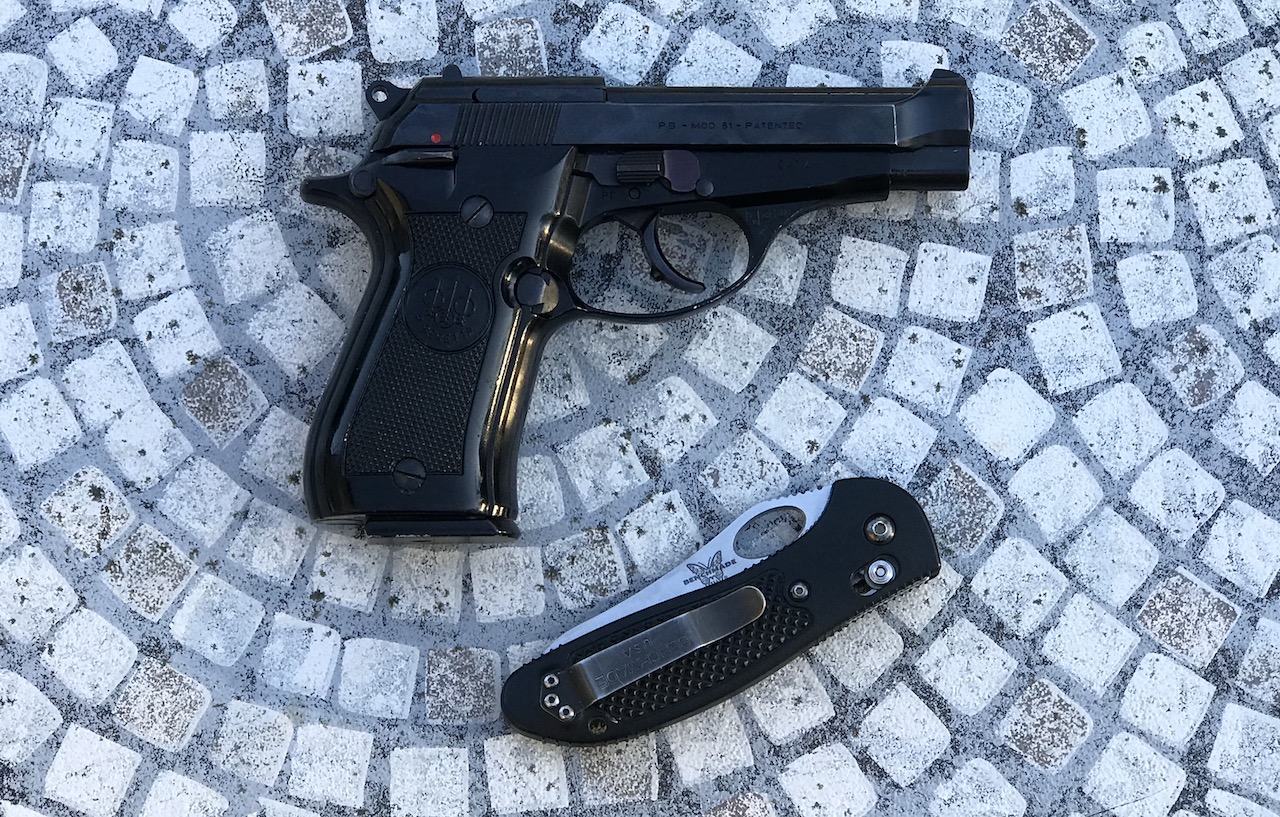
That is a full sized Benchmade Griptilian knife in the picture with the pistol. It's large for a .32 auto so I expect it to be very pleasant to shoot.
I had thought it might be a good gun for my wife but as a straight blowback retracting the slide requires quite a bit of effort, and there's not a lot to hold onto.
Along with the Beretta I picked up two boxes of Aguila 71 grain FMJ .32 ACP ammo. I hope to shoot it this weekend, and I plan to get some European-spec ammo, which tends to be loaded hotter than American ammo in this caliber.
Range reports to follow.
Sunday, August 25, 2019
Sunday, August 11, 2019
Sunday, August 04, 2019
Saturday, July 06, 2019
A Few Things to Improve My Get Home Bag
Full post on my other site, Survival and Emergency Preparedness. Please go check it out.
Subscribe to:
Posts (Atom)


 Posts
Posts


