Saturday, December 27, 2025

Cimarron Pistolero

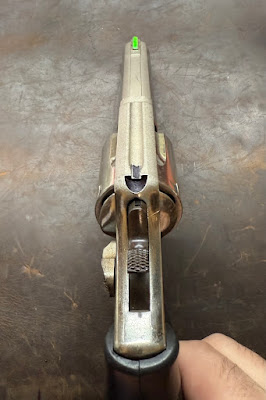
One of the slicker hoglegs I have in my stable is this 4.75" Cimarron Pistolero, built by Pietta. It's a .357 but in my hands it's seen almost entirely .38 Specials. It's one of the guns I kept when my brother and I divided up my father's collection after he passed last year.


As a .357 on a .45 frame it's got a lot of extra metal, which means it soaks up recoil from .38/44-equivalent loads with a 178 Keith and a stiff charge of Herco. Standard pressure .38 Specials are mild to shoot in it.


It's a copy of the Colt Model P and has the original type lockwork, meaning it should be charged with "load 1, skip 1, load 4 and pull the hammer all the way back then lower it onto the empty chamber." For a safety it has a 2-position cylinder pin that when inserted all the way blocks the hammer from dropping fully. This is more to meet import points under the Gun Control Act of 1968 than to actually be used.

I'm waiting on some 158 grain LRNFP bullets from Missouri Bullet Co. with a black powder-compatible lube. I've wanted to try black powder .38 Specials and figure cleanup of a single action will be easier than one of my double action revolvers. (.38 Special was originally a BP round for those who don't know, with 21 grains of BP under a 158 grain LRN bullet.) I load other rounds with BP, btw, so I'm not a newbie at that.

It'll be interesting to see what it'll do with black powder loads.

Sunday, December 14, 2025

Hanukkah 2025

In case anyone wasn't paying attention we got another example of what "Globalize the Intifada" means today.

Once again we see a terrorist attack on Jews on a religious holiday. This time in Australia. An Australian spox on TV said that at least one of the perps was on their radar, "although not for terrorist acts".

I also saw over on X that per Israeli TV, supposedly the Mossad warned the Australian government of an upcoming terrorist attack. See: https://x.com/yudapearl/status/2000197269858271283

On the eve of Hanukkah, the holiday in which we celebrate our triumph over the Greek invaders who desecrated the Temple, we are once again reminded that secular governments will not protect us.

Nobody, Jew or gentile, who is defenseless is protected from harm. The right to self defense is the most basic of human rights. A disarmed populace is deprived of its most essential right to life.

Make no mistake, gun control is EVIL. It disarms victims but never keeps their oppressors from hurting them.

As an American, and as a Jew, I am a Second Amendment absolutist*. I'm a an Endowment Life Member of the NRA, and a Life Member of Gun Owners of America and the Second Amendment Foundation. I've donated to the Firearms Policy Coalition as well.

I'm armed to the teeth -- as ALL good Americans should be. It's been a long standing source of frustration for me that too many of my co-religionists can't get their heads out of their asses on this issue.

There are many Jewish Americans who have woken up to the need to be armed. Not enough, but it's happening. 

As for Israel's gun laws, they are a major reason why I'd never consider living there, permanently or even temporarily for work. Israelis basically live in one of the shittiest neighborhoods on the planet, surrounded by people who want to exterminate them, and their government denies them the means for effective self defence. Fuck. That. Shit.

In the aftermath of October 7th I put together a PDF book, "Guns for Jews," which is available for free from my Google Drive: https://drive.google.com/file/d/18GXFERy8nH1iM6ERtLs-PXX3qXDo5C0K/view?usp=drive_link


*Absolutist, as in it is my belief that all Americans should be able to purchase military grade arms anonymously online and have them shipped to their door. Further, Constitutional Carry should be the law of the land.


Thursday, December 11, 2025

Why I Prefer Revolvers for Pocket Carry

A friend and I were recently discussing home defense and carry guns. We live in an urban/suburban environment. Wild animals aren't really a concern but two-legged cockroaches are. Primary concerns for carry guns are concealability and reliability. Another consideration is that we're both in our late 50s with hand issues.

Both of us used to favor semi autos for concealed carry. He changed over to a Kimber K6S .357 snub, mostly due to problems with grasping the slide on an auto.

In the past I've pocket carried guns like a Ruger LCP .380, a Ruger LCP II Lite Rack .22 LR, and a Keltec P32 in .32 ACP. The problems I've encounterd have been in the case of the LCP .380 is that recoil is extremely unpleasant, while the P32 has had some reliability problems and seems picky with regards to which ammo it functions with. Likewise, the LCP II is very ammo sensitive.

Ruger LCP II Lite Rack .22LR


Keltec P32 .32ACP, with regular and extended mags.


So, earlier this year I changed over first to a S&W Model 632 Airweight and now a S&W 432UC, both in .32 H&R Magnum for pocket carry.

The 632 was retired because it was a gift from my late father, and it's one of only 1471 made in the 1990s. The 432 is new production and has better sights.

The .32 Magnum in a J-Frame is a good choice for concealed carry in my opinion. J-Frames, especially the Centennial-style with an enclosed hammer, is snag-free and can be fired from within a pocket without jamming. In my experience they've been more reliable than subcompact semiauto pistols. The .32s give you 6 shots vs. 5 shots in a .38, .357, or 9mm J-Frame.

The ammo I carry is .32 H&R Magnum 100 grain wadcutter from High Desert Cartridge Company. I've run this over my Garmin chronograph from the 432UC, where it ran a bit over 800 FPS. Per Steve at HDCC it will meet the FBI's minimum penetration requirements in ballistic gel. In effect, this gives me a 5/16" hole punch that will reach an assailant's vitals. Compared with 85 grain JHPs in the same gun it's easier to control.

I should note that my 432UC was not perfect out of the box, however. It has a flaw in the finish which really shouldn't have left the factory but considering it's a carry piece I'm willing to overlook that. Also, the factory grips didn't suit my hand at all so I went on eBay and found a set of the old Uncle Mike's Boot Grips that I like. Finally, the trigger was very heavy, so I got a reduced power rebound slide spring from Wolff. This brought the trigger pull down to an acceptable weight without compromising trigger return, or ignition as a lighter hammer spring might.


S&W 432UC .32 H&R Magnum


I use a Simply Rugged Pocket Protector holster and carry a reload in a Quickstrip.


This is comfortable to pocket carry all day.

Revolver Guy has an unflattering review of a 432UC Ti up. Something he noted is that it's fitted with a short, "California" firing pin to improve its drop safety. It turns out this hurts ignition reliability. I already had on hand an Apex "extended" firing pin, which is actually the same length as the original J-Frame firing pins, so I installed it. I've not had any failures to ignite.

Note, a Colt D-Frame like the Detective Special will get you a 6th shot but be slightly larger, and unless you install a hammer shroud isn't as snag free. It's still nicely pocketable.


Information Technology with Dave Substack

Over the past week I've made the effort to revive my IT and cybersecurity focused Substack, Information Technology with Dave.

If you like what I write it would really help the Substack if you like my articles and subscribe to it.

Thanks.

Thursday, December 04, 2025

Criminal Activity in my Neighborhood Yesterday

We had an incident in our neighborhood yesterday which seems like it was a couple who were either casing my neighbor, or trying the old "distract the victim with a pretty girl" method of robbery.

Note that my neighborhood is not a high-crime area. There is a fair amount of property crime in our township but it's concentrated at a shopping mall about 1.5 - 2 miles away. Violent crime is rare.

My neighbor called me this morning to give me a heads up on the following.

At about 3:30 PM my neighbor came home from work to find his driveway blocked by an SUV, probably a black Honda Ridgeline. As he pulled up he beeped his horn and they moved forward so he could pull into his driveway.

As my neighbor got out of his truck a woman got out of the Honda. He immediately felt something off but was carrying concealed. He asked if he could help her.

She replied by asking if he wanted to sell his truck, which is a 20-year old Toyota Tacoma 4x2, not exactly something in high demand. This raised further red flags in his mind. After a little more questioning and stuttered replies, she got back in her vehicle and then drove off.

Before she drove off my neighbor was able to see through the Honda's darkly tinted windows that there was someone else inside, who tried to lower himself to avoid being seen.

Neighbor called the police. An officer was nearby and was over in about a minute to take a statement. He agreed that they were casing the house or looking to distract my neighbor while the second person in the Honda tried to get into the house.

I have a Ring Doorbell at my front door and a Ring Stick Up camera that covers my driveway and the street in front of my neighbor. They did capture the Honda on video. However, the video from my driveway camera was not able to resolve its license plate due to distance.

My neighbor has been looking into getting security cameras and more external lighting. This incident got him to stop procrastinating and he is now going to move forward. I'm probably going to augment my exterior security stuff as well.

I put together a list of the cameras and exterior solar lighting I have so my neighbor has a starting point for his own system. It's in a Google Sheet which I've shared from my G Drive, here:

https://docs.google.com/spreadsheets/d/1CS6mvUdXwghgEi8iP9QDSePdnUr_TxGVmWE9EUWO6RQ/edit?usp=sharing


Edit: Another neighbor captured some better quality video. Looks like it may be a late model Toyota Tundra. 

Edit 2: We got a better quality pic and ran that through ChatGPT and Google Gemini. Both IDed the truck as a third-gen Toyota Tundra.

Monday, November 24, 2025

More .38 Special Chronograph Results

Yesterday I loaded up 250 rounds of .38 Special. I used up the final 150 Speer 158 grain LSWCs I got when my brother and I split my dad's reloading components last year. These were loaded over 3.5 grains of Titegroup with Aguila No.1-1/2 small pistol primers. I've chronographed that load in the past and from a 4" .38 Special revolver it goes about 775 - 780 FPS, which is comparable to what factory 158 grain lead loads do.

I also had my first dud primer in quite some time today. It was one of the Aguilas. I hit it two or three times in a S&W Model 10-8 and then once more for good measure in a Pietta Pistolero (Colt SAA replica). No dice, so I'll put down that round and punch out the dud primer.

Aside from the Titegroup loads, I also put together 100 rounds with a Lee TL358-158SWC cast bullet over 4.7 grains of Unique, with Servicios Aventuras primers.

Results:


That's a large standard deviation and extreme spread, but not unusual with Unique. It's positionally dependent in the case which can lead to large spreads. That said, it shot well, albeit with a lot of smoke. The combination of the Lee Liquid Alox bullet lubricant and Unique powder makes for a very smokey smokeless load.

I don't have the ability to measure chamber pressure but the performance is definitely in the +P category. IMO, this would make a good woods load for Pennsylvania, and with proper shot placement would likely do well if defending yourself against a criminal. Even though the Lee SWC is not a hollowpoint it's got a very wide meplat and will penetrate well.

Edit: I'm a dope. This batch was loaded with 5.0 grains of Unique, not 4.7. That explains the average MV of over 900 FPS.


Saturday, November 22, 2025

Cylinder Throats on my .32-20

My brother has a set of pin gauges to today I measured the cylinder throats on my .32-20 S&W M-1905, 4th Change Military & Police. I hypothesized that if they were too large it would be the cause of the low velocities I'm seeing with it.

Nope, every one of them measured 0.313". Combined with the barrel/cylinder gap of 0.003" to 0.008" it's in spec. The only thing I can think of is the barrel. Some barrels are just slower than others.

To be fair, this gun is for informal plinking and target shooting for me, since centerfire rifles and handguns aren't legal for small game in PA, and I have much better choices for self defense, so the low velocities don't really matter.

Friday, November 21, 2025

Full charge wadcutters in .38 Special

I've previously mentioned the use of "full charge" wadcutters in .38 Special. As with much of the stuff I do, I got the idea from C.E. Harris. Read his article here.

Today I ran 10 such loads over my Garmin Xero C1 Pro chronograph with the following results:


Full specs for my handloads:

  • .358 powder coated 148 grain double end wadcutters from Missouri Bullet Company
  • 3.5 grains of Alliant Bullseye powder
  • Winchester WSP small pistol primer
  • Mixed .38 brass
I fired them from a Ruger Police Service Six chambered for .357 Magnum, with a 4" barrel.


Substituting 3.5 grains of Hodgdon Titegroup for the Bullseye should give similar results but be cleaner burning.


Chronographed the .32-20

Today I took the M-1905 Military & Police .32-20 to the range and ran a couple different loads over my Garmin Xero C1 chronograph.

First up were 10 of the rounds I loaded last week with an antique Ideal tong tool. These had a 107 grain RNFP bullet over 3.85 grains of Unique.


Next were 10 rounds from a box of HSM .32-20 cowboy action shooting ammo, which have a 115 grain RNFP bullet that's rated at 850 FPS, though HSM doesn't specify on the box or their website from what barrel length. I suspect it's from a rifle or at least a 7.5" revolver.


When I've chronographed this gun before it's been on the slow side. After I got home and cleaned it I measured the barrel/cylinder gap for each chamber using feeler gauges. They ranged from .003" to .008", so the gaps are in spec.

I need to measure the cylinder throats. I have a feeling they're a bit large and that's why the muzzle velocities I'm seeing are slower than load data suggests.


Wednesday, November 19, 2025

Free Soldier Softshell Jacket.

A couple months ago I realized I needed a new softshell jacket. However, I didn't want to spend REI-money as this will be mostly used around town, with light field usage. So, after doing some searching on and off Amazon I ordered a Free Soldier brand Soft Shell Hooded Military Tactical Jacket.


It has over 6,000 reviews on Amazon with an average rating of 4.5 out of 5 stars, so for $56 I thought it was worth a try. It's available in a variety of colors. I went with OD green which strikes a nice balance of being low key in either the city or the woods, without being as overtly military as a camo pattern. I prefer green over brown in the woods since it's not deer-colored.

Like most of the tactical soft shells on the market it's a copy of the TAD Gear Stealth Raider Hoodie, but at a much lower price.

My initial impressions were favorable. The sewing seems to be good quality, the zippers all move smoothly, there were no loose threads, and it fits me well with room for layering. I'm 5'5" but with a spare tire and broad shoulders for my height so I got a 2XL.


Jackets should have a hood if you're going to be out in inclement weather for an extended time. They keep you dryer and warmer. Ideally, the hood should fit comfortably over a hat without forcing it down onto your head. The hood on this jacket meets that requirement. The hood can be rolled up and secured with a flap although I normally just leave it unrolled. The front of the hood can be adjusted with shock cords that run down into the front pockets. It's big enough to comfortably fit over a ball cap and the brim is long enough to fully cover the cap's brim. Aside from helping to create a nice microclimate in front of your face, this is also great for those of us who wear glasses.


The FS jacket has six external pockets. There are two front pockets with long zippers. Inside each is a D-ring to dummy cord items to and a pen or penlight pocket. The right front pocket also has an internal vertical cell phone pocket that easily fits my iPhone 16 Pro.


Both arms have bicep pockets with Velcro panels on the outside. There's also a small pocket on the lower left arm.

Finally, there's a poacher's pocket on the back with zips on both sides. This would be good for stashing a beanie, gloves, or scarf but I wouldn't want something too bulky back there.


There are no inside pockets, which is a negative IMO. A Napoleon pocket would also be nice.

The cuffs are adjustable with Velcro and the hem is adjustable with shock cords to keep out the wind. There are pit zips for ventilation. The front zipper is two way and the pull is on the right side, i.e., American style.


Softshells should be wind and water resistant.

My initial test of the jacket's water resistance was to stand outside from about 10 - 15 minutes in a pouring rain while it was 70*F. While a short test it did not wet through. I felt some cold from the rain on my shoulders but after I came back inside and doffed the jacket it was completely dry inside. Based on this it should handle brief showers fine, and snow shouldn't be a problem, either.

Wind resistance is very good. I've taken it on a couple half hour walks in ~40*F weather with wind at 20 MPH, gusting to 35 MPH. It kept out the wind just fine.

I haven't owned it long enough to determine long term durability but the initial impressions are good, and the price was right.

Wednesday, November 12, 2025

Loading .32-20 WCF Ammunition with an Antique Ideal Tong Tool

Over the weekend I cast some bullets in an antique Ideal reloading tool, so I thought I'd put together a post on how to actually use these things.


From what I can tell it's a No.4 although it differs a little from other No.4s I've seen, in regards to how priming is handled. Anyway, here it is:


With this one tool, you can do the following:

  1. Cast bullets and size them
  2. Decap spent cases
  3. Reprime empty cases
  4. Flare the case mouth
  5. Seat a new bullet in place

Originally it came in a cardboard box with a powder scoop for the right amount of black powder, and a decapping pin. The scoop and decapping pin are usually missing when you find these tools today. For a decapping pin you can use a Lee Precision case length guide intended for trimming brass.

If you need to decap, place the decapper inside a spent case the put the case into the bullet seating chamber, and close the handles. This will pop out the spent primer. The extractor claw on the right side handle will pull the case out a bit so you can remove it from the tool.

I got 49 usable bullets from this session. You need to get and keep the mold hot which is challenging because of the small bullet and the mass of the tool, which is made from cast iron. The entire tool acts like a heat sink. Despite this, when I weighed the bullets they were pretty consistent at 107 grains plus or minus a grain, using soft lead. Only visibly wrinkled bullets weighed less.


The bullets are of a round nosed, flat pointed design, intended for use in lever action rifles and revolvers. It would make a good small game bullet.

To flare the case mouths, I used the outside of the bullet seating chamber as shown here:


Next up I needed to prime the cases. As you can see there's a position on the end of the mold blocks for this.


I was not happy how the Ideal tool handled the combination of virgin Starline .32-20 brass and Aguila No.1-1/2 primers. I couldn't really get the primers flush or below flush. The pin that drives the primers into the pockets needed to be a couple thousands longer. It may be worn down from use. So, I only did a couple then resorted to using a modern Frankford Arsenal hand priming tool to prime the rest of the brass. Another option would be to finish seating the primers flush using a dowel inserted in the case and tapping the case down onto a metal surface like an anvil. (This is how primers are seated using a Lee Loader.)

With bullets and primed cases in hand, the next step is to charge the cases with powder. I'll be shooting this ammo in a 1920s S&W Model 1905, 4th Change Military & Police revolver. I don't want to clean up black powder fouling so instead, I used Alliant Unique. (One of my better pre-election year purchases was an 8 lb. keg of Unique in the Fall of 2019.) Unique could easily have been used by early Ideal customers since it was introduced in 1900 and has been in production ever since.


To measure the powder I used a Lee 0.5cc dipper. With my technique and this batch of Unique, I get an average charge of 3.85 grains per scoop. I could use a slightly higher charge but since I'll just be paper punching or plinking with this ammo there's no need to hot rod a 100 year old gun.


OK, now it's time to seat the bullets. That large lube groove is there to handle a good amount of grease, e.g., tallow or a beeswax/tallow mix, which you need when shooting black powder. Since I'm shooting smokeless I just lubed the bullets with Lee Liquid Alox.

Charged case with bullet in the seating chamber:


And the extractor claw pulling the complete round of ammo out of the seating chamber:


The cartridge on the left is what they look like after the previous step. Something to keep in mind with this sort of tool is that it does not apply a strong crimp. When loaded of a full charge of black powder the bullet cannot telescope back into the case. That's not true with smokeless which leaves a mostly empty case, so as a final step I ran the assembled rounds through a Lee Carbide Factory Crimp Die on my press to fully secure the bullet in the case mouth.


There are some downsides to handloading using this kind of tool:

  • It's slow.
  • It works only with the bullet cast in the integral mold, since seating depth isn't adjustable. However, the bullets from the mold are well suited to the cartridge.
  • The aforementioned lack of crimp.
  • Because the entire tool including the handles is made from cast iron, it acts as a heat sink so getting good bullets from the mold can be a challenge.

That said, now I have 49 more rounds of .32-20 ammo, mostly loaded using late 19th Century technology.

BTW, here's what I'll be firing this ammo in, a 1920s vintage S&W Model 1905, 4th Change, Military & Police revolver. I replaced the original service grips with a set of later Magnas plus a Robertson Trading post grip adapter (copy of the Tyler T-Grip) to make it easier to hold onto when shooting double action. The paint on the front sight is to make it easier to see with 57 year old eyes. The M-1905 is the predecessor to the familiar Model 10, most commonly chambered for .38 Special.


Monday, November 03, 2025

Removing a Stuck Ball in a Muzzleloader

If you shoot a muzzleloader long enough at some point you'll "dry ball," i.e., load the ball without a powder charge. At that point you'll need to remove it.

Note that the following applies to traditional muzzleloaders, not inlines with easily removable breech plugs.

Some guns allow you to remove the nipple or flash hole liner and dribble in a little bit of fine grained powder, then shoot the ball out. E.g., if you do this in a percussion revolver it's pretty straightforward to remove the cylinder, remove the nipple, dribble in a small amount of powder, reassemble, cap and shoot the ball out.

However, many times you can't easily get enough powder behind the ball to bloop it out.

One option is a CO2 ball discharger. This uses CO2 from a cylinder to shoot out the ball using gas pressure. Many guys like these to unload a gun after hunting if they haven't fired it.

Otherwise, you need to pull the ball, for which you need a stout range rod or ramrod and a ball screw.

I've setup my rifles with Delrin ramrods that have threaded brass tips on both ends. The tips are both glued and cross-pinned to the rod so they don't pull off. (They will eventually come off if you don't cross-pin them.)

When I'm hunting or shooting a woods walk with a muzzleloader, I keep a small leather bag in my shooting pouch that contains a few items to keep my rifle running in the field:


L to R are:

  • Nipple wrench
  • Ball screw
  • Patch pulling worm
  • 8-32 male to 10-32 female thread adapter
  • Cleaning jag
  • Replica US M-1817 tow worm

Note how the ball screw has a brass collar around it. It's just smaller than the bore and serves to keep it centered as you screw it into the ball. 

The corkscrew-type worm is for pulling patches from the bore if one slips off a jag. The M-1817 worm will do that, but can also be used to scrub the bore with tow fiber wrapped around it like a primitive bore brush.

I've made up similar sets for .45, .50, .54, and .58. I may omit the thread adapter and don't usually carry both types of worm. 

You can get most if not all those accessories from Track of the Wolf, Dixie Gun Works, October Country, Crazy Crow Trading Post, Muzzle-loaders.com, The Possible Shop, or even Amazon.

Along with the bag of ramrod tips I also carry an aluminum T-handle from Track of the Wolf in my bag. This screws onto the other end of the rod and gives you something to grab onto.


To pull a ball here's how I do it:

  1. If the bore is fouled run a damp patch down it to remove most of the crud, then run an oiled patch down to lube the patched ball on the way out.

  2. Screw the T-handle and ball screw onto the rod.

  3. Optionally, put a small drop of oil or smear some bullet lube onto the tip of the ball screw to make it easier to screw into the lead ball.

  4. Put the ramrod down the barrel and using some pressure, drill into the stuck ball with the ball screw. You'll want to ensure you have good engagement but don't overdo it and strip it out

    Note: Once you start drilling the screw into the ball never turn the ramrod counter-clockwise because the ball screw will come off the end of your ramrod.

  5. Give the ramrod a sharp tug to get it started. If necessary, invert the rifle and hold the T-handle between your feet then give the rifle a sharp upwards tug. This usually gets it moving.

If the ball is really stuck, tie the T-handle to a tree or other immovable object and then yank on the rifle.

If the ball screw strips out of the ball you can retry it but at that point you may need to resort to a CO2 discharger or in a worst case scenario, unbreech the barrel. This is known as a bad day.

If you pull the ball from an unused hunting charge you may be able to dump some of the powder immediately, but you may need to break it up with the ball screw and/or worm first, because it'll be compacted in the breech.

Knowing how to pull a ball is an important skill for muzzleloader shooters. Aside from dry balls, you may want to pull a ball after an unsuccessful hunt rather than shooting it out and fouling your gun.

And yes, you can shoot a ball that you've pulled. It's basically a hollowpoint now if you load it with the hole facing up. AAMOF, yesterday I fired a ball I pulled after the Pennsylvania early muzzleloader deer season. I shot it at the Boyertown fun shoot and whacked a gong out at about 70 yards with it.

Sunday, November 02, 2025

Found the Real Problem with my .54 Caplock

I shot my Investarm .54 Hawken again today at the Boyertown fun shoot and it turns out that I wasn't having cap problems at all. Rather, it was that the fly in my lock was not working properly and on many of the drops wasn't allowing the hammer to fall past the half cock notch if the trigger was set before firing. I pulled the lock, made sure the fly was moving freely and lubed it with a couple of drops of Ballistol. After I did that I had no more ignition problems.

Tomorrow I'm going to remove the lock and blast it out with brake cleaner, then relube with Shooters Choice FP-10. Unlike Ballistol, FP-10 doesn't gum up and is good down to -40F, which is 50 degrees colder than I ever plan to be out shooting or hunting.

I plan to do that with my other sidelocks as well.

Note:

Sidelocks meant for use on muzzleloading rifles or pistols with set triggers have a part called a "fly." It is a small, pivoting piece that when working correctly, prevents the half cock notch from catching on the sear. A fly is not needed on a lock used with a gun that doesn't have a set trigger, because of how the set trigger kicks the sear when the gun is fired.

Sunday, October 19, 2025

Glad I Shot a Woodswalk Today

I shot the Boulder Valley woods walk course today with my .54 caplock and I'm really glad I did. I opened a new batch of CCI #11s and half of them were really snug on the nipple. About half my shots required multiple strikes to set off the cap. I even tried changing the nipple (I keep a spare in the cap box) but it was about as bad.

On the last target I hit the cap 4 times and it didn't go off. I replaced it and that one went off.


The rifle is a Cabela's (Investarm) Hawken that was originally a .50. I took a huge doe with it three years ago but even though the shot was good and did a massive amount of damage to both lungs, there was no exit wound and the blood trail was poor. So, last year I bought a replacement barrel in .54 in the hopes that the heavier ball will be more likely to completely pass through the deer and give a better blood trail if it runs.

After I got home I chucked both nipples in my drill and filed them down to accept RWS No.1075+ caps. I want to make sure I'm using known-good caps when I go hunting later this week. It's Pennsylvania's early muzzleloader, antlerless-only season.

My loads today were a .530 home cast ball in a pillow ticking patch lubed with Mr. Flintlock, over 70 grains of 2Fg Goex black powder. My hunting load for the rifle is 80 grains of powder but I wanted to save the steel targets a little wear and tear.

Anyway, even with the cap frustrations I shot an 18/20, one better than the match last weekend in which I took first place. (I shot my Slotter rifle replica in the match, as usual.)

Monday, October 06, 2025

LED Upgrade for Surefire G2, and Why Lithium Batteries Rock

Why lithium batteries rock:

Tonight I replaced the old halogen bulb in a Surefire G2 flashlight with an LED conversion unit. The output is much brighter with a great throw. I checked the batteries in the flashlight and they are the original Surefire CR123A batteries, with a 2015 expiration date, which was 10 years from when they were manufactured. Yes, this thing is still functioning with 20 year old batteries.

This particular light lives on a nightstand and gets used very infrequently, which is why I haven't used up the batteries. But for them to last 20 years and still be useful is impressive, to say the least.

This is the LED conversion I used: https://amzn.to/4oaiHzv

To fit the G2 I had to remove the outer coil spring, after that it just dropped in. 

Wednesday, October 01, 2025

Casting Sessions

Today I did some bullet casting. The temp was around 70F so I was able to do so out in my shop without sweating like a pig.


I cast up a bunch of .530" round balls for use in my .54 caliber rifles, and a few Lee 578-478M Minie balls to try in my Zouave. I'd forgotten about the Minie ball mould. I think I picked it up used last year at Dixon's.


After I culled the bad ones, I wound up with 106 of the .530 balls and 16 of the Minies.

The Minie mould is a little challenging to cast with. I think it would work better if Lee had used larger blocks to retain the heat better once it's up to temp.

The Lee round ball mould works fine, although I wish it was a 6 cavity instead of the 2 cavity mould I have. In my experience, the 6 bangers maintain temp better and you can cast a large quantity of bullets in a relatively short time.

Zouave Rifle Range Report

Yesterday I shot my Euroarms Remington 1863 "Zouave" rifle with replicas of the Williams cleaner bullet and some Lyman 575213 Minie balls.


My rifle was made in 1986 and I traded into it two years ago.

The original nipple took musket caps as you'd expect on a military rifle, but I found that as a left handed shooter, my right forearm and hand got peppered with debris. That was extremely unpleasant. I put a nipple that takes No.11 caps on it, which still gives reliable ignition but without the annoying spray on my arm.

The Williams cleaner bullets I have came from Gimcrack & Bunkum, a one man shop located in Pennsylvania. They are replicas of those issued during the Civil War. Unlike the Minie balls, they have a disc on a post that's attached to the base of the bullet. The disc expands into the rifling and scrapes out the fouling. These are 487 grains and .574" in diameter. I found them to shoot to about the same point of impact as the Lyman 575213 Minies, which weigh 510 grains, when both were fired over 60 grains of 2Fg Goex. I got the Minies from Track of the Wolf.


Some of my shots showed that the base separated from the body of the bullet and impacted elsewhere on the target. At 50 yards they broke the paper but not the plastic target backer.


When I bought the Williams bullets I chose to get them pre-lubed. The gap between the bottom disc and the base of the bullet has to be lube-free for it to work properly. The Minie was lubed by me a couple years ago with something, I forget what.

Offhand accuracy with this rifle is challenging due to a heavy trigger, probably around 10 lbs. I've considered taking the Zouave out for Pennsylvania's early antlerless-only season in October. I'll be hunting from a blind and will be able to shoot from a rest. But I'll probably use just a .54 caliber Investarm Bridger Hawken which has a nice trigger and is easier to shoot well.

Aside from the conicals I brought some .562" round balls, which shoot well in the rifle. However, I forgot my short starter so I stuck with the Williams and Minie bullets.

Friday, August 29, 2025

On a Percussion Revolver Kick Again

Lately I've been on a percussion revolver kick again, and chronographing several different loads. With the Garmin Xero C1 chronograph I got last year it's very easy to measure the velocity of your loads. Among other things, this tells you the relative strength of different powders. I've put my results into a spreadsheet hosted on my Google Drive here:

https://docs.google.com/spreadsheets/d/1DUpnrvYi4rrXWYR4gLM9YhW5mkkv1WjWNZwE3c2W0sM/edit?usp=drive_link

I'll update the spreadsheet as I get more data, but as you can see, from least to most energetic are Scheutzen 3Fg, Goex 3Fg, Swiss 3Fg, and Hodgdon Triple 7 3Fg.

Incidentally, I've read in several places that Triple 7 begins to lose power once you open the bottle, due to it absorbing atmospheric moisture. If that's true then it must've really been energetic because this is from a bottle I bought at least 10 years ago. Up until a couple months ago the T7 powder had remained in the bottle with the lid screwed on tightly, inside my house with central air conditioning. A few months ago I put the remaining T7 into a powder flask, which doesn't seal nearly as well as the factory bottle.

For the most part, I use loose powder and ball, but have experimented with combustible paper cartridges. The cartridges can be handy but many modern replica revolvers have loading ports which make using them difficult, unless you grind away some excess metal.

A good compromise between the convenience of cartridges and loose powder and ball are the Quick Load tubes sold by Dixie Gun Works. I've seen them in the Dixie catalog for years (really, decades) and more recently on Blackie Thomas's YouTube channel. I finally bought a couple bags, one each for .36 and .44 caliber.

Dixie tubes: https://www.dixiegunworks.com/index/page/search?FullText=dixie+tubes

I got the target tubes. In .44 caliber the maximum charge they'll hold and securely hold a roundball is 40 grains of black powder. Likewise, Dixie lists 25 grains as the maximum charge for the .36 tubes but I found 20 grains to be the most it can hold with a .380 ball. It's possible the batch I got are shorter than older batches.


(Yeah, my workbench is a mess.)

Compared with combustible cartridges in a properly setup revolver they're a bit slower to use but they are much quicker to load at home, and also more robust. That "properly setup" part is important. While the 19th Century revolvers were setup with the proper dimensions around the loading port to accept cartridges, many modern revolvers won't without some grinding. If you don't want to modify the loading port on your gun, the Dixie tubes are a nice alternative.

The Dixie tubes should also be more water resistant than combustible cartridges.

The .36 caliber tubes will fit into an MTM flip top cartridge box for .38 Special or .357 Magnum cartridges. The .44 tubes are a little too fat to fit into the MTM .44 Mag boxes but fit well in the MTM box for .500 S&W.


Another good option for field carry of pre-measured black powder charges are flip-top centrifuge tubes. I've been using them for several years to carry reloads for my rifle during the muzzleloader deer season. Patches balls are carried in a loading block.

Sunday, July 27, 2025

Musket Capper and Powder Can Spout

Yesterday I went up to the Gunmakers Fair at Kempton and drooled over a bunch of guns I cannot currently afford. However, I did pick up a couple items that will be handy when shooting my smokepoles.


The first is a musket capper. It doesn't have any markings on it except for "ITALY" but it appears to be the same capper that Dixie Gun Works used to sell as item # NA0401. When I got my Euroarms Zouave a few years ago I wanted to get one of these but they appear to be out of production, or at least nobody is importing them into the USA.

Dixie's description on how to load the caps is incorrect. You don't remove the lid, which is riveted on. Rather there is a sliding door through which you feed the caps.


I found it at one of the vendor's tables for $20. It even had seven musket caps in it. I've removed them for storage in a test tube since the make and whether they're any good is unknown. I'll pop them on the nipple to clear it of any oil before loading, saving a few of my known-good caps.

Incidentally, you can see why musket caps are sometimes called "top hat" caps.

The capper was a bit grungy so I rubbed it down with 0000 steel wool, just enough to remove any bumpy verdigris but not the patina.

The second item is a valve to install on a powder can lid for use at the range. The spout itself is a recycled 7.62 NATO blank, mated with a brass nipple, a couple washers, and a spring loaded cap.

EDIT: I discovered that you can unscrew the top of the capper. What I thought was a rivet is actually a threaded stud. I think though that using the sliding door on the side is how you're meant to fill it.


Sunday, July 06, 2025

Stainless Wheelgun Sunday

Today I took a couple wheelguns to the range and spent most of my time smacking the 25 yard plate rack.


The guns are a 2.75" Ruger Speed Six in .357 Magnum and a 4" Smith & Wesson Model 64-3 in .38 Special. All the ammo I shot today were my own .38 reloads with Speer 158 grain LSWCs in mixed brass, Servicio Aventuras primers, and Bullseye powder. 100 rounds had 3.3 grains of Bullseye while the other hundred had a more typical 3.5 grains.

With 3.5 grains of Bullseye, a 4" .38 will push a 158 grain bullet to about 775 FPS average, duplicating typical non-plus P performance. It's accurate and very pleasant to shoot in a service sized revolver.

I was also pleased to see that the two other people on the range while I was there were a couple fellow Members of the Tribe. It's always good to see fellow Jews exercising their Second Amendment right to keep and bear arms. One guy was instructing the other. They had some kind of semiatuomatic 9mm with a red dot sight, and learning defensive shooting.

My free PDF book for Jews looking to arm themselves is available from my Google Drive, Guns for Jews v5.0.


(How'd I know they were Jewish? Well, the kippah was the big giveaway. But a lot of us have Jewdar, too. ;) )

Thursday, July 03, 2025

High Desert Cartridge Company .38 Special 148 Grain Wadcutters

Today I ran some High Desert Cartridge Company .38 Special 148 grain HBWCs over my Garmin chronograph from 2 .357 Magnum revolvers.

First, from my S&W 640-1 with a 1-/7/8" (nominal 2") barrel, 10 shots averaged 753 FPS.


Second, from my S&W 66-2 with a 2.5" barrel, 8 shots averaged 788.7 FPS. For some reason 2 shots didn't register.


Everything else being equal, I would expect 25 - 50 FPS more velocity from a gun chambered in .38 Special, due to less freebore.

High Desert Cartridge Company advertises this load at 725 FPS from a 2" snubbie with 18" of penetration in ballistic gelatin.

In my opinion this would be an excellent carry load in .38 Special of .357 Magnum snubbie revolvers. It's controllable in rapid fire but will poke a clean hole all the way into the vitals.


Sunday, June 29, 2025

A Factory Nickel Smith & Wesson Model 10-8

Last year after my father died, my brother and I split up his gun collection. Among the large number of Smith & Wesson double actions was this factory nickel Model 10-8, chambered in .38 Special, of course.


Over on AmericanFightingRevolver.com, "Bryan with a Y" did a video covering the 10-8 variant of the Military & Police and noted it as being one of his favorites, for several reasons. Based on my sample of one he's absolutely right.

The action on this revolver is exceptionally smooth. Dad wasn't one to tinker. His idea of a trigger job on a K-Frame was putting 1,000 rounds through it double action. I don't think he fired this one all that much, though because it was very clean when I got it. In his later years he got less meticulous with cleaning, and this one was pretty much spotless.

As indicated by the "TWC (redacted number)" stamped on the left side of the frame, the gun formerly belonged to The Wackenhutt Corporation, a provider of security services. It appears to have spent most of its time in the armory.


When I got it the gun wore a set of S&W Magnas and I shot it like that for awhile. However, even when fitted with a grip adapter I find the old Uncle Mike's Combat grips more comfortable for long shooting sessions.

When looking at the back of the cylinder you can see that although the gun is nickeled, the ejector star and ratchet are blued. There is an "N" stamped between the top two charge holes, indicating that it came from the factory in nickel.


S&W matted the top of the frame and barrel but for improved visibility I painted the front sight using a white base coat topped with 2 or 3 coats of lime green nail polish. I blacked out the rear sight with a Sharpie marker to reduce glare.


Yesterday I got together with a friend to shoot on his property and put 100 rounds through the Model 10-8. From 10 yards in rapid double action it was easy to blow out the black on a B-8 repair center target.


The loads were a Speer 148 grain BBWC over 2.9 grains of Accurate No.2 in W-W wadcutter brass, and Servicio Aventuras primers. This is a very pleasant load to shoot in a K-Frame, and cleaner burning than the equivalent when loaded with Bullseye.