My G-d there is a lot of utter rubbish being spewed about 3D printed guns in the media over the past couple of days. Some facts:
1. You cannot "download a gun."
1a. On a related note, you cannot legally buy a gun off the Internet and avoid a background check. You can buy a gun over the Internet but it has to be shipped to a local, Federally-licensed firearms dealer, and you need to pass a background check before you take delivery. There is no "Internet loophole."
2. You can download plans, including 3D CAD files for various guns. Think of these as blueprints that can be turned into code for use by a 3D printer or CNC milling machine, which can be used to make a gun.
3. Speaking of which, it has always been legal under Federal law to make a gun for your own personal use. If you want to manufacture them for sale, that has been regulated for decades.
4. Some states do make it illegal to make a gun for your own use.
5. Most 3D printed guns are not undetectable. For example, if you 3D print the receiver for an AR-15 (the part that in the USA is legally the gun), you still need a lot of metal parts to have a functioning firearm. E.g., the barrel, bolt, firing pin, springs, etc.
5a. The exception to #5 appears to be the Defense Distributed Liberator, which is a single shot .22 pistol. Do you really think that a criminal is going to spend a shitload of money on a 3D printer so he can make an untraceable single shot .22 pistol? It's cheaper, easier, and faster to buy a stolen pistol like a Hi Point 9mm or even a Glock on the street.
6. For the most part, this hysteria about undetectable plastic guns is reminiscent of the BS spewed about Glocks in the 1980s. Despite what you heard in "Die Hard," Glocks are made largely of metal and stick out like a sore thumb if you try to pass one through a metal detector.
7. Even after Defense Distributed pulled their CAD files from the Internet in 2013, the cat was out of the bag. If you had a clue, they were not difficult to find. As per John Gilmore, the Internet interprets censorship as damage and routes around it.
Finally, gun controllers lie. That's what they do. They cannot make arguments based on facts, so they lie. For example, Senator Richard Blumenthal (D-CT) recently gave a speech about undetectable firearms with a picture of an AR-15 next to him. A rifle with a few pounds of steel and aluminum in it is going to be undetectable? Not hardly.
Think about any topic in which you have in depth knowledge. Then consider how the mainstream media covers said topic, and how inaccurate they usually are.
This is just the latest in the American left finding something to be outraged about and stir up shit.
Tuesday, July 31, 2018


Saturday, July 28, 2018
Old Gun Day at the Range
Today was old gun day at the range.
First up was my Wartime Commercial Mauser C96 Broomhandle, in 7.63x25 (.30 Mauser). I wanted to see how it would do at 50 yards when shot with the stock attached.

(The empty clip is in the pistol in lieu of a chamber flag.)
As you can see from the target, it's nothing to shout about. The short sight radius coupled with a front sight that's hard to see hinders accuracy. I fired this 20 shot group with my elbows rested on the shooting bench. (The hole on the right side of the target is from when my kid accidentally shot at my target instead of hers.)

It's nothing to write home about but if I needed to use this gun for defense (which has a probability approaching zero) it would work out to 50 yards.
Next up was my Winchester 1892 sporting rifle made in 1895. It's chambered for .38-40 WCF, which is a nice mild-recoiling round that will work for short-range deer hunting. Ballistics from a rifle are similar to a 10mm handgun.

Anyway, I am seriously considering having the barrel relined. The bore has quite a bit of pitting, and worse, the crown has a lot of cleaning rod wear. No pics of the target, but it was a 10-shot group of about 8". If I have it relined, I'd expect it to shoot as well as my Cimarron 1873, being able to hold the 10-ring at 50 yards.
First up was my Wartime Commercial Mauser C96 Broomhandle, in 7.63x25 (.30 Mauser). I wanted to see how it would do at 50 yards when shot with the stock attached.

(The empty clip is in the pistol in lieu of a chamber flag.)
As you can see from the target, it's nothing to shout about. The short sight radius coupled with a front sight that's hard to see hinders accuracy. I fired this 20 shot group with my elbows rested on the shooting bench. (The hole on the right side of the target is from when my kid accidentally shot at my target instead of hers.)

It's nothing to write home about but if I needed to use this gun for defense (which has a probability approaching zero) it would work out to 50 yards.
Next up was my Winchester 1892 sporting rifle made in 1895. It's chambered for .38-40 WCF, which is a nice mild-recoiling round that will work for short-range deer hunting. Ballistics from a rifle are similar to a 10mm handgun.

Anyway, I am seriously considering having the barrel relined. The bore has quite a bit of pitting, and worse, the crown has a lot of cleaning rod wear. No pics of the target, but it was a 10-shot group of about 8". If I have it relined, I'd expect it to shoot as well as my Cimarron 1873, being able to hold the 10-ring at 50 yards.
Vinpok Bolt "MagSafe" Power Cord for MacBook Pro
If there's one thing I hate about the most recent MacBook Pros, it's that Apple replaced the MagSafe power connector with USB-C AKA Thunderbolt 3 ports.
My MBP sits on my coffee table when not in use, and I've been worried that eventually someone would trip over the power cord. It happened with my previous machine but because of the MagSafe connector, it wasn't damaged.
About a week ago I went looking for a MagSafe-analogue that supports the 87W power supply of the 15" MBPs and found a couple. I ordered a Vinpok Bolt USB-C Magnetic Cable on July 15th and it arrived yesterday the 27th, from China.
The magnetic adapter that plugs into one of the USB-C ports:

It adds virtually no bulk. The matching cord that replaces the factory USB-C cable from the Apple power brick:

My first impressions are generally positive. However, it should be noted that the magnets in the Vinpok Bolt are much weaker than those found on the Apple MagSafe connectors. Moving the laptop is frequently enough to dislodge the Vinpok Bolt. The overall size of the Bolt is smaller than the MagSafe connector, so that's to be expected.
That said, as long as it continues to work as advertised, it's worth it IMO to regain the safety feature of the Apple MagSafe connector.
My MBP sits on my coffee table when not in use, and I've been worried that eventually someone would trip over the power cord. It happened with my previous machine but because of the MagSafe connector, it wasn't damaged.
About a week ago I went looking for a MagSafe-analogue that supports the 87W power supply of the 15" MBPs and found a couple. I ordered a Vinpok Bolt USB-C Magnetic Cable on July 15th and it arrived yesterday the 27th, from China.
The magnetic adapter that plugs into one of the USB-C ports:

It adds virtually no bulk. The matching cord that replaces the factory USB-C cable from the Apple power brick:

My first impressions are generally positive. However, it should be noted that the magnets in the Vinpok Bolt are much weaker than those found on the Apple MagSafe connectors. Moving the laptop is frequently enough to dislodge the Vinpok Bolt. The overall size of the Bolt is smaller than the MagSafe connector, so that's to be expected.
That said, as long as it continues to work as advertised, it's worth it IMO to regain the safety feature of the Apple MagSafe connector.
Monday, July 23, 2018
New Sights for the Rossi 92
My 14 y/o daughter wants to join me deer hunting this year so I needed something she could shoot well with mild recoil. The Rossi 92 in .357 Magnum I bought several years ago fits the bill, but I wanted to improve her hit probability, which meant mounting an optic.
As a copy of the Winchester 1892, the Rossi 92 is a top-eject design, which complicates optic mounting. You need to either find some kind of a mount offset to the side or use something with long eye relief mounted on the barrel.
Rossi drilled and tapped the barrel for a scope mount. The holes are covered up by the open rear sight, which must be removed to use them.
NOE Bullet Molds makes a very nice Picatanny rail that fits the Rossi. I ordered one and received it in a few days. Before installing it, I degreased the mounting holes in the barrel using denatured alcohol, and put a drop of thread locker on each screw.

The optic I chose was a Bushnell TRS-25 red dot sight. Since my Rossi is in .357 I view it as a 75 yard deer rifle. A non-magnified optic is fine for such ranges.
I have a few other TRS-25s and they've all been very good, with clear lenses, a well-defined dot, and rugged. As a micro-dot sight the TRS-25 hardly affects how a rifle feels. Finally, they are low-priced. I got this one for $45 shipped on Amazon Prime. (I just checked Amazon and it's now listed for $43.24.)
Because the NOE rail required removal of the rear sight the gun is left without backup irons if your optic tanks. So, I ordered a bolt-mounted peep from Steve's Guns. When I first bought the carbine I installed one of his safety replacement plugs. I wish I'd just gone straight to his very slick peep sight.

The resulting package is still light and handy with plenty of firepower, but vastly improved low-light shootability.
Last weekend I took my kids camping and my daughter got to put 50 rounds of Fiochi .357 Magnum 158 grain JHPs through the Rossi. Without zeroing the RDS on paper, she was easily able to keep her shots on a 10" gong, shooting rapidly offhand at 25 - 30 yards.
We're hoping to get to the range next weekend so she can get some more practice in and so we can zero the Bushnell.
The final touch to ready the Rossi for hunting season will be to add quick-detach sling swivel studs and a sling.
As a copy of the Winchester 1892, the Rossi 92 is a top-eject design, which complicates optic mounting. You need to either find some kind of a mount offset to the side or use something with long eye relief mounted on the barrel.
Rossi drilled and tapped the barrel for a scope mount. The holes are covered up by the open rear sight, which must be removed to use them.
NOE Bullet Molds makes a very nice Picatanny rail that fits the Rossi. I ordered one and received it in a few days. Before installing it, I degreased the mounting holes in the barrel using denatured alcohol, and put a drop of thread locker on each screw.

The optic I chose was a Bushnell TRS-25 red dot sight. Since my Rossi is in .357 I view it as a 75 yard deer rifle. A non-magnified optic is fine for such ranges.
I have a few other TRS-25s and they've all been very good, with clear lenses, a well-defined dot, and rugged. As a micro-dot sight the TRS-25 hardly affects how a rifle feels. Finally, they are low-priced. I got this one for $45 shipped on Amazon Prime. (I just checked Amazon and it's now listed for $43.24.)
Because the NOE rail required removal of the rear sight the gun is left without backup irons if your optic tanks. So, I ordered a bolt-mounted peep from Steve's Guns. When I first bought the carbine I installed one of his safety replacement plugs. I wish I'd just gone straight to his very slick peep sight.

The resulting package is still light and handy with plenty of firepower, but vastly improved low-light shootability.
Last weekend I took my kids camping and my daughter got to put 50 rounds of Fiochi .357 Magnum 158 grain JHPs through the Rossi. Without zeroing the RDS on paper, she was easily able to keep her shots on a 10" gong, shooting rapidly offhand at 25 - 30 yards.
We're hoping to get to the range next weekend so she can get some more practice in and so we can zero the Bushnell.
The final touch to ready the Rossi for hunting season will be to add quick-detach sling swivel studs and a sling.
Wednesday, July 11, 2018
Your Very Own Dictatorship
The following essay was Posted by an online acquaintance. I didn't write it. But I agree with it.
Your very own dictatorship.
Two or more sides disagree on who runs the country. And they can’t settle the question through elections because they don’t even agree that elections are how you decide who’s in charge.
That’s the basic issue here. Who decides who runs the country? When you hate each other but accept the election results, you have a country. When you stop accepting election results, you have a countdown to a civil war.
The Mueller investigation is about removing President Trump from office and overturning the results of an election. We all know that. But it’s not the first time they’ve done this. The first time a Republican president was elected this century, they said he didn’t really win. The Supreme Court gave him the election. There’s a pattern here.
What do sure odds of the Democrats rejecting the next Republican president really mean? It means they don’t accept the results of any election that they don’t win. It means they don’t believe that transfers of power in this country are determined by elections.
That’s a civil war.
There’s no shooting. At least not unless you count the attempt to kill a bunch of Republicans at a charity baseball game practice. But the Democrats have rejected our system of government.
This isn’t dissent. It’s not disagreement. You can hate the other party. You can think they’re the worst thing that ever happened to the country. But then you work harder to win the next election. When you consistently reject the results of elections that you don’t win, what you want is a dictatorship.
Your very own dictatorship.
The only legitimate exercise of power in this country, according to Democrats, is its own. Whenever Republicans exercise power, it’s inherently illegitimate. The Democrats lost Congress. They lost the White House. So what did they do? They began trying to run the country through Federal judges and bureaucrats. Every time that a Federal judge issues an order saying that the President of the United States can’t scratch his own back without his say so, that’s the civil war.
Our system of government is based on the constitution, but that’s not the system that runs this country. The Democrat's system is that any part of government that it runs gets total and unlimited power over the country.
If the Democrats are in the White House, then the president can do anything. And I mean anything. He can have his own amnesty for illegal aliens. He can fine you for not having health insurance. His power is unlimited. He’s a dictator.
But when Republicans get into the White House, suddenly the President can’t do anything. He isn’t even allowed to undo the illegal alien amnesty that his predecessor illegally invented. A Democrat in the White House has “discretion” to completely decide every aspect of immigration policy. A Republican doesn’t even have the “discretion” to reverse him. That’s how the game is played. That’s how our country is run. Sad but true, although the left hasn’t yet won that particular fight.
When a Democrat is in the White House, states aren’t even allowed to enforce immigration law. But when a Republican is in the White House, states can create their own immigration laws. Under Obama, a state wasn’t allowed to go to the bathroom without asking permission. But under Trump, Jerry Brown can go around saying that California is an independent republic and sign treaties with other countries. The Constitution has something to say about that.
Whether it’s Federal or State, Executive, Legislative or Judiciary, the left moves power around to run the country. If it controls an institution, then that institution is suddenly the supreme power in the land. This is what I call a moving dictatorship.
Donald Trump has caused the Shadow Government to come out of hiding: Professional government is a guild. Like medieval guilds. You can’t serve in if you’re not a member. If you haven’t been indoctrinated into its arcane rituals. If you aren’t in the club. And Trump isn’t in the club. He brought in a bunch of people who aren’t in the club with him.
Now we’re seeing what the pros do when amateurs try to walk in on them - They spy on them, they investigate them and they send them to jail. They use the tools of power to bring them down.
That’s not a free country.
It’s not a free country when FBI agents who support Hillary take out an “insurance policy” against Trump winning the election. It’s not a free country when Obama officials engage in massive unmasking of the opposition. It’s not a free country when the media responds to the other guy winning by trying to ban the conservative media that supported him from social media. It’s not a free country when all of the above collude together to overturn an election because the guy who wasn’t supposed to win won.
Have no doubt, we’re in a civil war between conservative volunteer government and a leftist professional government.
That is how WARS START from within.
Your very own dictatorship.
Two or more sides disagree on who runs the country. And they can’t settle the question through elections because they don’t even agree that elections are how you decide who’s in charge.
That’s the basic issue here. Who decides who runs the country? When you hate each other but accept the election results, you have a country. When you stop accepting election results, you have a countdown to a civil war.
The Mueller investigation is about removing President Trump from office and overturning the results of an election. We all know that. But it’s not the first time they’ve done this. The first time a Republican president was elected this century, they said he didn’t really win. The Supreme Court gave him the election. There’s a pattern here.
What do sure odds of the Democrats rejecting the next Republican president really mean? It means they don’t accept the results of any election that they don’t win. It means they don’t believe that transfers of power in this country are determined by elections.
That’s a civil war.
There’s no shooting. At least not unless you count the attempt to kill a bunch of Republicans at a charity baseball game practice. But the Democrats have rejected our system of government.
This isn’t dissent. It’s not disagreement. You can hate the other party. You can think they’re the worst thing that ever happened to the country. But then you work harder to win the next election. When you consistently reject the results of elections that you don’t win, what you want is a dictatorship.
Your very own dictatorship.
The only legitimate exercise of power in this country, according to Democrats, is its own. Whenever Republicans exercise power, it’s inherently illegitimate. The Democrats lost Congress. They lost the White House. So what did they do? They began trying to run the country through Federal judges and bureaucrats. Every time that a Federal judge issues an order saying that the President of the United States can’t scratch his own back without his say so, that’s the civil war.
Our system of government is based on the constitution, but that’s not the system that runs this country. The Democrat's system is that any part of government that it runs gets total and unlimited power over the country.
If the Democrats are in the White House, then the president can do anything. And I mean anything. He can have his own amnesty for illegal aliens. He can fine you for not having health insurance. His power is unlimited. He’s a dictator.
But when Republicans get into the White House, suddenly the President can’t do anything. He isn’t even allowed to undo the illegal alien amnesty that his predecessor illegally invented. A Democrat in the White House has “discretion” to completely decide every aspect of immigration policy. A Republican doesn’t even have the “discretion” to reverse him. That’s how the game is played. That’s how our country is run. Sad but true, although the left hasn’t yet won that particular fight.
When a Democrat is in the White House, states aren’t even allowed to enforce immigration law. But when a Republican is in the White House, states can create their own immigration laws. Under Obama, a state wasn’t allowed to go to the bathroom without asking permission. But under Trump, Jerry Brown can go around saying that California is an independent republic and sign treaties with other countries. The Constitution has something to say about that.
Whether it’s Federal or State, Executive, Legislative or Judiciary, the left moves power around to run the country. If it controls an institution, then that institution is suddenly the supreme power in the land. This is what I call a moving dictatorship.
Donald Trump has caused the Shadow Government to come out of hiding: Professional government is a guild. Like medieval guilds. You can’t serve in if you’re not a member. If you haven’t been indoctrinated into its arcane rituals. If you aren’t in the club. And Trump isn’t in the club. He brought in a bunch of people who aren’t in the club with him.
Now we’re seeing what the pros do when amateurs try to walk in on them - They spy on them, they investigate them and they send them to jail. They use the tools of power to bring them down.
That’s not a free country.
It’s not a free country when FBI agents who support Hillary take out an “insurance policy” against Trump winning the election. It’s not a free country when Obama officials engage in massive unmasking of the opposition. It’s not a free country when the media responds to the other guy winning by trying to ban the conservative media that supported him from social media. It’s not a free country when all of the above collude together to overturn an election because the guy who wasn’t supposed to win won.
Have no doubt, we’re in a civil war between conservative volunteer government and a leftist professional government.
That is how WARS START from within.
Monday, July 09, 2018
Made a Stropping Block
Today one of my friends on Facebook posted a link to an article on the A.G. Russell Knives website,
How to Make a Finishing Paddle.
Coincidentally, yesterday I put together my first stropping block/finishing paddle with a piece of leather glued to a piece of wood. Even though I've been sharpening knives for close to four decades, I only started using a strop in the last couple of weeks. I immediately noticed a difference in my knife edges.
That's been a real oversight on my part, because a strop can help you get a really sharp edge on a knife, and polish the bevel, which has a couple benefits. First, it reduces drag in the cut, and second, it makes the edge a little more corrosion-resistant because the smooth surface is less prone to retaining moisture.
Some pictures. First, the stropping block before I applied any compound.

Second, after applying the green compound from Eastwood. As you can see, it didn't go on evenly. I should probably have sanded the block to ensure it was as level as possible, and then sanded the leather also. Oh well, it's a learning process.

Finally, what it looks like after a little use. The dark spots are where it removed metal from the knife.

It may not look like much but it helped get a few of my knives really sharp. E.g., my Cold Steel Bushman feels like a razor now.
I made this one from some cowhide I had laying around that was about 1/8" thick, and a piece of a scrap 2x4. The thick base helps provide clearance so you don't hit your knuckles on your workbench.
I may go back and tweak it by scraping off most of the compound, adding some mineral oil to the leather, slightly roughing the leather so it takes the compound better, and then reapplying the compound.
My brother requested that I make him one and I'll use the lessons learned with this one in doing so.
If you don't have the materials for making one yourself laying around like I did, and want to try using a stropping block, you can get one off Amazon, here.
How to Make a Finishing Paddle.
Coincidentally, yesterday I put together my first stropping block/finishing paddle with a piece of leather glued to a piece of wood. Even though I've been sharpening knives for close to four decades, I only started using a strop in the last couple of weeks. I immediately noticed a difference in my knife edges.
That's been a real oversight on my part, because a strop can help you get a really sharp edge on a knife, and polish the bevel, which has a couple benefits. First, it reduces drag in the cut, and second, it makes the edge a little more corrosion-resistant because the smooth surface is less prone to retaining moisture.
Some pictures. First, the stropping block before I applied any compound.

Second, after applying the green compound from Eastwood. As you can see, it didn't go on evenly. I should probably have sanded the block to ensure it was as level as possible, and then sanded the leather also. Oh well, it's a learning process.
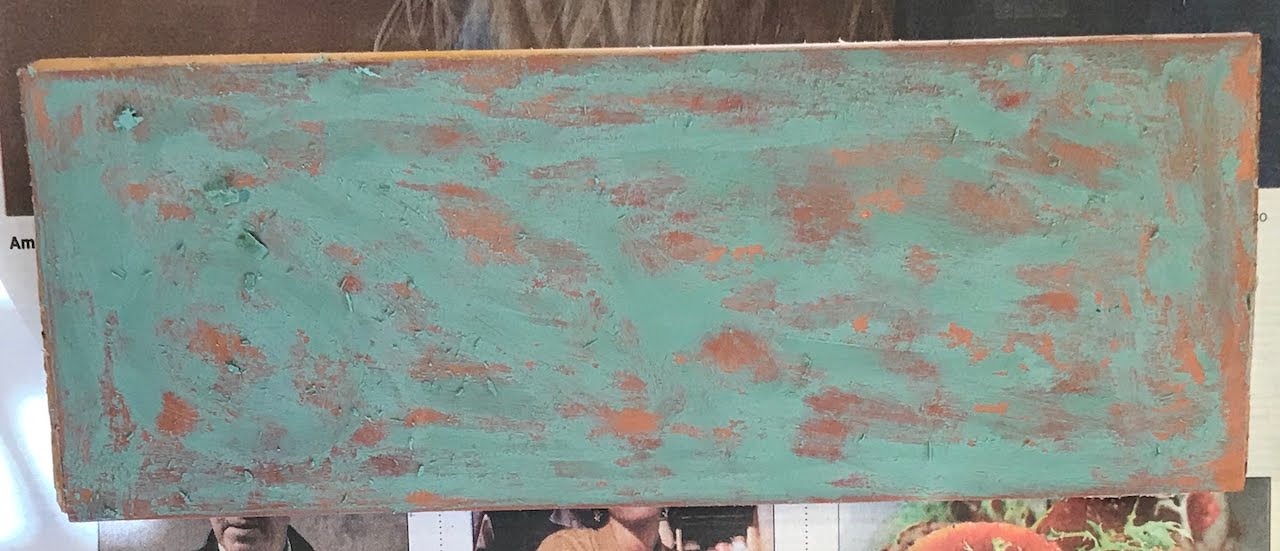
Finally, what it looks like after a little use. The dark spots are where it removed metal from the knife.

It may not look like much but it helped get a few of my knives really sharp. E.g., my Cold Steel Bushman feels like a razor now.
I made this one from some cowhide I had laying around that was about 1/8" thick, and a piece of a scrap 2x4. The thick base helps provide clearance so you don't hit your knuckles on your workbench.
I may go back and tweak it by scraping off most of the compound, adding some mineral oil to the leather, slightly roughing the leather so it takes the compound better, and then reapplying the compound.
My brother requested that I make him one and I'll use the lessons learned with this one in doing so.
If you don't have the materials for making one yourself laying around like I did, and want to try using a stropping block, you can get one off Amazon, here.
Sunday, July 08, 2018
Camillus TL-29 Electrician's Knife
I picked up this old Camillus electrician's knife off eBay for a whopping $11.50 shipped.

Generations of American servicemen have known this style of knife as the "TL-29." They were typically paired with a set of linesman's pliers and leather belt pouch to hold both items. Below is a picture I found on Pinterest, apparently scanned from a US military manual.

Used TL-29s can be found on eBay for little money and newly-made ones are available from Klein and other manufacturers.
According to the tang stamp guide found here, the knife was made between 1960 and the late 1970s.
It showed signs of use and some neglect, but no outright abuse. E.g., it was dull, dirty, and had some rust which I removed by an overnight soak in Evaporust. The blades snap into position nicely with positive half-stops and no side-to-side wiggle. The brass liner lock positively keeps the screwdriver in the open position.
As I received the knife it was very dull but now it's shaving sharp. It took about an hour's worth of work on my DMT fine diamond bench stone and Worksharp Field Sharpener combined to put a good edge on it.
I plan to keep the edge on the screwdriver blade relatively dull for use as a scraper; it was originally intended as such and as a wire stripper. I expect it to throw sparks from a ferro rod rather well.

Generations of American servicemen have known this style of knife as the "TL-29." They were typically paired with a set of linesman's pliers and leather belt pouch to hold both items. Below is a picture I found on Pinterest, apparently scanned from a US military manual.

Used TL-29s can be found on eBay for little money and newly-made ones are available from Klein and other manufacturers.
According to the tang stamp guide found here, the knife was made between 1960 and the late 1970s.
It showed signs of use and some neglect, but no outright abuse. E.g., it was dull, dirty, and had some rust which I removed by an overnight soak in Evaporust. The blades snap into position nicely with positive half-stops and no side-to-side wiggle. The brass liner lock positively keeps the screwdriver in the open position.
As I received the knife it was very dull but now it's shaving sharp. It took about an hour's worth of work on my DMT fine diamond bench stone and Worksharp Field Sharpener combined to put a good edge on it.
I plan to keep the edge on the screwdriver blade relatively dull for use as a scraper; it was originally intended as such and as a wire stripper. I expect it to throw sparks from a ferro rod rather well.
Worksharp Field Sharpener
In the past couple of weeks I’ve been on a cutlery buying binge. I received a nice Amazon gift card for my birthday at the end of May, and among the items I bought was a Work Sharp Field Sharpener.
The Worksharp Field Sharpener is an impressive little piece of gear for maintaining knives in the field or at home. It comes with coarse and fine diamond plates, a ceramic stick for honing, a small ceramic stick for working on serrations, and a leather strop. Built into the unit are guides to help you set the correct angle when using all of the sharpening bits.
Since receiving the Worksharp I’ve used it to touch up several pocketknives both old and new, and it’s enabled me to put shaving-sharp edges on them while sitting in my recliner.
The overall length is a bit under 7 inches, so it’s best used on smaller knives. Of course, you can use it on larger blades but you’ll need to work on shorter sections of the edge at a time. For scale, here it is next to an old Camillus TL-29 electrician's knife:

I plan to take the Worksharp with me on camping trips as my field edge maintenance solution. I might even get a second one to leave in my camping toolbox.
The Worksharp Field Sharpener is an impressive little piece of gear for maintaining knives in the field or at home. It comes with coarse and fine diamond plates, a ceramic stick for honing, a small ceramic stick for working on serrations, and a leather strop. Built into the unit are guides to help you set the correct angle when using all of the sharpening bits.
Since receiving the Worksharp I’ve used it to touch up several pocketknives both old and new, and it’s enabled me to put shaving-sharp edges on them while sitting in my recliner.
The overall length is a bit under 7 inches, so it’s best used on smaller knives. Of course, you can use it on larger blades but you’ll need to work on shorter sections of the edge at a time. For scale, here it is next to an old Camillus TL-29 electrician's knife:

I plan to take the Worksharp with me on camping trips as my field edge maintenance solution. I might even get a second one to leave in my camping toolbox.
Thursday, May 31, 2018
Day at the Range
I've been off all week and despite the crappy weather forecasts, made it to the range yesterday and today. This post has pics from today.

Today I shot my Cimarron Firearms 1873 Sporting Rifle in .44-40 WCF with two types of handloads. The first target was shot with loads containing a 200 grain soft cast bullet from Desperado Cowboy Bullets on top of 8.5 grains of Alliant Unique powder, sparked by a Federal large pistol primer, in Starline brass.

The second group was loaded with home cast 219 grain bullets from an Accurate Molds 43-215C mold. I used a 1:20 tin:lead alloy, so they are pretty soft. Powder charge was 35 grains of Swiss 3Fg black powder, with the same brass and primers.

I managed to capture the smoke cloud from one of the black powder rounds. It was hot, humid, and with little to no wind, so the smoke just hung around.

After cleaning the 1873, I also spent some time banging the 25 yard plate rack with my CZ P09 Duty and my 9mm reloads (mixed brass, 115 grain Berry's plated bullets, 4.5 grains of Hodgdon Universal Clays powder, and CCI small pistol primers). No pics of that, however.
It sure beats working.

Today I shot my Cimarron Firearms 1873 Sporting Rifle in .44-40 WCF with two types of handloads. The first target was shot with loads containing a 200 grain soft cast bullet from Desperado Cowboy Bullets on top of 8.5 grains of Alliant Unique powder, sparked by a Federal large pistol primer, in Starline brass.

The second group was loaded with home cast 219 grain bullets from an Accurate Molds 43-215C mold. I used a 1:20 tin:lead alloy, so they are pretty soft. Powder charge was 35 grains of Swiss 3Fg black powder, with the same brass and primers.

I managed to capture the smoke cloud from one of the black powder rounds. It was hot, humid, and with little to no wind, so the smoke just hung around.

After cleaning the 1873, I also spent some time banging the 25 yard plate rack with my CZ P09 Duty and my 9mm reloads (mixed brass, 115 grain Berry's plated bullets, 4.5 grains of Hodgdon Universal Clays powder, and CCI small pistol primers). No pics of that, however.
It sure beats working.
Sunday, May 06, 2018
Turning Components Into Ammo
Over the past few weekends I have been busy turning components into ammunition. I dipped into my stash of empty .38 Special brass and loaded up several different varieties:
DO NOT USE ANY OF THE ABOVE LOADING DATA WITHOUT VERIFYING IT IN ONE OR MORE LOADING MANUALS!!! I AM NOT RESPONSIBLE FOR ANY DAMAGE THAT OCCURS TO YOU OR YOUR GUNS IF YOU RELY ON IT.
The Keith SWCs, 195 grain LRNs, and Lee TL WCs came from Matt's Bullets. I ordered 100 count sample packs of each and was impressed with the projectiles. They are sized to .359 and loaded with Carnauba Red lube, except for the 148 TL WCs, which appear to be lubed with Lee Liquid Alox.
I was quite pleased with the service from Matt's Bullets, BTW. My order shipped in about a day and a half and was sent in a USPS flat-rate box. I received 2 days after I got the shipping notice. The bullets all looked good.
The Hornady 148 grain HBWCs have been laying around since I bought 1250 of them at the end of 2016. I've had the 500 count box of the Speer LSWCHPs for years.
So what prompted this binge reloading? First, the weather has been nice and it has been neither too hot nor too cold to work out in my backyard shop. Second, my gun interests go in phases and something rekindled my interest in revolvers. It's been too long since I shot one of my K-Frames, S&W Model 28, or 50th Anniversary Ruger Blackhawk.
And frankly, the state of the political left in this country is really starting to worry me. As far as I'm concerned, they've been acting completely batshit crazy since Trump's election. I want to get in some more practice in case the left decides to take their attempt at a soft coup hot.
I was pleasantly surprised that the .38s loaded with the Keith SWCs feed well in my Rossi 92 .357 carbine. I'd figured the SWCs might hang up during feeding, but they seem to be held at just the right angle to slip right into the chamber. (Testing was done with 3 dummy rounds, not live ammo.)
I got the 195 grain bullets because I thought it would be neat to try and duplicate the old .38 Special Super Police load, which had a 200 grain LRN at mild velocity. I wound up loading them over enough Unique, though, that they will only be shot in my .357s. If nothing else, they should make steel plates jump around nicely.
The Speer 158 LSWCHP loads should run about 850 FPS from a 4" barrel, very similar to the old FBI load. I can bump the powder charge up a little to get over 900 FPS but at +P pressures. These would be good for defense from any of my K-Frames, and should also work well in my J-Frame S&W Model 640.
To measure the powder charges I used both my Redding Model 3 measure and my RCBS Little Dandy. I don't like how Unique meters in the Redding, although it seems to meter a little more smoothly in the Little Dandy. In contrast, Universal Clays seems to meter very nicely in the Little Dandy -- smooth and extremely consistent. I haven't tried it yet in the Redding but I expect it to behave similarly.
Of course, the proof will be in the shooting of this ammo. I'm hoping to get to the range in the next week or two to dirty up some wheelguns.
- 50 rounds of 178 Keith semiwadcutters (SWC) on top of 3.8 grains of Unique.
- 50 rounds of 178 Keith SWCs on top of 5.0 of Unique.
- 100 rounds of 195 grain lead round nose bullets (LRNs) on top of a 5.0 grains of Unique.
- 100 rounds of 148 grain Lee tumble lube wadcutters on top of a 2.7 grains of Bullseye.
- 100 rounds of 148 grain Hornady hollow base wadcutters (HBWC) on top of 2.7 grains of Bullseye.
- 100 rounds of Speer 158 grain lead SWC hollow points on top of a 4.5 grains of Universal Clays.
DO NOT USE ANY OF THE ABOVE LOADING DATA WITHOUT VERIFYING IT IN ONE OR MORE LOADING MANUALS!!! I AM NOT RESPONSIBLE FOR ANY DAMAGE THAT OCCURS TO YOU OR YOUR GUNS IF YOU RELY ON IT.
The Keith SWCs, 195 grain LRNs, and Lee TL WCs came from Matt's Bullets. I ordered 100 count sample packs of each and was impressed with the projectiles. They are sized to .359 and loaded with Carnauba Red lube, except for the 148 TL WCs, which appear to be lubed with Lee Liquid Alox.
I was quite pleased with the service from Matt's Bullets, BTW. My order shipped in about a day and a half and was sent in a USPS flat-rate box. I received 2 days after I got the shipping notice. The bullets all looked good.
The Hornady 148 grain HBWCs have been laying around since I bought 1250 of them at the end of 2016. I've had the 500 count box of the Speer LSWCHPs for years.
So what prompted this binge reloading? First, the weather has been nice and it has been neither too hot nor too cold to work out in my backyard shop. Second, my gun interests go in phases and something rekindled my interest in revolvers. It's been too long since I shot one of my K-Frames, S&W Model 28, or 50th Anniversary Ruger Blackhawk.
And frankly, the state of the political left in this country is really starting to worry me. As far as I'm concerned, they've been acting completely batshit crazy since Trump's election. I want to get in some more practice in case the left decides to take their attempt at a soft coup hot.
I was pleasantly surprised that the .38s loaded with the Keith SWCs feed well in my Rossi 92 .357 carbine. I'd figured the SWCs might hang up during feeding, but they seem to be held at just the right angle to slip right into the chamber. (Testing was done with 3 dummy rounds, not live ammo.)
I got the 195 grain bullets because I thought it would be neat to try and duplicate the old .38 Special Super Police load, which had a 200 grain LRN at mild velocity. I wound up loading them over enough Unique, though, that they will only be shot in my .357s. If nothing else, they should make steel plates jump around nicely.
The Speer 158 LSWCHP loads should run about 850 FPS from a 4" barrel, very similar to the old FBI load. I can bump the powder charge up a little to get over 900 FPS but at +P pressures. These would be good for defense from any of my K-Frames, and should also work well in my J-Frame S&W Model 640.
To measure the powder charges I used both my Redding Model 3 measure and my RCBS Little Dandy. I don't like how Unique meters in the Redding, although it seems to meter a little more smoothly in the Little Dandy. In contrast, Universal Clays seems to meter very nicely in the Little Dandy -- smooth and extremely consistent. I haven't tried it yet in the Redding but I expect it to behave similarly.
Of course, the proof will be in the shooting of this ammo. I'm hoping to get to the range in the next week or two to dirty up some wheelguns.
Saturday, April 14, 2018
New Personal MacBook Pro
Last weekend I broke down and finally did my income taxes. I used Turbo Tax on my old mid-2009 MacBook Pro. When I installed the software, it warned that unless I upgrade to macOS High Sierra, I won't be able to use it again next year. That Mac is too old to be upgraded beyond Sierra. I've been thinking of getting a new personal laptop and this pushed me to finally do so.
Therefore, on the way home from work last night I stopped in the Apple Store in King of Prussia and bought a 2017-model 15" MBP (MacBookPro14,3). The specs are impressive:
It has the Touch Bar (yawn) and 4 Thunderbolt 3 / USB-C 3.1 ports and a headphone jack.
I got it in silver to clearly differentiate it from the work-provided Space Grey 15" MBP.
Since I use Google Drive and Dropbox for documents, migrating them over was as simple as installing the clients and letting them sync. To move over my videos, pictures, and music, I went old school and sneaker-netted them using a 64 GB SanDisk USB stick with both USB-A and USB-C connectors.
This machine is very similar to my company-provided work laptop so I knew what I was getting. To partially reiterate from my post last Spring after I got that one:
Since last night I've installed the following software:
I still need to install a few ham radio apps, including Fldigi, CHIRP, and WSJT. Using them with my radios will require a Thunderbolt 3 to USB-A adapter, and maybe an external sound card.
One thing I need to pick up is a 1 TB Thunderbolt 3-compatible hard disk, to use for Time Machine backups. MicroCenter appears to have several suitable models in stock.
My employer has a purchase plan negotiated with Apple which saved me a couple hundred bucks on the laptop and AppleCare. It still came out to about $3,100 after tax. That's a ton of money but it's worth it to me to have a top-quality machine that I fully expect to be able to use for nearly a decade.
Therefore, on the way home from work last night I stopped in the Apple Store in King of Prussia and bought a 2017-model 15" MBP (MacBookPro14,3). The specs are impressive:
- CPU: 2.9 GHz Intel Core i7 with 4 cores
- RAM: 16 GB
- SSD: 512 GB (I was running low on space on the old machine's 256 GB SSD.)
- Graphics: Onboard Intel HD Graphics 630 1536 MB AND a 4G AMD Radeon Pro 560 GPU.
It has the Touch Bar (yawn) and 4 Thunderbolt 3 / USB-C 3.1 ports and a headphone jack.
I got it in silver to clearly differentiate it from the work-provided Space Grey 15" MBP.
Since I use Google Drive and Dropbox for documents, migrating them over was as simple as installing the clients and letting them sync. To move over my videos, pictures, and music, I went old school and sneaker-netted them using a 64 GB SanDisk USB stick with both USB-A and USB-C connectors.
This machine is very similar to my company-provided work laptop so I knew what I was getting. To partially reiterate from my post last Spring after I got that one:
- Replacing the MagSafe 2 power connector with USB-C sucks.
- On the other hand, with the right cable I should be able to charge the battery from something like a cell phone power bank or my Harbor Freight jump pack/12V power source.
- I am underwhelmed with the Touch Bar. At work I rarely use it because 90% of the time the lid is closed while the machine is connected to an external keyboard, mouse, and dual displays. Since I use the machine at home as a laptop, I expect the Touch Bar will see more use.
- It's fast as hell.
- The screen is great.
- Battery life is good.
- The keyboard is OK.
- For me, macOS 10.13 High Sierra has been very stable. I expect the new machine to be even more so, because it won't have corporate IT management crap like the Eracent agent installed.
Since last night I've installed the following software:
- MS Office 2016.
- TextWrangler (in which I'm writing this.)
- Truecrypt 7.1a, which requires some tweaking to install.
- ZOC 7 for telnet and SSH. I don't use it much at home but at work for managing Linux servers or network devices, it's awesome.
- LibreOffice for some old OpenOffice files I have. Even on this machine, LibreOffice is a bloated, slow POS. Amazing.
- 1Password.
- Mozilla Thunderbird.
- Google Chrome.
I still need to install a few ham radio apps, including Fldigi, CHIRP, and WSJT. Using them with my radios will require a Thunderbolt 3 to USB-A adapter, and maybe an external sound card.
One thing I need to pick up is a 1 TB Thunderbolt 3-compatible hard disk, to use for Time Machine backups. MicroCenter appears to have several suitable models in stock.
My employer has a purchase plan negotiated with Apple which saved me a couple hundred bucks on the laptop and AppleCare. It still came out to about $3,100 after tax. That's a ton of money but it's worth it to me to have a top-quality machine that I fully expect to be able to use for nearly a decade.
Monday, April 02, 2018
Levergun Weekend
Saturday afternoon I loaded up 150 rounds of .38-40 with a 180 bullet on top of about 8.5 grains of Unique. After dinner, I loaded 100 rounds of .44-40 with a 200 grain bullet on top of the same powder charge. Bullets for both calibers were soft cast from Desperado Cowboy bullets. I mostly shoot black powder in .44-40 but still had a bunch of the DCB 200 grainers, which don't carry enough lube for BP in a rifle, so smokeless it was.
Sunday morning was my club's lever action rifle match. Even though it was Easter Sunday, we had 9 shooters. We had a couple Rossi 92s, a Cimarron 1873, a Henry Big Boy, a Marlin 1894 CB, and even a Winchester 1894 in .44 Magnum loaded with .44 Specials. I shot my Cimarron 1860 Henry with .44 Henry-equivalent black powder loads, and got some ribbing from the other guys about second hand smoke.
We started out at 10 - 12 yards, then moved back to 50. The targets were ~8" square steel plates.
I shot well, coming in 4th. I missed only one target but of course I was slower than the guys shooting mouse-fart level .38s. Also, the Henry has more drop in the stock than my 1873, which slowed me down compared to last month.
I put 55 rounds through the 1860 Henry. The .44 rimfire-level loads foul noticeably less than full-power .44 WCFs. It took only about a half dozen patches wet with moose milk to clean the bore.
The rifle's developing a nice patina on the brass receiver now.
We were done pretty early so in the afternoon I decided to replenish my supply of bullets suitable for shooting on top of black powder. So, I topped off my Lyman lead pot with some 1:20 alloy that I got from Roto Metals, and ran off a few hundred bullets in my Accurate Molds 43-215C. Hopefully, I'll be able to lube and size them this week after work.
Sunday morning was my club's lever action rifle match. Even though it was Easter Sunday, we had 9 shooters. We had a couple Rossi 92s, a Cimarron 1873, a Henry Big Boy, a Marlin 1894 CB, and even a Winchester 1894 in .44 Magnum loaded with .44 Specials. I shot my Cimarron 1860 Henry with .44 Henry-equivalent black powder loads, and got some ribbing from the other guys about second hand smoke.
We started out at 10 - 12 yards, then moved back to 50. The targets were ~8" square steel plates.
I shot well, coming in 4th. I missed only one target but of course I was slower than the guys shooting mouse-fart level .38s. Also, the Henry has more drop in the stock than my 1873, which slowed me down compared to last month.
I put 55 rounds through the 1860 Henry. The .44 rimfire-level loads foul noticeably less than full-power .44 WCFs. It took only about a half dozen patches wet with moose milk to clean the bore.
The rifle's developing a nice patina on the brass receiver now.
We were done pretty early so in the afternoon I decided to replenish my supply of bullets suitable for shooting on top of black powder. So, I topped off my Lyman lead pot with some 1:20 alloy that I got from Roto Metals, and ran off a few hundred bullets in my Accurate Molds 43-215C. Hopefully, I'll be able to lube and size them this week after work.
Monday, March 19, 2018
Shooting the 1860 Henry Rifle
Yesterday I went out to a friend's place and we put 100 rounds through the Cimarron Firearms 1860 Henry. The ammunition was 50 rounds each of two different loads:
First, .44 Henry Flat rimfire-equivalent loads:


First, .44 Henry Flat rimfire-equivalent loads:
- Starline brass
- CCI large pistol primers
- 28 grains Goex 3Fg black powder
- 0.5cc of cornmeal, to take up airspace
- 219 grain bullet cast from an Accurate Molds 43-215C mold
The second 50 rounds were as above, but with a full charge of 35 grains of 3Fg Goex and no cornmeal filler.
My first ten shots, fired offhand from about 40 - 45 yards:

My point of aim was at 6:00 on the bullseye. Can't complain about that.
We spent most of my rounds shooting at an 8-inch steel gong from the same distance. A short video:
In the video I was shooting the full-power .44 WCF loads with 35 grains of powder.
The rifle hangs really nicely for offhand shooting although at about 9 lbs. it's heavy. Recoil is very mild. Functioning was excellent and the action is slicking up, being noticeably smoother now than when it was fresh out of the box.
After shooting, we dropped the spent cases into a jar of soapy water to clean off most of the black powder fouling.

This took care of most of the fouling but I'm going to run them through my case tumbler for about 30 - 60 minutes.
This was the most black powder loads I've put through a rifle in one outing. The action got no fouling in it. The bore took only about 10 - 12 patches wet with moose milk (Ballistol/water mix) to get clean.
I'm going to load up some more of the .44 Henry-equivalent loads and use them at my club's next lever action shoot. I'll also run some mild smokeless loads with Unique through it, and I've recently read some pieces that indicate Herco is a good smokeless powder for use in .44 WCF, so if I see any at the next gun show I'll pick up a pound. It's a little slower and I think bulkier than Unique, and may meter better, which would be a plus.
Incidentally, we also shot my circa-1895 Winchester 1892 .38 WCF at the gong, with smokeless loads of a 180 grain cast bullet on top of 9.0 grains of Unique. These were noticeably more powerful than the Ultramax .38-40 cowboy ammo I'd shot in the rifle previously. However, even the .44 Henry-equivalent loads in the 1860 smacked the gong around a lot more.
Cimarron Firearms 1860 Henry Civil War Model
A couple of weeks ago I ordered a Cimarron Firearms 1860 Henry Civil War model rifle from Buffalo Arms, the same place I got my Cimarron 1873 Sporting Rifle from two years ago. The Henry arrived at my FFL last week and I did the transfer on Thursday. Like the 1873, the Henry is chambered for .44-40 / .44 WCF. I shot it for the first time yesterday.


As shown in the above picture, a sling swivel is mounted on the stock. I got a sling from Dell's Leather Works, which came from NY to PA in about 3 days.
This shows the German silver front sight blade and the sling attachment loop on the barrel.

The rear sight is a folding ladder. When folded, it's set for 100 yards. It's then graduated out to a very optimistic 800 yards. It also has a notch on the very top which may be for 900 yards.

Most Henry replicas come with a trapdoor in the buttplate which covers a cavity in the stock that accepts a four piece cleaning rod. My rifle doesn't have that, however. I plan to pull the buttplate off and see if the stock is drilled for a cleaning rod. If so, I may swap out the buttplate.

Overall, the rifle is extremely well finished. Wood-to-metal fit is excellent and the action works smoothly (and it's getting smoother as it gets worked).
Aside from the high quality, the other initial impression is that the rifle is heavy. It weighs in around 9 pounds, partially due to the weight of the brass receiver and partially due to how the magazine tube is machine from the same piece of steel as the barrel.
In my next post I'll talk about shooting it, but I wanted to leave off with this, a facsimile of an 1860s Henry Rifle advertisement.

Monday, March 05, 2018
Lever Action Rifle Shoot
Yesterday I attended for the first time one of my gun club's lever action rifle matches. I shot my Cimarron 1873 Sporting Rifle with my .44-40 handloads of bullets cast in the Accurate 43-215C mold on top of 35 grains of Goex 3Fg black powder in Starline brass.
Normally, the lever action matches involve shooting steel plates at 25 yards and 50 yards, but due to recent weather the range was a bit swampy. So, we shot at 25 yards only. Each of the first 9 relays was 5 shots on ~8" steel plates, against the clock. The final relay was 5 shots on one plate, against the clock, and if you didn't miss any, 5 seconds would be deducted from your total time.
Cimarron 1873s were the most common rifle choice, but mine was the only one with a 24" barrel. The rest were 20" short rifles in either .45 Colt or .357.
One guy was shooting an Uberti 1866 Carbine in .44-40. He and I were the only guys shooting .44 WCF.
We had a couple rifles from Henry and one Marlin 1894 Cowboy with 24" barrel. Finally, we had one guy shooting a Rossi 92 in .454 Casull but loaded with .45 Colts.
I was the only one shooting cartridges loaded with black powder. Everyone else used smokeless and mostly were light cowboy action shooting loads.
I saw a few feeding issues at least one of which was due to short-stroking, and the 1866 went down at one point due to a squib load. I am pleased to say that my rifle ran flawlessly.
Cleanup of my rifle afterwards was a snap. The thin .44-40 brass really seals the rifle's chamber so no fouling got back into the action. The bore needed about a dozen patches wet with moose milk (Ballistol/water mix) to get clean. Then, a couple dry patches and then two more with straight Ballistol.
The match was an absolute blast. Today I got an email with the scores and was happy to see that I came in third. Considering that the two guys who placed ahead of me were shooting mouse fart-level smokeless powder loads, I have absolutely no complaints.
I think I'll being doing it again.
Normally, the lever action matches involve shooting steel plates at 25 yards and 50 yards, but due to recent weather the range was a bit swampy. So, we shot at 25 yards only. Each of the first 9 relays was 5 shots on ~8" steel plates, against the clock. The final relay was 5 shots on one plate, against the clock, and if you didn't miss any, 5 seconds would be deducted from your total time.
Cimarron 1873s were the most common rifle choice, but mine was the only one with a 24" barrel. The rest were 20" short rifles in either .45 Colt or .357.
One guy was shooting an Uberti 1866 Carbine in .44-40. He and I were the only guys shooting .44 WCF.
We had a couple rifles from Henry and one Marlin 1894 Cowboy with 24" barrel. Finally, we had one guy shooting a Rossi 92 in .454 Casull but loaded with .45 Colts.
I was the only one shooting cartridges loaded with black powder. Everyone else used smokeless and mostly were light cowboy action shooting loads.
I saw a few feeding issues at least one of which was due to short-stroking, and the 1866 went down at one point due to a squib load. I am pleased to say that my rifle ran flawlessly.
Cleanup of my rifle afterwards was a snap. The thin .44-40 brass really seals the rifle's chamber so no fouling got back into the action. The bore needed about a dozen patches wet with moose milk (Ballistol/water mix) to get clean. Then, a couple dry patches and then two more with straight Ballistol.
The match was an absolute blast. Today I got an email with the scores and was happy to see that I came in third. Considering that the two guys who placed ahead of me were shooting mouse fart-level smokeless powder loads, I have absolutely no complaints.
I think I'll being doing it again.
Wednesday, February 21, 2018
Self Sufficiency, Part Two
It was unusually warm today for February, so I took advantage of that after getting home from work, and pan lubed and sized between 150 and 200 of the bullets I cast last weekend. These were cast from my Accurate 43-15C mold and will be shot in my Cimarron 1873 Sporting Rifle over black powder.

I use a hot plate that I got from Amazon for $14.95 or so to melt my roughly 50/50 mix of beeswax and mutton tallow. I recently picked up a .44 caliber Lee lube cutter off eBay, which made separating the bullets from the lube simpler than my previous solution. That was a .44-40 case with the mouth expanded a bit larger than normal and the flash hole drilled out so I can still a pin punch through it to poke out the bullets.
After separating them from the lube, I ran them through my Lee .429 sizer.
I still have about another 100 bullets to lube and size, which I'll try to get to tomorrow night.
The weather is supposed to be crappy this weekend, so I'm going to try to get some reloading in. I want to load at least one 50 round box of .44-40s using 2.2cc of Goex, to see how well this bullet works with it. I know it works well with Swiss black powder but I have a good supply of Goex on hand. The bullet was designed to carry enough lube to use with Goex in 24" barrels.

I use a hot plate that I got from Amazon for $14.95 or so to melt my roughly 50/50 mix of beeswax and mutton tallow. I recently picked up a .44 caliber Lee lube cutter off eBay, which made separating the bullets from the lube simpler than my previous solution. That was a .44-40 case with the mouth expanded a bit larger than normal and the flash hole drilled out so I can still a pin punch through it to poke out the bullets.
After separating them from the lube, I ran them through my Lee .429 sizer.
I still have about another 100 bullets to lube and size, which I'll try to get to tomorrow night.
The weather is supposed to be crappy this weekend, so I'm going to try to get some reloading in. I want to load at least one 50 round box of .44-40s using 2.2cc of Goex, to see how well this bullet works with it. I know it works well with Swiss black powder but I have a good supply of Goex on hand. The bullet was designed to carry enough lube to use with Goex in 24" barrels.
Monday, February 19, 2018
Consistent Cast Bullet Weights
Tonight I weighed a sample of ten bullets from the batch I cast yesterday and plugged them into Excel to figure out the average weight and the standard deviation in weights.
| Accurate Molds 43-215C Bullets | ||
| Bullets cast from 20:1 lead:tin alloy | ||
| Sample | Weight in Grains | |
| 1 | 219.6 | |
| 2 | 219.4 | |
| 3 | 219.0 | |
| 4 | 219.0 | |
| 5 | 219.2 | |
| 6 | 220.2 | |
| 7 | 219.6 | |
| 8 | 219.1 | |
| 9 | 219.4 | |
| 10 | 219.1 | |
| 219.4 | Average weight | |
| 0.371782493 | Standard deviation | |
According to Tom at Accurate Molds, this bullet should drop at about 215 grains when cast from wheel weight alloy. Since the 20:1 alloy I'm using lacks any antimony, they naturally weigh a little more.
Never let anyone tell you that homemade bullets won't be as good as factory-made.
Sunday, February 18, 2018
Self Sufficiency
Today I cast up a couple hundred bullets for .44-40 in my Accurate Molds 43-215C. Probably about 10 pounds worth.

The next time the Dems get into power, you know damn well that there will be a panic. What are you doing to protect yourself against that?

The next time the Dems get into power, you know damn well that there will be a panic. What are you doing to protect yourself against that?
Saturday, February 17, 2018
Put Together a Box of Smokeless .38-40s Today
Yesterday my orders arrived from Starline Brass and Desperado Cowboy Bullets. This afternoon I loaded up a 50-round box of .38-40s.
It was a bit cool outside and I didn't feel like working in my shop, so I did my handloading today at my dining room table using a Lee Hand Press that I bought many years ago. Mine is an older version, pre-Breech Lock.
The Lee Hand Press uses standard reloading dies and has enough leverage to resize rifle brass. I didn't have to resize the new brass, but did have to run them through the expander die after I deburred the case mouths.
The components I used today were:
Muzzle velocity should be around 1300 - 1400 FPS. So, about equivalent to a 10mm pistol.
Note that this load should be safe in a Winchester 1892 or Marlin 1894 in good condition, but you should always confirm loading data in a loading manual or two. You and you alone are responsible for the safety of your handloads.
To prime, I used a Lee Ram Prime attachment. This allows you to prime cases on a reloading press on the upstroke. It gives a good feel for seating the primers, but does require you to handle each and every one. If/when I do another indoor loading session I'll probably use my Lee Auto Prime tool.
I used a Lee Perfect powder measure, with my charge weight verified using a Frankford Arsenal digital scale. I've previously tested this scale again a Redding beam-type scale and it's very accurate.
It's been awhile since I used the Lee Hand Press. It works well but I kind of like using nutcracker-style tools like my Ideal Number 6 more. I may look into picking up a Lyman 310 tool with dies for .38-40 and .44-40. Unlike the 19th Century tong tools, the 310 allows you to neck size brass and use different bullets, not just the ones cast in the matching mold. Unfortunately, they don't use standard loading dies.
Hopefully I'll be able to take the Winchester 1892 out to the range again next week, since I now have two handloads to try through it, today's smokeless loads and the black powder loads I put together last week.
It was a bit cool outside and I didn't feel like working in my shop, so I did my handloading today at my dining room table using a Lee Hand Press that I bought many years ago. Mine is an older version, pre-Breech Lock.
The Lee Hand Press uses standard reloading dies and has enough leverage to resize rifle brass. I didn't have to resize the new brass, but did have to run them through the expander die after I deburred the case mouths.
The components I used today were:
- Virgin Starline cases
- Soft-cast 180 grain RNFP bullet from Desperado Cowboy Bullets
- Federal No.150 large pistol primer
- 9.0 grains of Alliant Unique powder
Muzzle velocity should be around 1300 - 1400 FPS. So, about equivalent to a 10mm pistol.
Note that this load should be safe in a Winchester 1892 or Marlin 1894 in good condition, but you should always confirm loading data in a loading manual or two. You and you alone are responsible for the safety of your handloads.
To prime, I used a Lee Ram Prime attachment. This allows you to prime cases on a reloading press on the upstroke. It gives a good feel for seating the primers, but does require you to handle each and every one. If/when I do another indoor loading session I'll probably use my Lee Auto Prime tool.
I used a Lee Perfect powder measure, with my charge weight verified using a Frankford Arsenal digital scale. I've previously tested this scale again a Redding beam-type scale and it's very accurate.
It's been awhile since I used the Lee Hand Press. It works well but I kind of like using nutcracker-style tools like my Ideal Number 6 more. I may look into picking up a Lyman 310 tool with dies for .38-40 and .44-40. Unlike the 19th Century tong tools, the 310 allows you to neck size brass and use different bullets, not just the ones cast in the matching mold. Unfortunately, they don't use standard loading dies.
Hopefully I'll be able to take the Winchester 1892 out to the range again next week, since I now have two handloads to try through it, today's smokeless loads and the black powder loads I put together last week.
Sunday, February 11, 2018
Loaded Up a Box of Black Powder .38-40s
Today I loaded up a box of black powder .38-40s using bullets I cast yesterday. I planned to use the Ideal Number 6 tool but I found that because it doesn't resize the brass, I had insufficient neck tension and crimp on the bullets. With a slightly compressed load, the powder sometimes pressed the bullets back out of the case.
I therefore ended up using the Lee seating die and the factory crimp die. Going forward, I'm only going to use the Ideal tool for priming at most. Between the flashing I got on most of the bullets and the inability to use it to seat and crimp bullets, it's a collector's item.
After I loaded 50 rounds I had to clean up the flashing on many of them with a file, which was a tedious PITA. Since life is too short to shoot crappy bullets, the remaining ones that I cast yesterday are going back into the pot.
I'll probably order a mold from Accurate Molds, probably the 40-185C. It's basically a .40 caliber version of the 43-215C that has worked so well for me in .44 WCF. This will give me bullets that will work well with smokeless but still carry enough lube to use Goex black powder in a 24" barrel, in case I get another rifle in .38-40.
I therefore ended up using the Lee seating die and the factory crimp die. Going forward, I'm only going to use the Ideal tool for priming at most. Between the flashing I got on most of the bullets and the inability to use it to seat and crimp bullets, it's a collector's item.
After I loaded 50 rounds I had to clean up the flashing on many of them with a file, which was a tedious PITA. Since life is too short to shoot crappy bullets, the remaining ones that I cast yesterday are going back into the pot.
I'll probably order a mold from Accurate Molds, probably the 40-185C. It's basically a .40 caliber version of the 43-215C that has worked so well for me in .44 WCF. This will give me bullets that will work well with smokeless but still carry enough lube to use Goex black powder in a 24" barrel, in case I get another rifle in .38-40.
Subscribe to:
Posts (Atom)


 Posts
Posts


