A good part of my gun collection was made by Uberti. However, a pet peeve of mine is that the scews they use to build their guns are apparently made from cheese. For the price of these guns it's reasonable to expect that the screws will be hardened, not cross threaded, and not over-torqued, as they often are.
Today I detail stripped my 1992-vintage Uberti 1851 Navy. It was working fine but filthy inside and in need of a thorough cleaning.
One of the things I found was that the screw that holds the bolt/trigger spring in place was cross threaded at the factory. I lucked out and had an 8-32 tap so I was able to chase the threads in the frame, but I don't have an 8-32 die. (I ordered one from Amazon after discovering this.) However, the screw itself is trashed and even if I had the die I don't know if I'd be able to restore it.
So, I went to VTI Gun Parts and sent them emails to check stock on their set of properly hardened replacement screws, and also a spare hand spring while I was at it. (For whatever reason their website doesn't report live inventory.)
One of the other weaknesses of the Italian replicas is the spring for the bolt and trigger. It's flat steel and prone to breaking. I haven't broken one myself but prevention is good, so I went over to Wolff Gun Springs and ordered wire replacements for my Uberti and Pietta single actions. I'm told that Piettas use the springs for EMF Hartford guns, so I ordered 4 of those along with three Uberti replacements.
If you mess with guns long enough you'll eventually run into a stuck screw. In the past I've been able to free some of these screws by soaking with Kroil, but other times I've had to drill them out using my milling machine and extract them with a screw extractor.
Another option is a hand impact driver that takes 1/4" bits commonly used in gunsmithing screwdriver sets. I bought this one from Amazon:
I've never used one of these before and it did not come with any instructions for changing which way it rotates. Naturally, it came setup to turn right, when I needed it to turn left. A minute of googling lead me to this short and informative video from Down Under:
The small driver I bought doesn't have the separate coupler shown in the video, but by clamping the narrow part in my vise I was able to change the direction of rotation.
I used the driver today to loosen the mainspring screw on my 1992-vintage Uberti 1851 Colt Navy percussion revolver, which I detail stripped for the first time. (Better late than never. Even though it was full of sludge, because it was oil soaked there was no corrosion. I don't recommend this, for the record.)
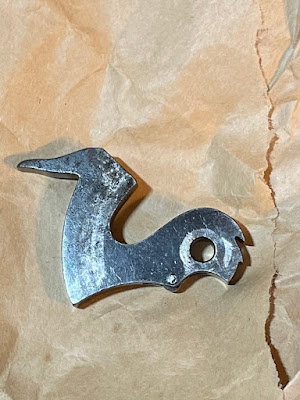
In November of 2020 I bought a Marlin 1889 sporting rifle chambered for .38 WCF (AKA .38-40). The Marlin 1889 was the first side-ejecting lever action, leading to the rifles that Marlin has built ever since. When I got it I discovered that the half cock notch on the hammer was chipped. It held OK at full cock but when placed in half cock, as you'd use it when hunting, the hammer could be pushed off. This was obviously no bueno.
At the time I bought it I was unable to find a replacement. This is a hazard of collecting old guns that have been out of production for decades, or in the case of the 1889, over a century.
Actually, the full cock notch doesn't look so good, either.
At the beginning of July I did an Internet search on a lark and found that Old Arms of Idaho had a few in stock, and I decided to take a chance.
It worked out splendidly, dropping in with no fitting required.
A few days later I took the rifle to the range.
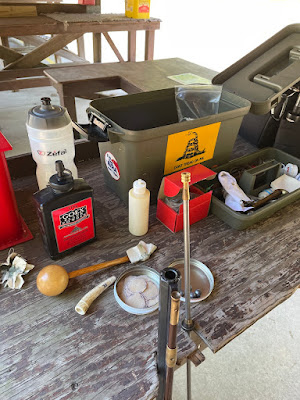
I shot the rifle with my black powder handloads in Starline brass. One oddity of guns chambered for .38 WCF is that the chamber dimensions and cartridge dimensions allow for a lot of case expansion. The British military had a similar situation with the chambers on their Lee-Enfields and .303 British ammunition. The result is that if you full length resize the brass for reloading, it work hardens the brass leading to short case life. To wit:
The good thing is that I didn't know the case split in half until after I tried to eject it and got out only half. The bad thing is that I noticed several other cases had splits and needed to be trashed.
Since I have two rifles in .38 WCF I am now sorting my cases by rifle and will adjust my sizing die to only neck size the brass. This is a hassle, especially given the current scarcity of .38 WCF brass. Unless I run across something I really want at a price I can't pass up, I won't be buying any more guns in this caliber because of the hassle.
Last weekend I took my Cabela's Hawken to the range for some offhand practice on both Saturday and Sunday.
The rifle was built by Investarms in Italy and is very similar to the Lyman Trade Rifle, which was also built by Ivestarms. I'd wanted a LTR for years but it was never offered in a left handed version, so I got the Cabela's rifle instead. A very similar or identical rifle is also sold by Dixie Gun Works, as well as muzzle-loaders.com.
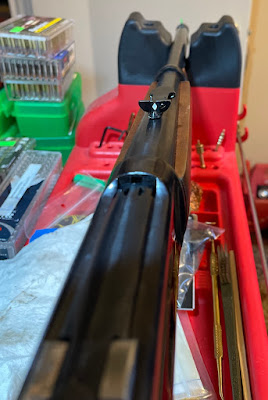
A few years ago I replaced the factory sights with a Lyman white bead front sight and a 57 SML aperture sight. I also replaced the factory nipple with a Hot Shot. I keep the original in the cap box as a spare.
Anyway, it's a caplock .50 caliber muzzleloader. The load I shot both days was:
70 grains of 3Fg Goex black powder
0.020" patch lubed with Bumblin' Bear Grease from October Country
Hornady swaged 0.490" round ball
CCI No.11 percussion cap
On Saturday, I shot with the peep sight's insert in place. This gives a smaller aperture which should allow better accuracy, at the expense of light transmission.
Decent, except for that one flyer above the bull.
When I went back on Sunday I removed the sight insert and used it as a ghost ring. This is what I'd do if hunting with the rifle.
Not quite as good but still minute of deer at the ranges I'd be shooting at. My final shot of the day was at a steel gong approximately six inches square, and I got a good solid hit.
A week ago I posted about the Rossi 92 .357 carbine I bought about 10 years ago. The reduced power hammer and ejector springs and new rear sight that I ordered from Steve's Gunz arrived today.
Before reassembling the gun I deburred the parts and applied a little white lithium grease to the wear points. I'll say this one went back together a lot easier than my Interarms 65 did last year. That rifle required another set of hands to get back in one piece.
A .357 functioning dummy helped keep the ejector in place during reassembly. Highly recommended if you have an 1892-type rifle. I function checked the rifle with a few of the dummies and ejection is positive but not as violent as it was originally.
Overall, the action works much more smoothly with less effort than it did before.
I also replaced the factory semi-buckhorn rear sight with a flat top sight made by Marble's. It has an insert that you can flip so that it has either a U- or V-shaped notch. It came with the U in place. I may take a file to it to make it a little larger, which will help in low light and make it faster to use.
Hopefully I'll get to shoot the rifle on Sunday to verify it works properly with live ammunition.
Recently I picked up 500 215 grain RNFP bullets from Matt's Bullets to be loaded into .44-40 cartridges. Matt uses Carnauba Red lube, which works great with smokeless powder. However, it's not compatible with black powder. So, I specially ordered this batch of bullets as-cast. I.e., unsized and unlubed.
My home cast bullets were lubed using a 50/50 mix of beeswax and mutton tallow. This is a great BP lube. However, my brother offered me the use of his RCBS Lub-A-Matic sizer and tossed in a couple sticks of SPG, a commercial BP lube.
As pictured, the sizer is attached to a Lyman universal heating unit but that's not plugged in. I'm just using the heater as a mount that can be clamped to my workbench.
The bullets from Matt's are similar to those I cast in the Accurate Molds 43-215C but with a slightly shorter ogive and the groove doesn't hold quite as much lubricant. However, it should hold enough, especially for my .44 Henry-equivalent loads (~28 grains of BP instead of 35 grains), or for shooting from revolvers. Rifles with barrels over 20" need more lube to prevent the bore from developing a hard fouling ring in the bore near the muzzle. It's less of an issue with carbines or revolvers.
Compared with my home mix, SPG is a lot softer. I was working out in my shop with the temperature in the uppers 80s and using SPG was messier than I expected.
BTW, I've placed several orders with Matt's Bullets over the past few years.. He's a pleasure to work with who delivers a top quality product. Unlike most commercial casters he doesn't make his bullets from hard alloy. Rather, he chooses alloys suitable for a particular bullet's application, which often is relatively soft. This often results in less leading because the bullets better fit the bore and so don't experience gas cutting.
Back in 2012 I bought a Rossi 92 carbine with a 20" barrel chambered for .357 Magnum. A few years ago my daughter expressed an interest in deer hunting so I set it up with a Bushnell TRS-25 mounted on an NOE Bullets scout rail. Since giving hunting a couple tries my daughter lost interest, so I am revisiting the Rossi's configuration.
Although functional, the rail mounted red dot spoiled the clean lines of the rifle. Also, I wasn't satisfied with the bolt mounted peep that replaced the firing pin blocking safety. It wasn't really solid, IMO. So, I've decided to go back to open irons.
This week I finally got around to installing quick detach sling studs, made by GrovTec. I had a lace-on sling intended for muzzleloaders on the rifle but it wasn't ideal. For one thing if it got wet it was a pain to remove so the buttplate and stock could dry. For a sling I got the same Hunter Company 220-1 carrying strap. Aesthetically, it looks like a simplified USGI M1907 sling, which goes nicely with a traditional levergun. I also have one each on my Interarms 65 (Rossi 92) .44-40 and my Cabela's Hawken .50 percussion muzzleloader.
I swapped out the peep for the safety delete plug I put in the rifle shortly after I bought it. While I can see the utility of the safety when unloading the rifle it's too easy to actuate. I also put the original rear sight back on the barrel.
However, the OEM rear sight is a buckhorn that blocks a lot of the target. So, tonight I put in an order with Steve's Gunz for a flat top rear sight, along with reduced power hammer and ejector springs.
The Interarms 64 has the reduced power springs and they really help slick up the action. The lighter hammer spring still ignites even hard CCI primers, and the lighter ejector spring makes the bolt easier to close and keeps the gun from sending empties into orbit. Ejected cases land near your feet, making it a lot easier to recover the brass for reloading.
While I'm waiting for the parts I have the rifle disassembled on my bench. I'll slick up the innards but making sure there aren't any burs and polishing contact points.
Incidentally, a good friend picked up a new stainless 20" Rossi 92 in .357. This is one of the guns made in the new factory and I am extremely impressed. Right out of the box it was very smooth and the external finish was excellent, with good wood to metal fit. He's an engineer and a tinkerer, so he took it down to do an action job and replace the ejector spring. Unlike the older Rossis, he said that this resulted in minimal improvement. It appears that with their new factory, Rossi has really upped their game.
Aside from recreational shooting, my friend lives on property in one of PA's special regulations areas for hunting. This was formerly a muzzleloader, shotgun, or archery only area. However, the PA Game Commission is now allowing the use of straight walled cartridges, so he's planning to use it for deer. 35 yards would be a long shot on his land so a .357 carbine is just about perfect. If I can get out there during the appropriate season I'll probably be carrying my .357.
I've previously written about the High Standard Sentinel R-101 I picked up earlier this year. Yesterday, Chris from Lucky Gunner posted a nice video about the Sentinel revolvers. Check it out:
So, I've had this whole .357 magnum revolver idea stuck in my head about long enough now that it's kind of becoming a serious consideration.
I have no interest in concealed carry, this would be strictly a woods bumming gun.
I've owned very few handguns over the years. the two longest running are, a Contender in 7-30 Waters scoped bull barrel for about twenty years. It was fantastically accurate, but awkward to carry and shooting offhand was difficult at best. It was very barrel heavy. I traded it for a milling machine about ten years ago and as much as I enjoyed shooting it I don't miss it. It never really fit my hunting style. For deer I've always been a still hunter in very thick cover.
I have a Ruger Bearcat .22 that it's only redeeming quality is it is light weight. I hate the fixed sights, to me that ruins the whole gun package. Also we don't have grey squirrels or cotton tails around here except in town pretty much. We can't shoot grouse with anything other than a shotgun. So snowshoe hares are the only thing to shoot with a .22.
In comes the .357.
I seem to think it would be fine for the heavy cover thick brush highly mobile style of deer hunting that I like with shots of 40 yards or less.
Loaded with .38 special it would be enough for the odd coyote or even more rare fox.
Maybe some wadcutter for small game if I wanted or just plinking and fooling around.
And realistically fooling around would probably be its primary job.
I have most of my reloading stuff yet, so handloads are an option if I decided to go back down that rabbit hole again.
...
To which I replied:
My favorite handgun cartridge is .38 Special. It handles everything I need a pistol to do, with mild recoil, useful power, and excellent accuracy.
In my opinion, the most versatile handgun you can have is a medium frame .357 Magnum double action revolver with a 4" barrel. They a full sized guns but small enough for concealed carry with the right holster.
With the right ammo you can use them for target shooting, hunting game up to deer sized, training new shooters, and self defense.
Reloading .38 Special and .357 Magnum is relatively easy because they are straight walled, rimmed cases. Carbide sizing dies eliminate the need to lubricate cases. They are usable with a wide variety of powders (even black powder, since the .38 was originally designed for it). There is a huge variety of bullets available in cast, swaged, plated, powder coated, and jacketed flavors.
If you're OK with limiting yourself to single actions, Ruger makes the Blackhawk Convertible that comes with .357 and a 9mm cylinders, further increasing versatility. Taurus sells the 692 double action that comes with .357 and 9mm cylinders.
And of course, a .357 revolver makes a dandy companion to a lever action in the same caliber. Even full house .357s are mild to shoot in a carbine and firing .38s in a carbine is much like shooting a .22.
We live about 5 miles outside Philadelphia and my wife often has the local Fox affiliate on before work, and every day there is a report about an armed robbery and/or shootings. On Friday morning, the story was about a hold up at a Dollar General at 9th & Girard, which ended with the store manger killing the perp with a head shot. The reporter mentioned that law abiding citizens are applying for LTCF in droves and I thought the tone was actually pretty positive.
Some notes about PA firearms laws, which are generally pretty good:
In PA, a carry permit is called a "License to Carry a Firearm." It applies to handguns and “firearms,” which under state statute includes short barreled rifles, short barreled shotguns, and AOWs. It does not apply to knives, not does PA have a preemption law for knives and switchblades are illegal statewide.
PA has a strong preemption law that prevents local municipalities from enacting more restrictive laws than the commonwealth. Sometimes Philadelphia or Pittsburgh tries to do so and gets slapped down by the Supreme Court of PA.
Pennsylvania is a shall-issue state with applications and renewals handled by each county’s sheriff’s department. Note that in PA, the sheriffs otherwise basically provide courthouse security and prisoner transport, they are not involved with day-to-day law enforcement. That’s handled by local PDs or the PA State Police.
The state gives the sheriffs a fair amount of leeway in how they handle applications and renewals. For example, in Philly it’s my understanding they almost always call the character references provided by the applicant. In contrast, I live in Montgomery County, which borders Philly to the northwest. I’ve had a LTCF since the early 90s, renewed several times (they are good for 5 years), and never had a reference called. Regardless of the county, applicants do go through a background check administered by the State Police (the PA Insta-Check System), which is also used when you buy a gun from an FFL. PA doesn’t use NICS.
There are no training or qualification requirements for issuance of a LTCF. If you are legal to possess a firearm, you are legal to carry it once you have a LTCF.
There are no restrictions in PA on “assault weapons,” magazine capacity, ownership of body armor, or possession of night vision gear.
Most of the state is Title II friendly. I.e., silencers, MGs, SBRs, SBSes. Large bore Destructive Devices are legal in PA (i.e., you can have a 20mm cannon) but explosive DDs are not.
Last weekend I was upstate camping. As usual, we did some target shooting.
We've used a few different target holders in the past but none have been ideal. The problem we run into is that the ground is very rocky so it's hard to drive any kind of target holder into it. This time we used a Birchwood Casey stand (Amazon affiliate link) that we're very happy with.
I added two four foot long 1"x2" boards. For the backer, I cut open the box it came in and stapled it to the boards. It's more than wide enough to hold a military SR-1 rifle target.
The Birchwood Casey base has holes in it so you can secure it to the ground with stakes, but when we need to do that we'll probably just weight it down with a couple logs.
If you do target shooting at an informal range, this definitely gets two big thumbs up.
Today I gave my Ruger SR22 pistol a deep cleaning. The last time I shot it I had several rounds which failed to go off on the first hit, but which went off on the second hit on the same spot on the rim. This isn't too unusual with .22 rimfire ammo but neither of the other two pistols I shot in the same session had the same problem. So, I think I was getting the occasional light strike.
First I field stripped the Ruger and cleaned the barrel, paying particular attention to the chamber. It had some build up in it which I removed with a bronze brush and Kroil. After I was done I pushed a few dry patches through the bore. The barrel is made from stainless steel and in my environment doesn't need any oil to prevent rust.
My final check for the chamber's cleanliness was to drop several rounds into it (Remington Golden Bullet, CCI Standard Velocity, and Aguial Super Extra SV). I tried with 2 or 3 examples of each and most freely dropped all the way in. A couple required a slight touch. I expect this kind of variance in .22 rimfire ammo.
The next thing I did was to detail strip the slide so I could ensure the firing pin channel was clean and dry, and that there weren't any burrs on the firing pin itself. To do so I used the instructions here:
If you remove the breech block from an SR22 slide, be careful. There are several small parts and springs. I dropped the firing pin safety and had to get on my hands and knees to find it.
While I had it apart I lightly polished the sides, top, and bottom of the firing pin on a gunsmith's stone.
After blasting it with solvent and then with compressed air until everything was dry, I reassembled it. To prevent any oil from migrating up into the breech block I removed what oil I had on the slide and rails, and put a small dab of white lithium grease on the slide rails before putting the gun back together.
I wanted to remove the lockwork from the grip frame but that pin was really stubborn and I did not want to really wail on it at this time.
It may be a week or two before I'm able to test fire the Ruger. I'm hoping for better reliability.
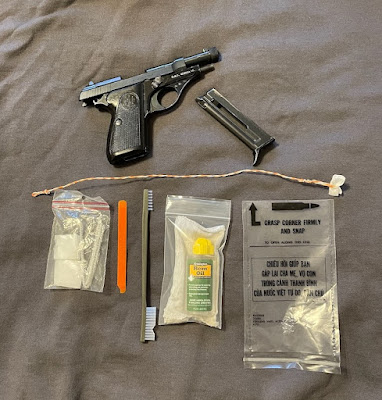
Several years ago I put together the first version of this cleaning kit to accompany an M1 Carbine I used as a road trip gun. I updated it today to keep with my Beretta 71.
Contents:
1 pull through with loops on each end to hold a cleaning patch. This was made from two of the conductors stripped from a piece of CAT5e network cable. It's plastic coated so it won't damage the bore, and coils up to fit in the plastic bag at lower left. A boresnake or sectional cleaning rod could be substituted. I might make a short brass cleaning rod for the kit because then I could use it to push out bore obstructions.
1 plastic bag containing some .22 - .270 cotton flannel cleaning patches, and two pipe cleaners.
1 "Norton's Universal Cleaning Stick" from Countycomm.com. This is a thin plastic bar that can be used for scraping or pushing a cleaning patch through crevices.
1 USGI-type gun cleaning brush.
1 plastic bag containing a 1 oz. bottle of Rem Oil and a rag torn from an old T-shirt. Rem Oil isn't the best gun oil but it works well as a CLP for short term use and the bottle size is handy. Use your favorite gun oil or CLP.
1 USGI Vietnam-era surplus "Chieu Hoi" bag, into which everything fits. These were originally intended to use as covers for 20 round M16 magazines in Vietnam. The idea was that they'd be discarded on the battlefield to induce any Viet Cong who picked them up to defect. They are still readily available and make good storage parts for small parts or kits like this one.
Naturally, this isn't a comprehensive maintenance kit. Rather, it's intended to be an ultra compact cleaning kit to keep in the pistol case to keep it running as part of a grab and go kit.
The pistol, extra magazines, and cleaning kit all fit into this US Peacekeeper attache-style gun case (Amazon affiliate link). A 100 round box of .22LR ammo should also fit.
This weekend I got to the range with a few .22 pistols:
Ruger 22/45 Lite
Ruger SR22
High Standard R-100 Sentinel
I'd recently remounted a Bushnell TRS-25 red dot sight on the 22/45 and it needed to be zeroed. It wasn't too far off at 7 yards so zeroing it didn't take long. However, my plan is to do the final sighting in at 25 yards. The piece ran flawlessly through a mix of CCI Mini Mags, Federal Game Shocks, and Remington Golden Bullets.
Next up was the SR22. The last time I shot it I had a few rounds which required more than one hit on the rim to go off. That's not terribly unusual with .22 rimfire ammo but the SR22 seemed to be a bit more prone to it, so I gave it as thorough a cleaning as possible with removing the breech block from the slide. Unfortunately, I had a few rounds which required more than one hit, both Federal and Remington. From what I can tell, the SR22 would benefit with a slightly stronger hammer spring.
Finally, I put a few different types of .22LR through the High Standard that I bought a week previously. These included Aguila Super Extra and CCI, both standard velocity, Remington Viper Hyper Velocity, and Remington Golden Bullets.
Except for the final cylinder, I shot the Sentinel single action. It whacks the case rims with authority and I had no failures to fire. It seemed to give slightly better accuracy with the standard velocity ammunition.
I only put 9 rounds (one cylinder-full) of Vipers through the H-S. After a few shots the gun became more difficult to cock as the cylinder rotated. I think what happened is that on one round brass flowed back and was dragging. When I went to eject the empties it required a lot of force, unlike the other types of ammo. So, no more Vipers for that gun.
I really wish someone could design a small framed double action .22 revolver that would be reliable without a ridiculously heavy DA trigger pull. My medium-framed S&W Model 18 has a tolerable DA pull but if someone was able to come up with something smaller that reliably ignited rimfire ammo and had a similar DA, they'd have a real winner. And no, the Ruger LCP ain't it.
As an aside, I've had positive experiences with Remington Golden Bullet .22 ammo manufactured in the past 6 or 7 years. Overall in my experience, CCI has been the most reliable .22 rimfire ammo, but in the 5 years or so prior to their bankruptcy, Remington really improved the quality of their .22 ammo. I hope that now that Remington ammo is back in production the quality will be high.
My Remington 550-1 and Nylon 77 rifles both shoot Golden Bullets really well. Also, they are loaded noticeably hotter than CCI Mini Mags. I haven't shot any game with them but a friend gave up on GB hollow points for squirrels because they are too destructive. To paraphrase, "They blow the guts out."
Today I spent a little time playing with my Beretta Model 71 "Jaguar," and found a used factory 10 round magazine on eBay for the Model 73, 74, 76, and 101. These fit the 71 but stick out a bit from the butt. The price was about $70 but for a real Beretta mag it should be worth it. While I had the gun out I painted the front sight with a bright green. I've been doing this on many of my pistols because it makes the sight much easier to see.
Back in the 1940s through the 1980s, High Standard was well known for their excellent semiautomatic .22 pistols. Many serious bullseye shooters favored High Standard autoloaders.
As I started my search I ran across numerous blog and forum posts about the Sentinels, the vast majority of which were very positive. Among other well known shooters, Skeeter Skelton, Mas Ayoob, Elmer Keith, and Chic Gaylord liked and spoke highly of them.
Hickok45 has a video about the Revelation Model 99 that belonged to his father. It's simply a rebranded High Standard.
Revelation was a house brand of the old Western Auto store chain. They resold guns from several makers under this brand name. Sears did the same thing with the J.C. Higgins and Ted Williams brands.
Last week I found a 1950s-vintage Sentinel R-101 on Gunbroker at a gun store in NJ. I waited until the end of the auction and was able to get it for the asking price. After I called the dealer to arrange payment he overnighted it to my local FFL, where I picked it up yesterday morning.
I photographed it next to my K-Frame S&W Model 18-3 for scale.
The steel 3" barrel and cylinder, and the aluminum alloy frame of my revolver are nickel plated. The plating remains almost entirely intact.
Looking it over I could tell that it had been barely, if ever fired. There was no powder or lead fouling on the gun and the front of the cylinder lacked the telltale black marks of a gun shot with lead bullets. The cylinder has no endshake and locks up tight. Timing is perfect.
The rear sight was damaged at some point, with the right corner being chipped. This doesn't affect usage but I may replace it anyway.
Upon getting it home I dismounted the cylinder and grip, then hosed out the action with Rem Oil and compressed air, then relubed it with G-96 CLP.
This video on YouTube details basic takedown of the Sentinels and really shows the clever nature of their design.
Further disassembly isn't needed unless it's to replace a part. The action is held together with pins, so it can be challenging to reassemble. In other words, don't, unless you really need to do so.
I put around 60 rounds through it last night at an indoor range at 10 and 7 yards, shooting Federal Game Shock high velocity .22 LR 36 grain hollowpoints. The single action trigger pull is excellent, probably breaking at no more than 4 lbs., with no creep. The double action pull is another story. As expected it's heavy, probably about 14 lbs. but at least it's smooth. As I understand it not much can be done about the DA pull without affecting the SA pull. I regard this as a single action revolver with emergency double action capability.
Groups with the Federal ammo were nothing to brag about. .22s in general can be very finicky as to what ammo they'll shoot well so I plan to try it with a variety from my stash.
It also shot about 1" to 2" high. Numrich Arms has replacement front sights, one of which I may order and modify in my milling machine to take a taller blade. I'd like to see point of aim and point of impact coincide at 10 yards.
The revolver functioned perfectly, delivering good hammer strikes to the case rims. Unlike a friend's Ruger LCR in .22 LR, it does not seem prone to being easily short-stroked, which will cause a misfire.
Before I fired the High Standard I put 70 shots through my S&W Model 18-3, also in .22 LR. The Smith is a higher quality gun but the cylinder holds 6, compared with 9 in the HS. It also has tighter chambers than the HS, so even though the Sentinel holds half again as many rounds, ejecting spent brass from the Model 18 requires more effort.
The Sentinel is just a little smaller than a S&W K-Frame but it's noticeably lighter due to the alloy frame. I tried it out in a Pacific Canvas and Leather shoulder holster made for S&W Victory Models. It's a little loose but it fits and the strap will hold it securely in place.
As noted at the beginning of this post, the High Standard revolvers were generally well thought of by some experienced handgunners as well as many others. Last year, Diamondback Firearms introduced the Sidekick, which is a Western-styled DA/SA revolver like the old High Standard Double Nine. In fact, the Sidekick appears to be based very closely on the High Standards and has the advantage of shipping with two cylinders, one for .22 LR and the other for .22 Magnum.
I expect this High Standard Sentinel to make a nice little gun for plinking and woods bumming.
Continuing a theme from previous posts, today I installed these Uncle Mike's rubber Combat Grips on a pencil barreled S&W Model 10-5 .38 Special revolver. The piece previously had a set of Pachmayr Gripper Pros on it. The new grips fit my hand better.
Uncle Mike's no longer makes these grips, which for awhile came standard on several Smith & Wesson revolvers. I found this set on eBay.
I recently posted about putting new target stocks on my S&W Model 15-3 Combat Masterpiece .38. I also have an example of the Model 15's understudy, the Model 18, chambered for .22 Long Rifle.
For years, I've had a set of Uncle Mike's Boot Grips on the Model 18. They are functional but not aesthetically pleasing. About a week and a half ago I found that Herrett's Stocks had some smooth Honduran rosewood target stocks for sale on their eBay store, so I ordered a set.
What an improvement.
They look about a million times better than black rubber and fit my hands well. I took the gun to the range last night and it was a joy to shoot with them.
Last week I was on the BK Grips web site and saw his comment stating that his K-Frame adaptors may fit Colt Bisleys. I decided to give it a try and order one. I figured if it doesn't fit I can always put it on a K-Frame.
A few days later I was rummaging around the midden and ran across a Pachmayr K-Frame adaptor that I'd known I had but didn't remember where I put it. (Doesn't it always work that way?) I had to give it a try on the Bisley, and hot damn, it fits!
Last night I took the Bisley to an indoor range. I was pleased to see that augmenting the grip did not change the point of impact, nor did it make the gun uncomfortable shoot. I'll be leaving this grip adaptor on the gun.
When the USPS deigns to deliver the adaptor I'll put it on my S&W Model 1905, 4th Change Target Model.
I got to the range today with my Keltec RDB 17 rifle and Ruger GP-100 revolver.
I've had the RDB for about 4 years. It’s a neat rifle in that it’s an almost fully ambidextrous bullpup semiauto chambered for 5.56mm. Some of the early production RDBs had teething troubles but mine was made after they were worked out. I have at least 500 rounds through it with no malfunctions.
Anyway, I put a new scope on it this week and wanted to zero it. The scope is a Primary Arms SLx 2.5x compact. For a defensive rifle 2.5x with a wide field of view is very fast on target at close range while still providing a little magnification for distances out to a couple hundred yards. Since it’s a prismatic optic, I am able to see the the reticle clearly even though I have astigmatism. The reticles in most red dot sights are not perfectly clear for me due to that.
The scope has a range finding reticle usable out to 600 yards. I doubt I’ll shoot this rifle any further than 250. The instructions say to zero at 50 to get a point blank range of 300 yards.
Even though it was daylight I used the reticle illumination feature because I was shooting at black targets. The illumination lights up the reticle in red, so it had nice contrast with the targets.
My initial impressions of the scope are favorable. It has clear glass, tactile clicks on the adjustments, and a nice reticle. One thing I failed to do beforehand (and I should know better) was to tighten and Loctite the two screws that hold the scope to its base. Naturally, they loosened up after about 40 rounds. I had to dismount the scope, Loctite and tighten the screws, and remount it on the rifle. Luckily, I had both Loctite and the correct tools in my range bag. I was able to rezero the scope in 6 shots (two 3-shot groups).
After finishing up with the Keltec I went to the 25 yard line and put 50 .38 wadcutters through the GP-100. I recently replaced the trigger and hammer springs with reduced power springs from Wolff so I needed to verify it was working properly. I used my handloads of a Hornady 148 grain HBWC on top of 3.0 grains of Bullseye sparked with a CCI small pistol primer. CCI primer cups tend to be harder than other makers’, so if it reliably ignited them I know the gun is dependable. All 50 rounds went off as expected.
I was pleased to see a fellow club member teaching a couple younger guys who were out for their first time shooting. (By “younger” I mean teens or early 20s.) They were shooting a suppressed S&W M&P .22 pistol. The guy instructing was a Russian Jewish immigrant and it’s always good to see a fellow MoT at the range, especially when he’s introducing new shooters to the sport, and especially with an NFA item.
One of the perks of having a father who is a S&W revolver aficionado but prefers Hogue grips, and who lives around the corner, is that he has a drawer full of OEM S&W revolver stocks. I was at my folks’ tonight for dinner and grabbed a set of K-Frame target stocks with the speedloader cut.
They show a good bit of finish wear but structurally they are solid. I previously had a set of Pachmayr Gripper Pro rubber stocks on the gun. Even with the exposed backstrap they were a little large for my small hands. The wood grips fit me better.
Before asking Dad if he had any of these gathering dust I looked on eBay and holy crap. Grips in this condition would probably bring over $100. NIB examples are closer to $180 now.
This Model 15 was the first good centerfire handgun I ever bought, and will be the last to go. It’s what I learned to be a competent pistol shot with. About 25 years ago I was at the range with Walt Rauch and he put a cylinder through it. As he handed the gun back to me he said, “Yup, the K-Frame is G-d’s gift to handgunners.”
This blog contains Amazon affiliate links. If you buy something from Amazon.com after clicking on one of those links I'll get a small commission with no extra cost to you.










 Posts
Posts


