Sunday, April 16, 2023

ATF Day

Last week my membership to Boulder Valley Sportsman's Association was approved. Today I went there and shot the woods walk course. While the camaderie of the matches held there is great, sometimes it's nice to have the range to yourself, as I did today.

This is the first station, with a turkey head and a metal strap to shoot at. Today I took two shots and the turkey and manage to miss both. At the last match I shot at the strap and hit it, which earned me a Mulligan.


The rock in the foreground is where you shot from.


Here are a few other stations, zoomed in so you can see the targets.


The round target with the cross cutout in the center is the one I missed at the last match. I banged it good today.


I forgot to take a picture of the last station, which has the longest target. It's a rectangular steel gong set out at 82 yards.

And a couple pics of the Slotter rifle* in its natural environment, my shooting pouch, and powder horn.


One thing I noticed today is that I definitely spill more powder with the horn than when I use my Peace flask with a Treso free flow spout. This is a mid-19th Century type rifle so a flask is suitable, anyway.

Today I tried out some .480 balls in .020 patches lubed with Mr. Flintlock. I've had the balls for a while so they're a bit crusty but they shot fine.


Accuracy with the .480 balls was good enough so that out of the 25 shots I fired, 22 were hits. Loading was really easy. The muzzle of my rifle is coned and I'm able to seat them below flush with just my thumb. I did not need to use my short starter all day.

After I got home and finished cleaning the rifle I relaxed out back with some Wild Turkey 101 and a Baccarat cigar.


Sure beats working!

* I bought the rifle from Track of the Wolf, who advertised it as a "California" rifle. It's actually a pretty good replica of rifles made for the California trade by Slotter of Philadelphia, PA.

Saturday, April 15, 2023

Ball Starter Holders on Shooting Pouch Straps

When loading and shooting a muzzleloader from a shooting pouch, the less stuff in the pouch the better. The more stuff that's in the bag, the more you have to rummage through when reloading. Many shooters who use a ball or short starter store it on the bag strap when not in use.

The shooting pouch I have from The Leatherman came with such a holder sewn to the jute strap. However, as a lefty, it's on the wrong side of the strap because I have the bag slung across my right shoulder, hanging on my left hip. The October Country bag I've been using with my halfstock percussion rifle didn't have anything on the strap. I fixed up both bags today.

This is the short starter holder that came on the Leatherman bag:


And here are the holders I added to both bags today:


They are simply pieces of 1-1/4" wide leather strap folder over and held in place with Chicago screws. Rivets would work just as well. On the Leatherman bag, I used one of the existing holes in the strap while I punched a hole in the October Country bag strab. A drop of blue thread locker on each Chicago screw ensures that they will stay together.

The leather I used is fairly thick and rigid, so the holders stay open when the starter is removed, and they don't flop around when inserted. I made them snug enough so that I don't need to worry about losing the starter but it's still easy to remove.

Sunday, April 09, 2023

Alpineaire Black Bart Chili Review

Back in the fall I bought two packages of Alpineaire Black Bart Chili from Amazon Prime. Today I decided to try one for lunch.


To prepared it, pour two cups of boiling water into the bag, mix, and then let sit for 10 - 12 minutes. Then mix it again before eating.

I let it sit for at least 12 minutes, mixed it up, and it looked like this:


It came out a bit soupier than I'd like. The texture was typical for reconstituted freeze dried meals. It was fairly spicy.

Because it was so soupy, after I ate half I tried adding some parched corn flour to it to thicken it a bit. Not recommended. I didn't care for the resulting texture.


Overall, I'd recommend it and will probably buy some more for my camping/emergency prep food stash.

Thursday, April 06, 2023

Made a new short starter today

I have been wanting to try a short starter that has a flat head, which should carry better in my shooting pouch than those with a ball head. So, today I made one today from oak, a hardwood dowel, brass tubing, and brass rod. I used Fiebing’s medium brown leather dye for stain and finished it with Watco Danish oil. Tomorrow I’ll rub in some Sno-Seal.


All joints are glued and pinned, so it's not coming apart anytime soon.

Monday, April 03, 2023

Shot Another Woods Walk Yesterday

Due to popular demand, another woods walk was added yesterday to the season at Boulder Valley Sportsmen's Association. Since I've been enjoying them so much I made sure to attend. I shot my California rifle again. It's turning into my favorite muzzleloader.

This time the organizer mixed it up a little. At previous shoots, the first target was a gong shaped like a turkey head, out at about 15 - 20 yards. It's pretty challenging and I missed it last month. Yesterday he added an option to shoot at a steel strap about 1.5" wide by about a foot long, at the same distance. If you chose to shoot at the strap and hit it, your first miss on the rest of the course was scored as a hit. I.e., it got you a Mulligan. I decided to shoot at the strap and I hit it.

Yesterday I was in the groove and wound up missing only one target -- a large disc with most of the center cut out in a cross shape. I'm pretty sure I shot through the middle of it. Since I hit the strap I used this as my Mulligan, and wound up with a score of 20 to take first place.

The annual membership fee at BVSA is reasonable and it's only about a half hour away so I've submitted a membership application. It needs to be approved by the board of directors and then I'll need to attend a meeting, get a range tours, and then I should get my membership card. I'm looking forward to having another place to shoot.

Saturday, April 01, 2023

Enhancing my ramrod and short starter

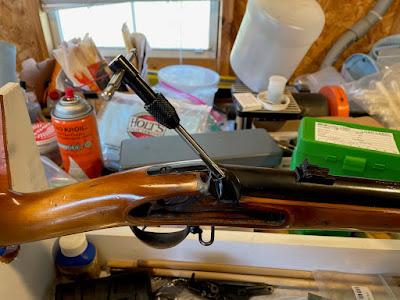
The Delrin ramrod I put together for my California half stock rifle only had one threaded end on it. If I'm ever out in the field with the rifle and need to pull a ball that would be a problem, so today I added a tapered steel ferrule to the other end. It's threaded 8-32 to accept accessories, including this T-handle I have.


The T-handle also provides a better grip if I'm cleaning, the patch is too tight, and it gets stuck down at the breech.

While I was at it I also drilled a 5/16" hole about 1/2" deep in my short starter, so I can use it as a palm saver if it gets difficult to fully seat a ball due to fouling.


When adding a ferrule to the end of a ramrod it's very important to not only have a tight fit, but to glue and pin it in place. Otherwise, the odds are good that at some point it will come off, especially if you have a stubborn patch or are trying to pull a ball. I cross drill a hole through both the tip and rod after glueing the ferrule on, chamfer the ends of the hole, put a little glue in the hole, and drive the pin through. Then I cut it a little long and peen over both ends, and finally, file or sand it smooth.

Sunday, March 26, 2023

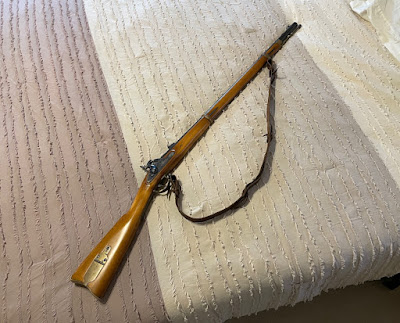
Took the Zouave to the Range Today

Today I took the Zouave to the range to benchrest it at 50 yards. I tried three different loads:

  • 10 shots with the .58 service load of a Lyman 575213 Minie on top of 60 grains of FFg Goex BP.
  • 3 shots with a .570 ball, .018 patch, and 80 grains of Goex FFFg BP.
  • 7 or 8 shots with a .562 ball, .020 patch, and 70 grains of Goex FFFg BP.
  • 1 more shot with the service load, offhand at a steel plate, which range nicely.

The Minies were lubed with Track of the Wolf's Mink Oil Tallow, while the patches for the balls were lubed with October Country Bumblin Bear Grease. I did not need to swab the bore between shots.

The Minies mostly shot into one big hole about 3" across and 2" or 3" above the point of aim.

I was underwhelmed with the performance of the round balls. The .570s which were very hard to seat in the muzzle grouped into 4" to 5" and at least 6" high. The .562s on 10 grains less of powder didn't shoot quite as high but the group was at least 6".

As it stands right now if I was to take the gun deer hunting, I'd load it with the service load. However, without a lot more practice with this gun and its stiff trigger, I'll probably use my California / Philadelphia .50 caliber half stock rifle during the early antlerless season. I need to do more load development with that gun as well, since so far I've been mostly shooting it with a relatively light 55 grains of FFFg powder. I want to see what it'll do with 80 grains.

After I finished shooting I tried a new to me way of cleaning. I took a piece of greased leather and placed it over the nipple then lowered the hammer. Then I filled the barrel with some water and let it soak for a few minutes before dumping it out. I repeated that a couple more times then wiped it with a couple dry patches, then a few with Mr. Flintlock on it. This got the bore clean quickly but was a bit of a mess because the leather seal over the nipple leaked. Unless I come up with a water tight cap, the next time I'll just use the flush nipple I bought for the gun, and maybe put a binder clip on the rubber tube.

While I didn't settle on a hunting load for the Zouave, experimenting is a big part of the fun of shooting these things.

Wednesday, March 22, 2023

Picked up a few things for the Zouave

Last Saturday I ordered a few things for the Zouave from The Possible Shop, and they arrived today.


First off was a lace-on sling made by October Country. It's a simple, two-piece carrying strap that's 1-1/4" wide, which will help distribute the 9 lb. rifle's weight. (Last week I'd bought an 1861 Springfield sling off eBay but it's too long for the shorter Zouave.) Since I am not reenacting this will work just fine and still looks 19th Centuryish.

Along with the sling I got a Treso musket nipple and one to take #11 caps, both made from AMPCO bronze. The musket nipple needs to be turned down slightly to take Scheutzen musket caps but the #11 nipple is actually a little small. CCI #11s are loose and would need to be pinched to stay on. RWS 1075 Plus caps fit snugly, however. The main reason for getting the #11 nipple is in case I ever need to use homemade caps.

Finally, I also got another bottle of Hoppe's No.9 black powder patch lube and solvent, and some bulk pillow ticking and .020" patch material. These of course are not just for the Zouave.

Sunday, March 19, 2023

Shot the Zouave Today

I shot it today with .562 and .570 PRBs, and a few .575 Minies. Just some offhand shooting from about 35 yards. The first three shots were on top of 50 grains of Goex FFg but after those I bumped it up to 60 grains. For ignition I used Scheutzen musket caps.

The .562s load easily with a .020" patch while the .570s are a tight fit with the same, but once started seat easily on the powder. The .570s were noticeably easier to load with 0.018" pillow ticking patches.

I lubed the patches with Hoppe's No. Plus and the Minies with Bumblin Bear Grease that I smeared on with my fingers. I didn't need to wipe the bore until after I was done.

The Minies loaded easily as well. They are from Track of the Wolf, were cast in a Lyman 575-213 mold, and should weigh about 510 grains (well over an ounce).


With the 60 grain service charge it's only doing about 950 - 1,000 FPS. On a sunny day you can see them go downrange. However, because of the weight they have a ton of momentum. During the Civil War, if these struck bone in an extremity it meant amputation if the poor guy didn't die from shock. Even with today's medicine the result would often be same. People talk about the "high powered 5.56mm bullet used in AR-15s," but it's nothing compared to a Minie ball.

Recoil of the patched round balls and Minies was pretty mild in the ~9 lb. Zouave. I'll probably just use round balls if I take it hunting but bump the powder charge up to 70 or 80 grains, mainly to flatten the trajectory. At close range even with 60 grains a patched ball would have a good chance of blowing right though a Pennsylvania whitetail, but loading it hotter will make it easier to hit past 50 yards due to less drop.

Incidentally, that's a .45 caliber rifle to the left.

I'm used to shooting rifles with set triggers so the military trigger of the Zouave took some getting used to, but overall I'm really happy with the gun. Offhand accuracy was good but of course I'll both bench it and shoot it offhand at 50 yards to see what it's really capable of. But it's looking promising for use during the early antlerless deer season here in PA.

Saturday, March 18, 2023

Borescoped my Zouave Rifle

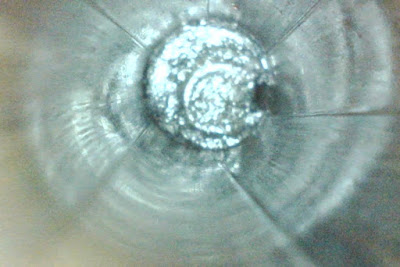
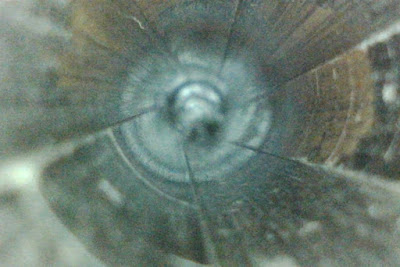
Tonight I used my cheap USB bore scope to inspect the bore on the Zouave. It's in good shape for a 37 year old muzzleloader

This is the breech. The black spot at about 3:00 is the flash hole.


There is some minor surface rust about 6" above the breech face, but it's not bad.


After scoping the bore I ran some Hoppe's No.9 down and will let it soak until tomorrow.

On a Mac, PhotoBooth works to watch video as the camera goes down the bore and to grab stills. I didn't have to install a driver or any other software.

I bought the scope in 2017 from Amazon. The unit I bought is no longer available but they have an assortment of others. Mine requires the use of a USB A to USB C 3.1 adapter to work with my MacBook Air. It will not work with an Apple 3-in-1 dongle, but it works fine with this Amazon Basics model.

This model of borescope is very similar to mine but the connector is USB C, and it comes with a USB A adapter.

Zouave Maintenance

One of the risks you run when buying a used gun is that it will need mechanical attention. When I got a couple replacement nipples for the Zouave from Track of the Wolf I noticed that the threads on them were the correct pitch (M8-1mm) but the threaded portion was longer than the nipple that came with the gun. When I tried to install one it would not screw all the way in. When I looked inside the bolster it was evident that the threads needed to be chased.

I did not have an M8-1 tap or die so I ordered a set from Amazon Prime and it came today. When I got to working it was apparent that the threads were pretty well boogered but after awhile I was able to clean them up.


Aside from the bolster, the replacement nipples' threads could have been better so I chased them with the die that came in the set. To do so I held each nipple by its square shank in my vise and put the die in the holder from my big Harbor Freight set. Now they both screw in and out easily.

While I was in the bolster I also noticed that there was a crusty buildup in the bottom near the flash channel. That cleaned up using a small twist drill bit turned in my fingers.

Tomorrow I should get to shoot the Zouave. I'm bringing a variety of components: .562, .570, and .575 round balls, .575 Minie balls, and .018" and .020" patch material for the round balls.

Sunday, March 12, 2023

Refining my Woods Walk Loadout

Today I shot the woods walk at Boulder Valley with this rifle, getting 18 out of 20 targets. The top three shooters all got 18 but they place shooters based on how early in the course the misses were, so I took 3rd place. I'm extremely happy with how I shot today. I used 55 grains of Goex 3Fg for all targets except for a gong out at 82 yards. I bumped up my powder charge on that one to 70 grains for a flatter trajectory, aimed dead on, and hit it.

Last week I wore partially period correct clothing. I was feeling lazy today and just wore regular clothes. The other guys who normally wear PC clothing didn't today, I guess the laziness is going around.


Each woods walk I shoot in is a shakedown run and I continue to refine my loadout. Today I used my Peace flask with a Treso free flow spout on it. (I bought the spout at Dixon's yesterday.) This was faster and easier to dump powder into my measure compared with my powder horn.

I used the same double bag shooting pouch as last weekend, but this time I had only patches and balls in the front pouch. My cleaning kit and nipple primer were in the rear pouch while my capper and powder measure were in a jacket pocket. If I'd worn PC apparel I would have kept the capper and powder measure in a belt pouch.

Instead of using a ball bag, I dumped the balls into the front pouch. This made them a lot easier to retrieve, instead of fumbling to get into a separate ball bag. I wouldn't do this for hunting or an kept my extended trip in the wilderness, but for a woods walk it works well.

I also got to try out my PCP Pro Polish capper for the first time. This gets two big thumbs up from me. Since it's 3D printed plastic it wouldn't be acceptable at an event requiring everything to be period correct, but it was inexpensive and worked perfectly with CCI No.11 caps.


I ordered two of them on February 27th (one for me, one for my brother) and they arrived on March 10th. Not bad for mail from Poland. The cost was 120 PLN which came out to about $32 and change.

The reason I wanted to try the Polish capper was that the Ted Cash capper shown above was driving me nuts with caps flipping over the last time I used it. I'll have to try it with RWS 1075s but the CCI No.11s were a pain in the neck. I'm perfectly satisfied with the Polish capper.

Today I was really glad that the barrel wedges on my rifle are captive. About halfway through the shoot I noticed the rear wedge hanging all the way out. If it had fallen out it would have surely been lost. The wedge on my Cabela's Hawken is not captive, which I'll fix. Cutting a slot in it will be simple with my milling machine. Then I'll make a pin from a nail and inlet it in the stock behind the escutcheon.

They also announced that they've added another shoot at Boulder Valley on April 2nd, which is great.

Saturday, March 11, 2023

Traded Into a Zouave Today

Today I took another trip up to Dixon's and wound up trading my Pedersoli Brown Bess carbine for a Euroarms Remington 1863 Contract Rifle, AKA Zouave. Although about 12,000 of these were made by Remington during the Civil War, it's unlikely that any of them saw service. They are called Zouaves nowadays because somewhere along the line someone thought they were made for Union Zouave units. Regardless of whether they were ever used in service, they are a relatively handy example of a rifle musket.

It goes perfectly with the Zouave flask I just picked up. :)


This one bears a date code of AP, which translates to 1986. The stock shows some dings but the metal is in great shape and the bore is excellent. It's a .58 caliber and was intended to shoot Minie balls on top of 60 grains of powder. Back in the 1970s my father had a Zoli Zouave and got best accuracy with patched round balls. From what I can find, the Euroarms Zouaves have a 1:66 twist so I suspect that it, too will shoot better with a PRB. In any case, I have a couple of suitable ball sizes and some Minies to try.

The front sight appears to be a taller replacement intended for competition use. It'll give me plenty of metal in case I need to file it down to raise the POI.

Something I thought was interesting is that it lists a maximum powder charge on the barrel, but it's in drams. 3-1/2 to be exact. That translates to 95.7 grains, probably more than I'll ever shoot.


The nipple unscrewed easily but the flash hole looks a bit enlarged. I put in an order with Track of the Wolf for 2 spares and few other odds and ends.

The ramrod is made from brass and has male threads on the end. Along with the gun I got a Treso adapter that allows me to use standard 10-32 accessories. Naturally, I found that I already had one when I got home; I'd bought it to use with the Bess I traded in today. Oh well, 2 is 1 and 1 is none.

The stock is one of the blandest pieces of wood I've seen on a gun. I may strip it, stain it darker, and finish it with BLO. I think it has some kind of polyurethane on it now.

Assuming it shoots well it's a definite candidate to use during PA's early muzzleloader antlerless deer season, which allows caplocks. (We have a flintlock-only season after Christmas.) A .562 or .570 patched round ball should be very effective on Pennsylvania whitetail.

Tomorrow I'll be shooting a woods walk and using my plains rifle, so I won't get to shoot this rifle until next week at the earliest.


Friday, March 10, 2023

Peace Flask

In the mid-19th Century powder flasks became popular for carrying gun powder, supplanting the use of powder horns.

I just got this Pedersoli-made Peace flask AKA Zouave flask in from Dixie Gunworks, to go with my plains rifle. Dixie sells the cord separately in 20 foot hanks. I'll use another piece of it on a powder measure. I'm planning to use this at my next woods walk.


These flasks were developed before the Civil War for issue with the M-1841 "Mississippi" rifle. The "Peace" moniker comes from the clasped hands motif. Modern shooters have also called them "Zouave" flasks based on the mistaken belief that they were issued with the Remington M-1863 contract rifles, but none of those actually saw service during the war.

The flask holds about 12 oz. of powder and the spout measures out 60 grains. That works out to about 77 shots per fill. I'll probably cut down the spout to hold 55 grains.

Back in the 19th Century it was common practice to pour the charge into the gun directly from the flask. Nowadays that is frowned upon because if there is a spark remaining in the bore, it can ignite the entire flask right in your face. Doing so at a sanctioned shoot will get you an invitation to leave, AAMOF.

So, when I use this I'll decant the charge into a separate, fixed measure which will then be used to load the rifle. I plan to use a 70 grain measure made from deer antler. That way, if I want to bump my powder charge up a little for long shots on woods walks it's simple enough to do so.

Treso, the maker of powder flask spouts, nipples, and other black powder accessories, makes a short free flow pour spout that screws into powder flask heads. I may eventually get one of those.

Incidentally, when I got the flask today it had what looked like some kitty litter rattling around inside. I'm sure this was left over from the manufacturing process. To get all of it out I had to remove the head which is held on with three set screws. If you ever need to do this you'll need a precision screwdriver and do it over something to catch any screws you drop, which will probably happen due to their tiny size.

Finally, Dixie Gunworks was hit hard by COVID a couple years ago and experienced many shipping delays. They still seem to be having staffing difficulties. With all that, I ordered the flask and cord on Saturday, March 4th, and got it today Friday the 10th. So, they are doing better with speedy shipping.

Mike Beliveau (duelist1954) Being Harassed and Could Use Our Help

Mike Beliveau (duelist1954) is a YouTuber who puts out a lot of good content, primarily black powder related. A local zoning official is falsely claiming that he's operating a shooting range business on the rural property where his films most of his videos. Mike needs help to pay for the legal expenses of his zoning appeal. He first needs to exhaust the administrative process before he can sue the township in the Pennsylvania Commonwealth Court.


Here's a link to the GoFundMe, to which I contributed:

https://www.gofundme.com/f/stand-with-a-patriot-for-property-rights

If an official in a rural PA township can get away with something like this, nowhere is safe.

Friday, March 03, 2023

My California Rifle is Really a Philadelphia Rifle

In doing some more online research it looks like my "California" rifle would more appropriately called a Philadelphia rifle. It appears to be inspired by rifles built by Slotter & Co. of Philadelphia, PA during the mid-19th Century.  They made a lot of rifle, some of which were shipped to A.J. Plate of San Francisco for sale in that market.

As a Pennsylvanian sitting about 5 miles from the Philly line, this works for me. :)


Monday, February 27, 2023

Shot the California Rifle Again and a Discussion of Cappers

Yesterday a few friends and I had an ATF day* and I put another 20 rounds downrange with the California rifle.

As with my first outing I used Mr. Flintlock lube on my patches, but this time I prepped them in advance instead of cutting them on the muzzle. The 20th ball seated just as easily as the first and there was no sign of any increase in fouling that would eventually require me to swab.

We shot from about 30 - 35 yards offhand at steel and a paper target. At first I tried a 50 grain charge of 3Fg but it shot a little low so I bumped it to 55 grains which got the point of impact to coincide with point of aim. I am planning to take the rifle on a woods walk this Sunday at Boyertown. I figure I'll use 55 to 60 grains but there's one station with long shots that I'll probably use 75 to 80.

As expected, the rifle performed flawlessly with very fast ignition. I made sure to swab the barrel with rubbing alcohol before shooting and to pop a cap to ensure the flash channel in the patent breech was clear of any oil.

Most of my muzzleloading rifle shooting in the past 20 years has been with flintlocks. However, I first learned to shoot muzzleloaders with percussion guns. I've been rereading Ned Roberts' The Muzzleloading Cap Lock Rifle and it rekindled my interest in them. That book is one of the first that my father bought when he got into muzzleloading around 1970 and I read it at a young age. It's to black powder shooters what Elmer Keith's Sixguns is to revolver shooters.

I'd wanted to try it with some Scheutzen brand musket caps that I got last week from Grafs, but the USPS didn't get my new nipple wrench for musket nipples here in time. So, I just used CCI No.11 caps. My primary reason for getting the musket caps and suitable nipples for this rifle and my Cabela's Hawken is to give me options. Number 11 caps have been scarce since the 2020 COVID-induced buying panic. Musket caps have remained more available and also have the advantage of being easier to handle, and in the case of RWS and Scheutzen, more powerful than smaller caps. (By most accounts current production CCI musket caps are no stronger than No.11s.)

Yes, I have the kit to make No.11 caps, but damn it's tedious. Note that the Prime All compound results in corrosive caps or reloaded .22 rimfire, so clean accordingly with a water-based cleaner that will dissolve the salts left behind.

Although I had to wait on trying musket caps, I was able to try out one of the leather cappers I got from October Country. They were only a few bucks each so I got two. They are made from two leather disks held together with a rivet. Each disk has 10 holes punched in it, allowing it to hold 20 caps total. You just press the cap down on the nipple and if it's a snug fit it will remain in place when you pull the capper off. If the caps are a little loose you can cut a slit in the leather from each cap hole to the edge, and pull the capper off sideways.


Aside from the leather capper I also had some of these 3D printed star cappers with me, although I didn't use any.


The printed cappers are available in several colors but I chose orange for when I inevitably drop one in the woods.

These are really nifty and should work well for both rifle and some revolvers. I tried it on my Uberti 1851 Navy Colt and Pietta Dance Brothers, and there's plenty of space to pull the capper off sideways. However, my Pietta 1858 Remington Navy would need to be modified for this to work as there isn't enough room for the larger area on the end of each arm to fit when pulled off sideways. It should work fine on my Rogers and Spencer, which has large dished-out areas around each nipple.

The reason I got the leather and star cappers is because the last time I shot the California rifle I used a Ted Cash capper that gave me fits with caps flipping over. These don't hold as much but are much simpler.

That said, this morning I ordered a PCP PRO from Polish Cappers. The reviews I've seen of the Polish cappers have been very good and the price for their 3D printed version is low (about $16 plus postage). I'll post a follow up after receiving it.


* The alchohol and cigars were consumed after all the guns were put away.

Wednesday, February 22, 2023

Converting Rifle Brass to Use No.209 Shotshell Primers

AKA, “Yet another reason to have a small lathe.”

Obligatory disclaimer: We don’t guarantee that these will be safe in your rifle or with your components. Do this at your own risk.

The cartridge cases converted using this method are NOT safe to use with full loads. Read that again. They are only safe to use with low pressure reduced loads. Use at your own risk.

My friend N. has recently delved into shooting his M-1891/59 Mosin-Nagant and No.4 Mk.I Lee-Enfield with "mousefart" loads. These are even less powerful than Ed Harris’s “The Load” of 13 grains of Red Dot under a 150 - 180 grain bullet. N. is loading a 115 or 125 grain cast bullet on top of 5.0 grains of Bullseye. (His first try in 7.62R used 6 grains of Bullseye but accuracy was horrible. Backing off to 5 grains shrank the groups.)

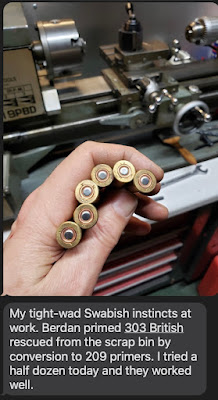
He has a good stock of No.209 shotshell primers but not a lot of large rifle primers. He also has a lathe in his basement workshop, as you can see in the picture. It’s an older Jet unit with a 7” swing (not sure how long it is). He took some Berdan primed .303 cases that he’d stashed away and drilled out the primer pockets so they will accept No.209 primers.


Per N., he used three drill bits to modify each case:

"Center drill to keep main drill from following the firing pin dent, letter C for the main body, 21/64 to countersink the flange on the battery cup.  Be careful!  My Fiocchi primers are .002" larger than my Cheddite, and I understand the Cheddites are larger than most Yankee brands."

So measure the No.209 primers you have and pick drill sizes to match.

We haven't tried this with Boxer-primed brass but I don't see why it wouldn't work. This project was primarily to make something useful from what otherwise would be trash.

Something else to consider is how your rifle will handle escaping gas if something goes wrong. I have been present when someone experienced complete case head separations in a No.4 Lee-Enfield and another time in a Mosin-Nagant. The Lee-Enfield shooter didn't notice anything awry until he opened the bolt. The Mosin shooter got gas back in his face but was uninjured because he wore eye protection.

Also note that a lot of milsurp .303 and all 7.62x54R were corrosively primed. Make sure to clean your rifle accordingly when shooting that ammo. You also need to rinse out the brass with water if you plan to reuse it. (The No.209 primers are not corrosive. I'm only referring to the initial firing with the original primers.)


Sunday, February 19, 2023

Funnel for filling powder horns

Today I received a package of 6 small aluminum funnels from Amazon. They are sold for filling small perfume bottles but are a good size for filling a powder horn.


They should also work for filling powder flasks but for those, I prefer the Ted Cash powder flask funnel. The Ted Cash funnel screws into the flask and holds the valve open. It also happens to fit the mouth of a .44-40 case perfectly when I'm handloading.

Friday, February 17, 2023

A California Halfstock Percussion Rifle

Last week I was browsing Track of the Wolf's website and ran across this rifle. I've been wanting a percussion sidelock for use in local trail walks and for deer hunting during PA's early antlerless season. After mulling it over for a day I ordered it on Saturday. I paid extra for 2 day shipping to reduce the time in transit (and therefore the opportunity for foul play). It shipped on Monday and arrived on Wednesday.


It's based on a rifle built by a gunsmith in California in the late 19th Century. Key differences are that the original had a back-action lock and a Dimmick-style trigger guard. In contrast, this one has a front-action L&R Hawken lock, and an Ohio-style trigger guard.

The barrel was made by Jim Goodoien of Blaine, MN. It's my understanding that his barrels are some of the best made in recent years. According to an email I got from Track, Goodoein barrels are hand lapped and choked, which makes loading easier. The bore has the best polish I've ever seen on a rifle. If I shine a light down it I can see all the way to breech, something rare on a muzzleloader with a closed breech and a long barrel. It's 34" long with a round ball twist.


Whoever built the rifle (which is unknown), left the muzzle with a flat crown. I didn't like that so I used my Joe Wood coning tool to put a slight cone in it. I didn't go as far as I did on my longrifle but I may do some more work on it.

The stock is Claro walnut with German silver mountings. The barrel and sights were left with a patina finish although I put some cold blue on the sights to reduce glare.

The barrel keys are captured to prevent loss. The nosecap is poured pewter.


Detail of the sideplate, which looks to me like the Flying Spaghetti Monster.


The double set triggers may be from R.E. Davis but I'm not sure. They look like Davis triggers with the rear trigger bent forward a little bit. Regardless, when set the gun fires with mere ounces of pressure on the front trigger.

Overall, it balance nicely for offhand shooting. It's no lightweight, though, at about 9.5 lbs.

Today I took a vacation day and took the new rifle to my club even though it was raining. We have a covered firing line that kept me dry until a squall blew in for a few minutes and got me and everything wet. But before that I got the rifle zeroed at 50 yards. Windage was dead on but it was shooting 8" - 10" low. Some trial and error with a file work on the front sight got it shooting ~2" high at 50 yards, about where I like it.


The loading tables on the 50 yard range at my club have notches for the rifle and a range rod. There's no danger it'll fall over.

Those of you who've seen my prior posts may have noticed that this is a right handed rifle, while I'm left handed. As a southpaw I don't even notice the hammer when shooting a right handed caplock rifle. (Righty flintlocks are another story and require a lot more concentration.)

If I do my part (not always guaranteed) it looks like it'll put them within 2" - 3" at 50 yards. Load development may help that. I mostly shot .490 balls patched in .020" patches cut at the muzzle, lubed with Mr. Flintlock Patch Lube and Bore Cleaner, on top of 60 grains of 3Fg Goex black powder. I used CCI No.11 caps and in about 2 dozen shots had no ignition problems.

For the last 4 or 5 shots I used 0.018" pillow ticking lubed with neatsfoot oil. I fired these at steel gongs offhand so I can't compare how the rifle shoots with the thinner patches.

I did not have to swab until after I finished shooting. The last round loaded as easily as the first. I attribute this to the Mr. Flintlock lube but also to the hand-lapped bore. Although Track's email stated that Goodoien barrels are choked I could not feel that while loading. It's possible that this barrel was originally longer and cut down at some point, removing the choke.

I have some .495 balls that I plan to try in the rifle to see how they load and shoot.

But right now I'm happy as a clam with this purchase.

Sunday, February 12, 2023

Mr. Flintlock Patch Lube and Bore Cleaner

I shot the Boulder Valley woods walk today and hit 15 out of 20. This was my first time using Mr. Flintlock lube on my patches and did not need to swab between shots at all. 20 shots with no swabbing and I could have shot another round of 20. Cleanup afterwards wasn’t bad. (I shot my normal load with a .490 ball, 0.018" ticking patch, and 60 grains of Goex 3Fg, except for the last target which was out at 80 yards so I loaded 80 grains of powder.)


For all I know it’s a mix of alcohol and Murphy’s Oil Soap or Pine Sol, but it freakin works for target shooting. I’ll stick with Track’s Mink Oil or October Country’s Bumblin Bear Grease for hunting but for long strings of fire this stuff is amazing. I partially attribute my score today to not needing to swab and thus reducing my fatigue.

It's available directly from the maker at https://mrflintlock.com/. I've also seen it on the shelf at Dixon's so it might also be available at a shop local to you.

I have no connection with Mr. Flintlock aside from being a very satisfied customer.


Sunday, January 01, 2023

Shot Another Woods Walk Today

For New Year's I was able to go shoot another woods walk at Boyertown today.

I posted yesterday about my shooting pouch. It worked out well today. I did change a couple things from when I shot the woods walk a month ago:

  1. This time my horn was filled with Goex 3Fg while a month ago it was Scheutzen 3Fg.
  2. I loaded with 65 grains of powder instead of 70 grains. This resulted in a little less fouling per shot but since I used different makes of powder, I can't draw a straight comparison.

My score today was the same as last month's: 11 out of 20. I consider myself a better than average shot but this course is difficult so I am pretty happy with it.

Some of the targets this time around were a little different. One gong was shaped like a hammer and sickle as seen on the Soviet flag, while the one next to it was a coronavirus. Both were most definitely worth shooting and I wish I'd taken a picture of them.

As I did last month, today I swabbed between shots to keep the black powder fouling down and make loading easy. I need to try shooting .480 balls instead of .490s to see if they shoot well in this gun, and if so, if I can get a few shots between swabbing. I haven't had the chance to do so in the past month.

Before packing away my rifle after the match I ran a couple wet patches down the bore to save some time when I got home. After getting home I ran several wads of tow down the bore, wet with Hoppe's No.9 Black Powder Cleaner. This did a pretty good job of scrubbing, much like a bore brush, so it reduced the number of cleaning patches I needed to use.

However, I'd still like to pump hot water through the bore for cleaning. I have a clamp-on flush tube from Track of the Wolf but it doesn't attach very well to my rifle because of the stock design. Over on the Muzzleloading Forum several members spoke highly of a flush tube that attaches to the barrel using strong rare-earth magnets, made by "The Lucky Bag". I could probably make something similar but decided to take the easy way out and ordered one. I am hoping that it will simplify cleaning my flintlock rifles.

Next Sunday there's another woods walk at the Boulder Valley Muzzleloaders in Green Lane, PA which I hope to attend. This is addictive.


Saturday, December 31, 2022

Shooting Pouch and Contents

I am planning to shoot in another woods walk tomorrow at Boyertown and in preparation went through my shooting pouch, so I thought it was a good opportunity to do a post on the contents. I will be shooting my .50 caliber George Dech flintlock longrifle, so the bag is setup to support it.

The bag itself was made by The Leatherman. I bought it many years ago at Dixon's. Although it was made to be worn on the right hip I wear it hanging on my left. If I can get motivated I may reverse the strap but that will require a lot of restitching.

I've previously posted about the horn, which came from October Country and then refinished by me.


The contents of the pouch are limited to support shooting and maintaining the rifle for a day or two of shooting. I could carry a few more things but then it would require fishing around in the bag too much.


First, note that I have a vent pick and pan brush hanging from the shoulder strap of the bag. I use the vent pick before priming the pan for each shot. This ensures that the vent is clear and allows me to confirm that I didn't dry ball.

On the top left is an Altoids tin containing cotton cleaning patches, some tow, a .50 caliber cleaning jag, and a US M1817-style worm to use with the tow. I also carry a small bottle of 70% rubbing alcohol in my jacket for use as a cleaning solvent. Running a damp patch down the bore between shots keeps loading easy and makes it so that my final cleaning isn't as difficult.

To the right of that is a tin with 30 0.018" shooting patches lubed with pure neatsfoot oil, and to the right of that is my powder measure, attached to the bag with a leather thong.

In the middle row is a leather bag containing 30 .490" round balls and next to that is my priming flask full of 3Fg powder. That will be carried in a jacket pocket during the shoot.

Below that is a flint/tool wallet and its contents: two lens wipes for my eyeglasses or the frizzen if it gets really dirty, ball pulling screw, patch pulling worm, three flints, and a piece of leather for holding the flint in the hammer.


This pic shows the back of the bag as well as the inside of the flint/tool wallet. It also shows the flint knapping hammer I carry in the bottom of the bag but forgot to take out for the first picture. I can use it to refresh the edge of a worn flint without removing it from the hammer.

I've previously used a small set of hand forged pliers for flint knapping, but Boyertown's rules require using a brass, non-sparking implement if knapping the flint when a charge is down the bore. I can't argue with that so I picked up the hammer shown since their last shoot.

Friday, December 30, 2022

Passed the GIAC GCIH Certification Exam Today

Today I passed the GIAC Certified Incident Handler (GCIH) exam. I previously reviewed the SANS Course, SEC504, which is the prep class for this exam.

In my previous career I was an attorney. After switching into IT, I took several certifications including COMPTIA's A+, Network+, and Linux+, along with getting my MCSE in Windows NT4 (yeah, I'm old). The GCIH exam was the most difficult test I've taken since the Pennsylvania Bar Exam.

The test consists of 106 multiple choice questions, about 10 or 11 of which require the use of a "CyberLive" virtual machine to perform a task. The test is open book with a minimum passing score of 70%, and there's a four hour time limit. I used up about 3 hours, with one very brief bathroom break.

If you search online for tips on passing GIAC exams, the one common theme is that you need to prepare a really good index of the course materials. SANS actually includes a course material index in their downloadable materials but you want to create your own, because the primary value of the index is the absorbtion of knowledge you get while creating it.

The way I built my index was as follows:

  1. Created a MS Excel spreadsheet with one tab for each of the five course books, plus a "Combined" tab.
  2. I then went through each book and indexed concepts and terms.
  3. Next, I assigned a different color to each book.
  4. Copied the contents of each book's tab over to the Combined tab.
  5. Used the Excel Sort function to sort the entries alphabetically.
  6. Copied this sorted table into MS Word and printed it.
  7. I put the printed index along with a bunch of cheat sheets into a 1/2" 3-ring binder.

I also used color-coded Post-It notes to make tabs for key sections in each book. The colors of the Post-Its matched the colors in my index. So, for example if I looked in the index for a term and it was color-coded yellow, I knew immediately to grab the book with yellow Post-Its sticking out.

Overall, I think I reviewed the SEC504 books three times, and did the labs at least twice each.  Another thing I did was sign up for a TryHackMe.com account and worked through some exercises relating to topics that the GIAC practice tests showed needed more attention from me, especially Metasploit and SQL injection. 

I'm currently working my way through TryHackMe's Junior Penetration Tester learning path, but that'll be the subject for another post.

Saturday, December 17, 2022

Shot the .36 Flintlock Again Today

Today I took the .36 flintlock rifle to the range again.

Before heading out, I setup a new Delrin ramrod for it that I got in my last order from Track of the Wolf. It's 5/16" in diameter with brass tip threaded to take 8-32 accessories. I cut it to a couple inches longer than the bore and then added another brass tip on the other end. That one is threaded to take 10-32 accessories. Because the ramrod thimbles are sized for a 3/8" rod and ramrod hole was drilled a bit large for a .36, I'm able to fully seat the rod in the gun without it being tapered on one end.

If your ramrod has brass or steel tips I strongly recommend pinning them in place. Even if they are glued on and a tight friction fit, they can pull off if you try to pull a ball, or get a tight cleaning patch stuck down near the breach. Drilling and cross-pinning them will prevent that.

For my first group of 5 shots I tried .358" balls in .015" patches. These were a real bear to seat flush with the muzzle, so I don't think I'll be trying that combination again unless/until I cone it. Once past the muzzle they seated on the powder without excess effort.

My remaining shots were with .350" balls in .020" patches. These were easy to seat with my short starter and of course, seated easily on the powder. I used October Country's Bumblin Bear Grease for lubing all the patches.

All told I fired about 24 or 25 shots today and experience no hang fires or misfires. However, I found that it was difficult for me to get consistent groups. I am 99% certain it's due to the front sight, which is only .06" wide and rounded on top, so how I see it is really affected by changes in lighting.

As an experiment, I didn't swab between shots for about the last 11 rounds. I was still able to seat the last ball easily.

Those final 11 shots were fired at steel gongs. I whacked an ~8" gong a few times and it didn't visibly move, although it rang nicely, especially when I bumped my powder charge from 35 to 40 grains of 3Fg Goex. A smaller gone, probably about 6" square did visibly move. This is actually giving me second thoughts about using this rifle in woods walks where you shoot at steel gong targets.

After I got home and finished cleaning the rifle I measured the width of the front sight on my George Dech .50 longrifle and found that it's .08". It also has a nearly vertical rear face. This front sight is much easier for me to see than the one on the .36, so I ordered a similar front sight from Track of the Wolf.

Along with the new front sight I ordered a 5 pound box of Hornady 000 buckshot, which they swage to .350" diameter. While the Hornady .350" round balls sold for use in muzzleloaders are pure lead, the buckshot has a little antimony in it. According to a few folks on the Muzzleloading Forum the buckshot works fine in .36 muzzleloaders. ASSuming this works out it's definitely cheaper than buying 100 count boxes of .350" round balls.

Note: Some manufacturers of 000 buck make it at .360". Likewise, Lee 000 buckshot molds nominally cast .360" balls. Hornady may use the same swages for .350" muzzleloader balls and 000 buckshot.

Anyway, I am hoping that with the new front sight I'll be able to shoot the rifle better.

Sunday, December 11, 2022

Shot the .36 Flintlock Rifle Today

I shot the rifle today and a load consisting of a .350 ball, 0.020" patch lubed with October Country Bumblin Bear Grease, and 40 grains of Goex 3Fg shows promise.

I started with 30 grains of powder and also tried 0.015" and 0.018" patches but they don't group as well. Recoil with 30 grains was on par with a .22 while 40 grains has slightly more push.

A member of the Muzzleloading Forum today posted that he has had good results in a Green Mountain .36 barrel using a .358 ball in a 0.015” patch. Track of the Wolf carries .358s so I’ll add a bag to my next order with them.

Once I settle on a load I'll adjust the sights so POA = POI at 50 yards. Currently it's shooting 2" or 3" to the right.


Saturday, December 10, 2022

A .36 Caliber Flintlock Rifle by C. Gibson

Today I picked up this left handed flintlock rifle at Dixon's.


Greg Dixon wasn't sure who built it but after getting it home I found it marked "C. Gibson '08" in the stock behind the patchbox. It's not signed on the barrel.

Some googling has not revealed any contemporary makers by that name, so I'm thinking it was put together by a talented hobbyist. Regardless, it's pretty well built and appears to have been fired very little.

Greg had actually done the engraving on the patchbox and toe plate, so I asked him to note that on the receipt.

The stock profile and trigger guard look very much like those found on the Isaac Haines rifle kits that Track of the Wolf formerly sold, which is nice because it's probably my favorite style of rifle.

The major components are all good stuff:

  • Barrel: Green Mountain 42” long x 13/16” octagon
  • Caliber: .36
  • Twist: Unknown but my SWAG is 1:48"
  • Finish: In the white
  • Lock: Large LH Siler flint
  • Triggers: Davis double-set
  • Stock: Unknown wood, pretty plain grain but with some nice carving and a cheekpiece inlay.

Although a smallbore it's no lightweight rifle:

  • Weight: 8.7 lbs.
  • OAL: 58”
  • LOP: 14”

It came with a vent pick attached with leather thong tied to trigger guard.

This is my first muzzleloading rifle smaller than .45 caliber. Along with the rifle I bought suitable ramrod accessories, a box of Hornady .350 balls, a bag of 0.018" ticking patches, and a bag of 0.015" patches to try.

The rifle came with a 5/16" ramrod but the channel in the stock is sized for 9mm or 3/8" rods, as are the thimbles. The top two thimbles have thin pieces of leather glued inside to keep the rod snug.

Depending on the weather I maybe able to get it to the range tomorrow, else it'll have to wait.

I'm looking forward to figuring out an accurate load and using it for target shooting, woods walks, and maybe small game.

Monday, December 05, 2022

Shot my first Woods Walk

I've been shooting muzzleloaders for over 40 years. However, yesterday I shot in my first ever woods walk match and had a lot of fun. I've been wanting to try one for a while and watching the videos from the Folk Firearms Collective certainly spurred my interest even more.

I'll definitely be doing it again.

The walk was held at the Boyertown Rod and Gun Association. The fellow there were very welcoming to this newcomer. The course of fire was 20 shots at varying distances. Each station was 3 shots, except for #1 and #20. The first target was an easy gong at maybe 15 yards, while the final target was a pushpin at about 10 yards. I missed that one.

The turnout was pretty good, around twenty shooters. I was pleased to see a group of Scouts participating, working on their muzzleloading merit badge.

The guns used ran the gamut from custom flintlock rifles like mine, to Investarm Hawkens, and one T/C Seneca .36 caplock. In order to help prevent the targets from being excessively damaged, Boyertown has a rule to keep calibers at .54 and below. Being in Pennsylvania, I expected to see flintlock predominate but the field seemed pretty evenly split between flinters and caplocks.

The last couple of trips I made to the range at my club with my flintlock longrifle, I did most of my loading from my shooting pouch but doing a woods walk provides a better shakedown for your gear.

My patches were lubed with 100% pure neatsfoot oil. I've used this in the past and was able to run over 20 shorts through my rifle without swabbing, but that may have been with a lighter powder charge. The air may have been more humid as well, which helps keep fouling soft.

Yesterday, I wound up swabbing between shots and a little extra between stations, to keep the crud down. Normally I use pillow ticking patches with .490 balls. I have some .480 balls I may try in the next shoot to ease loading. I got decent accuracy with them at 50 yards. The looser fit may allow me to load more times between swabbing.

Here is what I carried:

  • My George Dech flintlock longrifle. One thing I did at home so I didn't have to do so at the range was run a couple patches down the bore to remove the oil I use when it's being stored. I then ran a patch with October Country's Bumblin Bear Grease patch lube down it.
  • I brought a range rod with me but left it in my truck. I might bring it along with me the next time I do a woods walk.
  • Powder horn containing FFFg black powder. At 70 grains per shot I went through most of my powder. I need to see if I can get suitable accuracy and a similar POI with a lighter charge.

Shooting pouch contents:

  • Antler measure holding 70 grains of black powder, dummy corded to the bag.
  • Priming flask, dummy corded to the bag. I may just move this to my pocket.
  • Ball bag containing 25 round balls. I might replace this with a ball flask that can more easily dispense balls. E.g., https://www.octobercountry.com/hard-leather-bullet-bag-flask/ 
  • A screw top tin containing 25 lubricated shooting patches. They were lubed with neatsfoot oil.
  • Small, hand forged pliers (can also be used to reshape a flint but the Boyertown rules require you to use a brass instrument to do so if the gun has a charge in it. Today I ordered a brass knapping hammer from Track of the Wolf.
  • Short starter. Even though my muzzle is coned I still used it because it gets a crud ring a few inches down the bore after a shot or two.
  • Vent pick and brush hanging from bag strap (I never used the brush but picked the vent before each shot.)
  • Rag, used to wipe down the flint, frizzen, pan, and my hands.

Inside the pouch I had tool wallet containing:

  • 3 spare flints.
  • Two or three pieces of leather for holding the flint in the hammer.
  • Hand forged turnscrew.
  • Ball puller.
  • Patch worm.
  • Two lens wipes with alcohol on them in case the frizzen really needed cleaning, but the rag was sufficient.

In a jacket pocket I carried a cleaning kit so I could swab the bore:

  • Small bottle of rubbing alcohol.
  • Altoids tin containing:
    • Cotton flannel cleaning patches (I mostly used these instead of tow.)
    • Hemp tow
    • Cleaning jag
    • M1817-style worm with tow pre-wrapped around it

Next time I might bring a ziplock bag or a tin with pre-moistened cleaning patches in it.

I recently joined the Pennsylvania Federation of Black Powder Shooters. In looking at the booklet they publish with match schedules in it, it looks like there are a few clubs within reasonable driving distance.


Wednesday, November 30, 2022

The Woodland Escape YouTube Channel

Last week I discovered The Woodland Escape YouTube channel, created by Peter Kelly and Catherine Wolfe up in Ontario, Canada. I've been binge watching it since then. They've put out some great content on 18th and 19th Century living history. This morning I watched this one on what he carries in his shooting pouch and also about making them:


This is the kind of content that The History Channel should be showing, instead of Ancient Space Alien Nazis on the Dark Side of the Moon. Two thumbs up!

More Flintlock Practice

Yesterday I got out to the range again with my flintlock longrifle for some more practice.


My shooting was frankly, bad, due to poor follow through. Black powder guns in general, but flintlocks in particular, require you to maintain your form after you pull the trigger because the lock time in slow. The 41.5" barrel of this rifle compound the need for follow through even more.

I had a hard time with all that yesterday. After shooting a rather crummy offhand group on paper I spent the rest of the time banging an 18" or so gong, which I was able to do regularly.

That said, a mediocre day at the range beats a good day in the office!

The Delrin ramrod I fitted to the gun a week and a half ago got its initial use. It's whippier than I'd like but I don't need to worry about it breaking on me.

One thing I noticed was that with the October Country Bumblin Bear Grease lube I was using, the rifle develops a crud ring of fouling a few inches down the bore if I didn't wipe between shots. Even though the rifle's muzzle is coned, I found myself using a short starter to get the ball past that ring of fouling.

I also tried using spit for patch lube and wiping between shots. For targets this seems to work fine. I'll note that the cotton flannel cleaning patches don't have much of a taste but the pillow ticking I use for shooting patches is a bit tangy.

Another patch lube I've used in the past is 100% pure neatsfoot oil. I was able to fire over 20 shots without wiping, but that was before I had coned the muzzle and used a short starter as a matter of course. I plan to try it again and see if I still get that crud ring.

Last week I joined the Pennsylvania Federation of Black Powder Shooters, and I'm looking forward to getting the booklet they publish which lists matches. I'm hoping to find a woods walk or two within reasonable driving distance of southeast Pennsylvania, so I want to get my loading from the pouch routine dialed in.


Monday, November 28, 2022

Deer Camp Dinner Pics

Last Friday a friend and I went to his cabin on 65 acres in Tioga County, PA for the opening of firearms season. We hunted Saturday and again on Sunday but then really bad rain blew in and we bailed.

He missed a big buck at ~210 yards Saturday morning (for which I busted his chops) and the rest of the deer we saw over the weekend were does. Both of us already tagged out on does during the early muzzleloader season, so they all got to walk. We may go up again for flintlock in January.

Anyway, Friday night's dinner was backstrap from the fat corn-fed doe I shot in October.

We cooked it on the cabin's wood stove, along with sliced red potatoes, onions, and garlic.


Paper plate, because it's a primitive cabin with no running water and we like to limit the dishes we need to wash.


This was one of the best pieces of meat I have ever had. Absolutely no gaminess and if I didn't know better, I would have thought it was top quality beef.

How to make for those so inclined:

  • Pre-season both sides of the meat with Montreal Steak Seasoning to taste (or don't).
  • Pre-heat your skillet with olive oil in it until you can flick a drop of water into it so that it pops. Then put in the meat which will sear on the bottom side. Flip over after about 4 minutes. Cook on that side for another 4 minutes. Remove from the heat to rest for a few minutes.
  • Optional: Deglaze the pan by pouring in some red wine or some other spirit, let it reduce, then pour over the meat. We didn't have any wine with us so we didn't do that and I wasn't about to pour Longbranch bourbon into a hot frying pan.


How we made the side:

  • Slice up small red potatoes so that they are pretty thin. Also slice up one large or two small onions and a few cloves of garlic.
  • Fry the potatoes and garlic in olive oil, turning occasionally. Cook until they are starting to turn golden brown then add the sliced onions. Cook until the onions are soft.

Proceed to stuff your face.

Serves two.


Saturday, November 19, 2022

Delrin Ramrod for my Longrifle

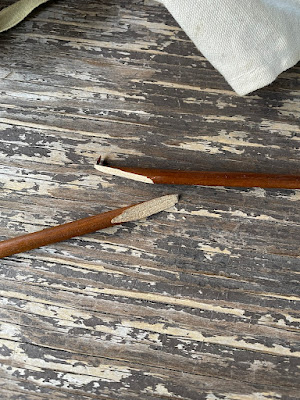
My longrifle, which is a reworked Dixie Tennessee Mountain Rifle, came with the original ramrod. It was made of some mystery wood by Miroku and was 9mm in diameter (a standard metric dowel size). I've managed to damage a ramin wood replacement that I bought several years ago and then this happened yesterday at the range with the original rod:


(Several years ago there was a shortage of hickory ramrods so ramin was offered as a replacement. IMHO, it is inferior to hickory.)

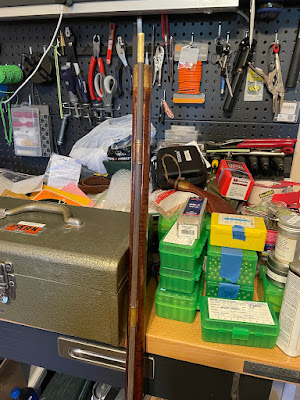
Thankfully, I didn't get stuck. Last night I ordered a couple hickory replacements from Track but I later also found a Delrin 9mm rod that I'd bought from them but never fit to my rifle, and forgot about. I fixed that this morning.


It needed some tapering down towards the bottom so it'll fit inside the stock. Some 60 grit sandpaper worked for that. After I was finished fitting it I sanded it to 220 grit which gives it some faux grain so that it doesn't look too plasticky.

The brass tip was not pinned to the rod which is a recipe for losing it down the bore. The tip has a snug fit on the rod but I drilled a hole and pinned it with a piece of .098" diameter brass rod, peened over on both ends.

Thin Delrin ramrods tend to be whippy but won't break. They are less abrasive to the bore than fiberglass or aluminum. I'll be more comfortable taking the rifle into the woods with this ramrod in place.